
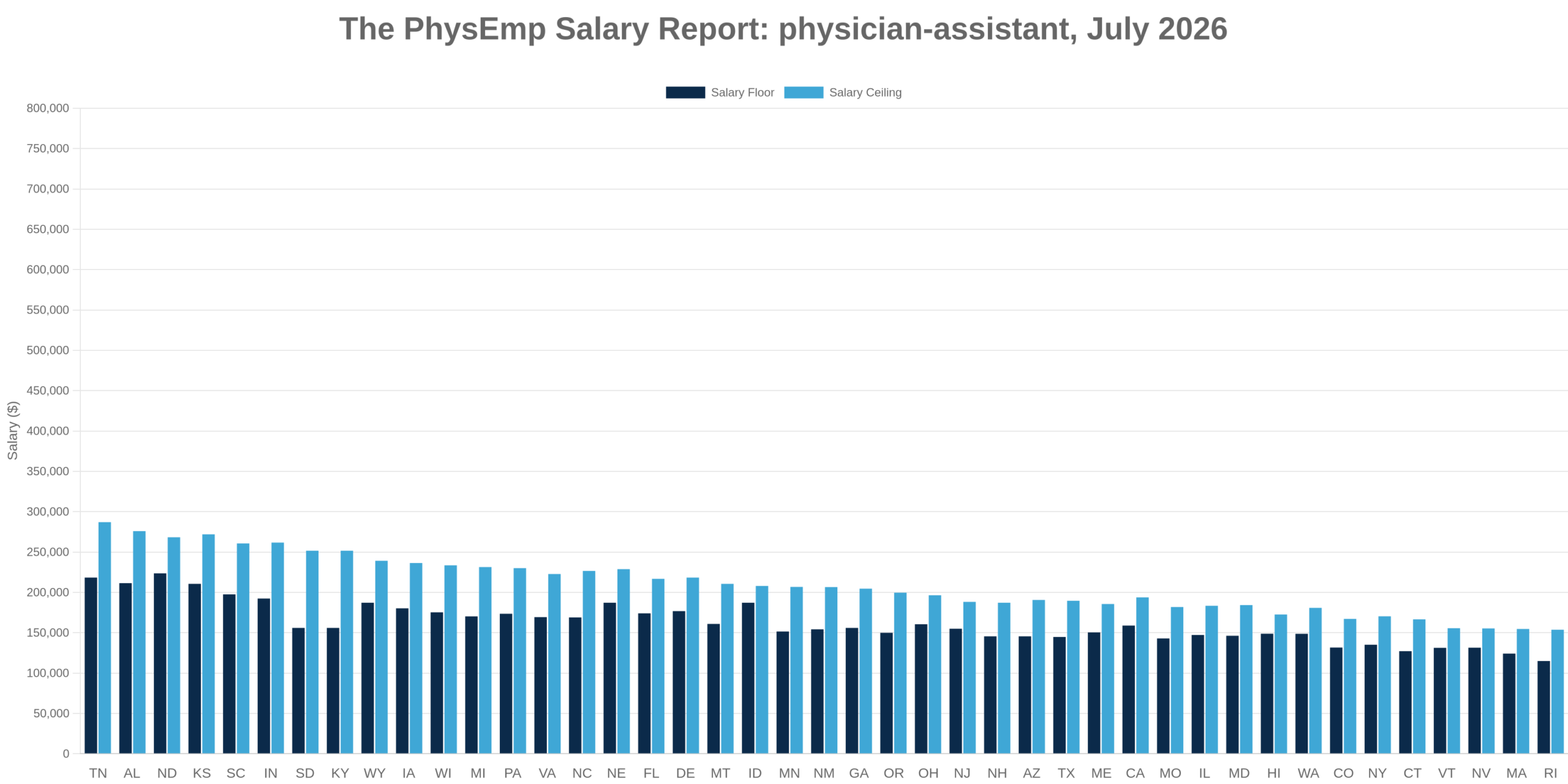
The physician assistant market spans from $45,000 to $400,000 annually, a range so wide it suggests either extraordinary flexibility or complete chaos. (It’s both.) With 1,233 listings distributed across more than 40 states, the market offers volume, geographic diversity, and compensation structures that vary wildly by region, practice setting, and whether someone decided to post a part-time rate as if it were a career benchmark. The data reveals a profession with robust demand and a compensation landscape that rewards strategic geography.
👉 Explore Physician Assistant job market insights and trends
The Physician Assistant Job Market at a Glance
Total listings: 1,233. Listings with salary data: 539. Full compensation range: $45,000 to $400,000. National average range: $152,580 to $193,812.
The spread is dramatic, but the average tells a more grounded story. Most full-time roles cluster between $110,000 and $200,000, a reasonable band for a profession that requires graduate-level training and clinical autonomy. The floor of $45,000 almost certainly reflects part-time or per-diem work, while the $400,000 ceiling likely captures locum, travel, or highly specialized assignments. The middle remains stable and predictable, even if the edges are not.
States represented: Alabama, Alaska, Arizona, Arkansas, California, Colorado, Connecticut, Delaware, Florida, Georgia, Hawaii, Idaho, Illinois, Indiana, Iowa, Kansas, Kentucky, Louisiana, Maine, Maryland, Massachusetts, Michigan, Minnesota, Mississippi, Missouri, Montana, Nebraska, Nevada, New Hampshire, New Jersey, New Mexico, New York, North Carolina, North Dakota, Ohio, Oklahoma, Oregon, Pennsylvania, Rhode Island, South Carolina, South Dakota, Tennessee, Texas, Utah, Vermont, Virginia, Washington, West Virginia, Wisconsin, and Wyoming.
👉 Browse Physician Assistant physician job opportunities
How States Stack Up
Overperformers
- Tennessee ($218,400 to $287,040): Leads the nation on average pay with only six listings, suggesting either scarcity premiums or highly specialized roles.
- North Dakota ($223,600 to $268,320): Three listings, two with salary data, and both are paying top dollar for someone willing to endure the winter.
- Alabama ($211,467 to $275,947): Six listings, three with data, all well above the national mean.
- Kansas ($210,600 to $271,960): Eight listings, four with salary transparency, and all of them competitive.
- South Carolina ($197,600 to $260,693): Thirty-seven listings, only six with data, but those six are paying well.
- Indiana ($192,400 to $261,733): Twelve listings, half with salary data, and a strong showing for the Midwest.
- Nebraska ($187,200 to $228,800): Seven listings, one with data, but that one is paying attention.
- Wyoming ($187,200 to $239,200): Five listings, one salary disclosed, and it’s enough to make a point.
- Idaho ($187,200 to $208,000): Two listings, one with data, holding its own.
- Iowa ($180,267 to $236,427): Four listings, three with transparency, all above average.
- Delaware ($176,800 to $218,400): Four listings, all with salary data, all respectable.
- Wisconsin ($175,333 to $233,585): Thirty-nine listings, twenty-one with data, and consistent overperformance.
- Florida ($174,057 to $216,800): Thirty-two listings, only seven with salary data, but those seven are paying well.
- Pennsylvania ($173,550 to $230,080): Twelve listings, eight with data, quietly competitive.
Near-Average Performers
- Michigan ($170,300 to $231,400): Nineteen listings, eight with data, tracking just above the mean.
- Virginia ($169,378 to $222,773): Twenty-four listings, nine with salary transparency, holding steady.
- North Carolina ($168,990 to $226,606): Ninety-one listings with strong pay and volume, a rare combination.
- Montana ($160,971 to $210,594): Nineteen listings, seven with data, performing near expectations.
- Ohio ($160,580 to $196,486): Seventeen listings, ten with data, middle of the pack.
- California ($158,907 to $193,842): One hundred fifty-five listings, eighty-four with salary data, delivering both volume and competitive pay.
- Georgia ($156,000 to $204,620): Thirty-nine listings, sixteen with transparency, tracking near average.
- Kentucky ($156,000 to $251,680): Three listings, one with data, and that one is an outlier.
- South Dakota ($156,000 to $251,680): Ten listings, two with salary data, both on the high end.
- New Jersey ($155,000 to $188,289): Twenty-seven listings, nine with data, near the national midpoint.
- New Mexico ($154,267 to $206,613): Twenty-three listings, six with transparency, hovering near average.
- Minnesota ($151,573 to $206,833): Fifteen listings, thirteen with data, solid transparency and pay.
- Maine ($150,440 to $185,640): Eighteen listings, five with salary data, tracking close to the mean.
- Oregon ($149,925 to $199,670): Seventy-one listings, sixteen with data, holding near average despite strong volume.
- Hawaii ($148,820 to $172,640): Eleven listings, ten with data, near the midpoint.
- Washington ($148,730 to $180,846): Seventy-seven listings, fifty-three with salary transparency, near-average pay with excellent volume.
- Illinois ($147,247 to $183,407): Fifty-one listings, twenty-seven with data, tracking near expectations.
- Maryland ($146,289 to $184,307): Ten listings, nine with data, near the national average.
- Arizona ($145,600 to $190,667): Forty-three listings, only three with salary data, insufficient transparency.
- New Hampshire ($145,600 to $187,200): Twenty-three listings, one with data, essentially unreadable.
- Texas ($144,800 to $189,618): Forty-three listings, eighteen with transparency, near-average pay in a high-volume state.
- Missouri ($142,976 to $181,920): Fourteen listings, five with data, tracking slightly below average.
Underperformers
- New York ($135,155 to $170,410): Ninety-seven listings with below-average pay, a volume-compensation mismatch that will require geographic or lifestyle selling points.
- Colorado ($131,672 to $167,191): Twenty-five listings, sixteen with data, paying below average despite cost-of-living pressures.
- Nevada ($131,495 to $155,365): Three listings, all with data, all paying below the mean.
- Vermont ($131,314 to $155,640): Eight listings, seven with transparency, all below average.
- Connecticut ($127,210 to $166,642): Thirty-eight listings, twenty with data, underperforming given the regional cost structure.
- Massachusetts ($124,200 to $154,722): Forty-eight listings, eighteen with data, paying well below average in an expensive market.
- Rhode Island ($115,000 to $153,750): Four listings, all with salary data, and all at the bottom of the national range.
Volume Leaders
California leads with 155 listings and delivers above-average pay ($158,907 to $193,842), a rare pairing of volume and value. New York follows with 97 listings but pays below average ($135,155 to $170,410), creating a pipeline challenge. North Carolina posts 91 listings with strong compensation ($168,990 to $226,606), combining opportunity and pay. Washington contributes 77 listings near the national average ($148,730 to $180,846), and Oregon adds 71 listings also near average ($149,925 to $199,670). High-volume states do not uniformly pay well, and low-volume states occasionally lead on salary.
👉 Compare Physician Assistant compensation and opportunities by region
What This Means If You’re a Physician
If your priority is maximum compensation: Target Tennessee, North Dakota, Alabama, Kansas, or South Carolina. The highest disclosed listing is a position in Vancouver, WA at $180,000 to $200,000 annually, though travel and locum roles in Montana reach $156,000 to $251,700 annualized ($75 to $121 per hour). These figures reflect scarcity, specialization, or willingness to work in underserved or less competitive markets.
If your priority is maximum optionality: California, New York, and North Carolina dominate in volume. California pairs 155 listings with above-average pay. New York offers 97 listings but compensates below the national mean, a trade-off that favors location over income. North Carolina delivers both volume and competitive pay, making it the strongest all-around market.
If your priority is balance: Indiana, Wisconsin, Pennsylvania, and North Carolina offer above-average pay with meaningful listing counts. Florida and Virginia provide solid compensation with moderate volume. Washington and Oregon deliver near-average pay with strong job availability. Massachusetts and Connecticut post high volumes but pay below average relative to cost of living, a mismatch worth scrutinizing.
👉 Search Physician Assistant jobs by location and compensation
What This Means If You’re a Recruiter
Salary transparency rate: 43.7% (539 listings with data divided by 1,233 total listings). Less than half of all postings disclose compensation, which places the burden of salary discovery on candidates and elongates the recruitment cycle. In a market this active, opacity is a competitive disadvantage.
Candidate pipeline implications: High-volume states like New York and Connecticut pay below the national average, which will require recruiters to lead with location, lifestyle, practice culture, or benefits rather than base salary. California and North Carolina combine volume and competitive pay, giving recruiters in those markets a structural advantage. Low-volume, high-pay states like Tennessee and North Dakota will attract opportunistic candidates but lack the listing density to support large-scale hiring.
Volume-pay misalignments: New York, Massachusetts, and Connecticut post significant job counts but underperform on compensation. This suggests either saturated candidate pools or cost-conscious health systems. Recruiters in these markets will need to emphasize non-financial value propositions. Conversely, Tennessee, Alabama, and Kansas pay well but offer limited openings, signaling either scarcity-driven premiums or highly specialized roles that will require targeted outreach.
👉 Post Physician Assistant positions on PhysEmp
What’s Driving the Numbers
Geographic scarcity commands a measurable premium. Tennessee, North Dakota, Alabama, and Kansas lead on average pay despite minimal listing volumes. These are not population centers or high-cost-of-living markets. They are places where supply has not kept pace with demand, and compensation reflects that imbalance. Candidates willing to prioritize income over geography will find the highest returns in states that most people are not targeting.
High-volume markets do not uniformly pay well. California pairs 155 listings with above-average compensation, but New York posts 97 listings at below-average pay. The volume-pay relationship is inconsistent, which suggests that candidate supply, regional cost structures, and health system budgets vary independently. Recruiters in high-volume, low-pay states will face longer time-to-fill and higher offer rejection rates unless they compensate with non-salary incentives.
Cost-of-living mismatches create strategic opportunities. Massachusetts, Connecticut, and Colorado pay below the national average despite above-average living costs. Rhode Island offers the lowest average compensation in the dataset. These markets are either oversupplied with candidates or constrained by reimbursement models that do not adjust for regional expenses. Candidates should approach these states with salary expectations calibrated to local realities, not national averages.
Part-time and locum roles distort the floor and ceiling. The $45,000 low almost certainly reflects part-time work, while the $400,000 high likely captures locum or travel assignments with premium hourly rates. The national average of $152,580 to $193,812 is a more reliable benchmark for full-time, permanent roles. Candidates evaluating offers should confirm FTE status, benefits, and annualized compensation before comparing across listings.
The Bottom Line
The physician assistant market is geographically diverse, compensation-variable, and structurally favorable to candidates willing to prioritize income over location. High-volume states offer optionality but not always competitive pay. Low-volume states deliver premium compensation but limited openings. The middle remains stable, predictable, and wide enough to accommodate most career priorities.
There are 1,233 ways to practice as a physician assistant, and at least 539 of them will tell you what they pay.
👉 Browse all Physician Assistant physician jobs
👉 Upload your CV to get matched with opportunities
👉 Set alerts for new Physician Assistant roles
Salary data based on 539 listings with disclosed compensation. Figures may reflect part-time or specialized roles. This report is informational and should not replace professional judgment or financial planning.