
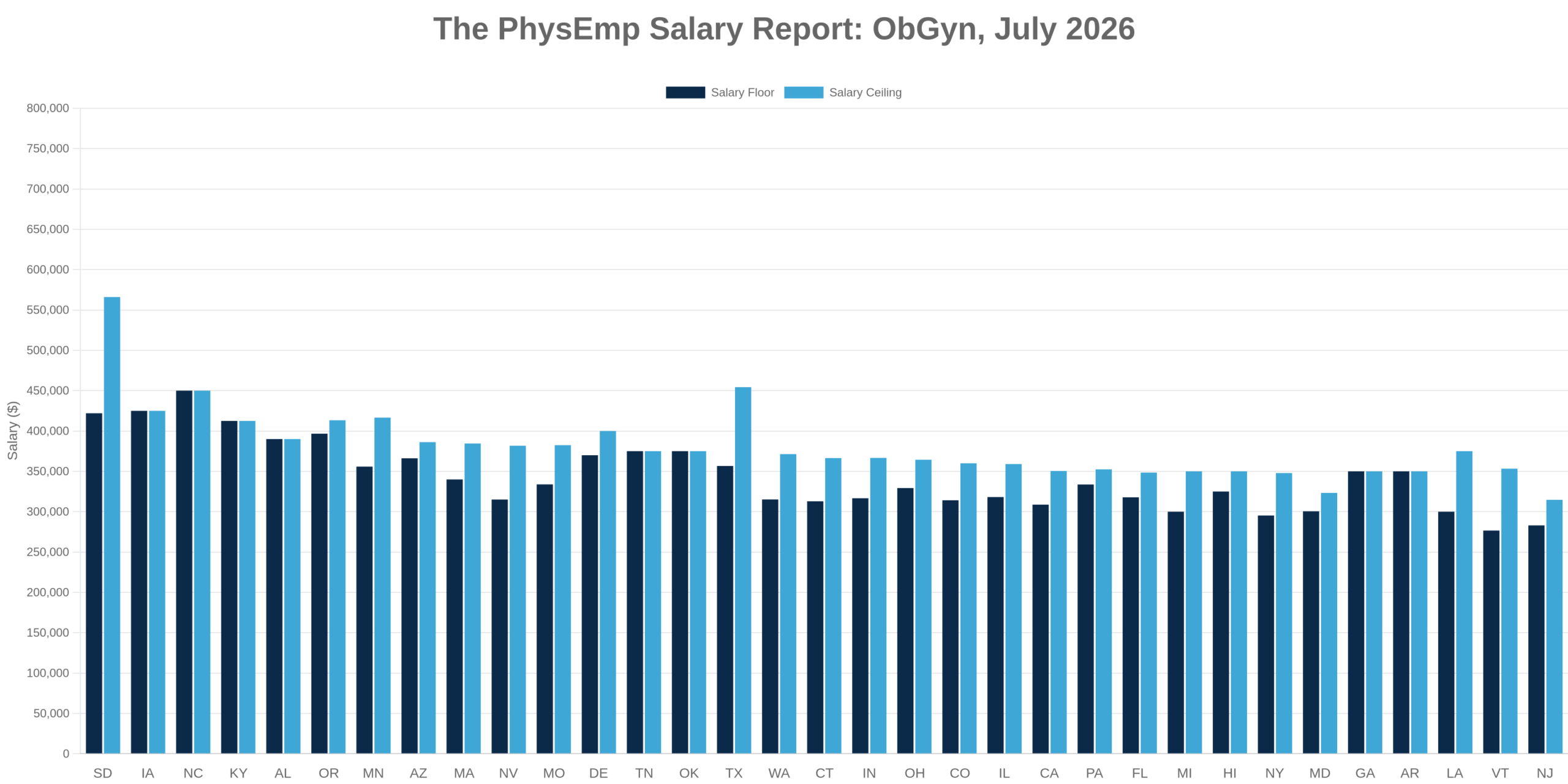
South Dakota—a state with roughly 900,000 residents and more cattle than people—is paying ObGyns an average of $422,000 to $566,000 annually, making it the highest-compensated market in the nation. Meanwhile, New York and California, which together account for 247 active listings, are paying below the national average. The ObGyn market includes 1,261 active listings nationwide, with compensation data available for 290 of them. The data reveals a market where scarcity commands a premium and volume guarantees nothing.
👉 Explore ObGyn job market insights and trends
The ObGyn Job Market at a Glance
Total listings: 1,261. Listings with salary data: 290. Full compensation range: $125,000 to $750,000. National average range: $316,624 to $362,080.
The six-fold spread from floor to ceiling reflects everything from part-time clinical roles to high-volume private practice partnerships in underserved markets. Most positions cluster between $270,000 and $400,000, a range that captures the majority of hospital-employed and group practice models. The variance suggests that practice setting, call burden, and geographic scarcity matter more than metropolitan prestige.
States represented: New York, California, Texas, Illinois, North Carolina, Florida, Arizona, Pennsylvania, Wisconsin, Indiana, Ohio, Washington, Michigan, New Jersey, Virginia, North Carolina, Georgia, Tennessee, New Mexico, Minnesota, Connecticut, Oregon, South Dakota, Missouri, Kentucky, Colorado, Alabama, New Hampshire, South Carolina, Idaho, Oklahoma, Utah, Arkansas, Iowa, Delaware, Mississippi, Louisiana, Maryland, Montana, Vermont, West Virginia, Maine, Hawaii, Alaska, North Dakota, Rhode Island, Nebraska, Kansas, Wyoming, Washington DC, and the Northern Mariana Islands.
👉 Browse ObGyn physician job opportunities
How States Stack Up
Overperformers
South Dakota ($422,000–$566,000): Twenty listings, six with salary data, and the highest average compensation in the country—scarcity pricing in its purest form. North Carolina ($450,000): A single listing skews the average, but it’s still the second-highest figure nationally. Iowa ($425,000): One listing, one data point, one very attractive number. Texas ($356,667–$454,333): High pay and high volume—a rare combination that suggests sustained demand. Kentucky ($412,500): Two listings averaging over $400,000 in a state not typically associated with top-tier physician comp. Oregon ($396,667–$413,333): Three listings with data, all above $390,000—West Coast pay without the West Coast volume. Alabama ($390,000): One listing, but it’s enough to place the state in the top tier. Delaware ($370,000–$400,000): A single data point that outperforms most of the Mid-Atlantic. Tennessee ($375,000): Two listings, both identical, both well above average. Oklahoma ($375,000): One listing that beats most of the Midwest and South.
Near-Average Performers
Arizona ($366,200–$386,200): Fifty listings and above-average pay—a volume leader that actually compensates accordingly. Minnesota ($355,876–$416,593): Five listings with wide variance, but the average holds near national norms. Connecticut ($312,921–$366,467): Nine listings that track closely with the national midpoint. Washington ($315,185–$371,343): Five listings with salary data and compensation that mirrors the national average almost exactly. Colorado ($314,167–$360,000): Six listings, stable range, no surprises. Florida ($317,850–$348,475): Fifty-three listings and near-average pay—high volume, predictable comp. Indiana ($316,667–$366,667): Three listings with data, all landing near the national mean. Nevada ($315,093–$381,760): Three listings with enough variance to suggest market segmentation. Georgia ($350,000): One listing, right in the middle. Arkansas ($350,000): One listing, national average on the dot. Louisiana ($300,533–$323,300): One listing that barely clears $300,000. Hawaii ($325,000–$350,000): One listing in paradise, paying like the mainland. Massachusetts ($340,000–$384,500): Two listings that land slightly above average despite the Boston cost of living.
Underperformers
New Jersey ($283,040–$314,720): Fifteen listings with data, all paying below the national average—high cost of living, low compensation. Vermont ($276,667–$353,333): Three listings with the second-lowest floor in the dataset. New York ($295,273–$347,892): The volume leader with 126 listings, paying $20,000 below the national average on the low end. California ($308,760–$350,431): One hundred twenty-one listings and below-average pay—the West Coast premium does not apply here. Maryland ($300,533–$323,300): Six listings, all clustering near $300,000 in one of the most expensive regions in the country. Michigan ($300,000–$350,000): Three listings, all underwhelming. Ohio ($329,286–$364,400): Seven listings with data, slightly below average despite relatively low cost of living. Illinois ($318,156–$359,031): Sixty-three listings and thirty-two with salary data—high volume, middling pay. Pennsylvania ($333,750–$352,500): Forty-five listings, four with data, all landing near but slightly below average.
Volume Leaders
New York leads with 126 listings. California follows with 121. Texas posts 78. North Carolina has 54. Florida has 53. Arizona has 50. Pennsylvania has 45. Indiana has 42. Wisconsin has 38. Washington has 37.
New York and California dominate on volume but underperform on compensation. Texas manages both high volume and high pay. Arizona does the same. Wisconsin, New Hampshire, and New Mexico post double-digit listings but zero salary transparency.
👉 Compare ObGyn compensation and opportunities by region
What This Means If You’re a Physician
If your priority is maximum compensation: Target South Dakota, North Carolina, Iowa, Kentucky, and Texas. The single highest-paying listing in the dataset is in El Paso, TX, offering $425,000 to $648,000 annually. A close second is Sharon, CT at $550,000 to $600,000. Both reflect either scarcity premiums or partnership buy-in models that reward high-volume practitioners.
If your priority is maximum optionality: New York and California offer 247 combined listings, though compensation lags the national average by $20,000 to $30,000 on the lower bound. Texas, Arizona, and North Carolina provide strong volume with above-average or competitive pay.
If your priority is balance: Arizona ($366,200–$386,200 across fifty listings), Washington ($315,185–$371,343 across thirty-seven listings), and Connecticut ($312,921–$366,467 across twenty-two listings) offer stable compensation and meaningful job volume. Florida provides fifty-three listings at near-average pay in a no-income-tax state—a cost-of-living arbitrage worth considering.
Cost-of-living mismatches: New York, New Jersey, California, and Maryland all rank among the most expensive states in the country, yet all pay below or near the national average. Vermont pays the second-lowest salary floor in the dataset despite rural isolation and limited amenities. South Dakota and Iowa pay top-tier compensation in low-cost-of-living environments—a rare and meaningful advantage.
👉 Search ObGyn jobs by location and compensation
What This Means If You’re a Recruiter
Salary transparency rate: 23.0% (290 listings with compensation data out of 1,261 total listings).
That’s nearly four out of five listings with no published salary range—a transparency problem that will cost you pipeline velocity. Candidates are comparison-shopping in real time, and if your competitors in South Dakota, Texas, and Arizona are leading with $400,000+ figures, your undisclosed “competitive compensation” in New York is a non-starter.
Volume-pay misalignment: New York posts 126 listings at an average of $295,273–$347,892. California posts 121 listings at $308,760–$350,431. Both are paying $20,000 to $30,000 below the national average on the lower bound. You’re competing with smaller markets that are paying more and saying so upfront. If you’re recruiting in these states, you’ll need to lead with lifestyle, academic affiliation, subspecialty support, or partnership track—because the comp alone won’t close the deal.
Wisconsin, New Hampshire, New Mexico, and Virginia combine for 109 listings with zero salary transparency. You’re flying blind and asking candidates to do the same.
👉 Post ObGyn positions on PhysEmp
What’s Driving the Numbers
Scarcity commands a premium, and volume does not.
South Dakota has twenty listings and pays an average of $422,000 to $566,000. New York has 126 listings and pays $295,273 to $347,892. The inverse relationship between supply and compensation is nearly perfect. Low-population states with limited ObGyn coverage are pricing in scarcity, call burden, and the cost of recruiting to rural or underserved markets. High-volume metro markets are pricing in competition among candidates, not competition among employers.
High cost of living does not translate to high compensation.
New York, New Jersey, California, and Maryland are all expensive places to live and all pay below the national average. Vermont combines rural isolation with below-average pay. The traditional “coastal premium” does not exist in the ObGyn market. If anything, the data suggests a coastal discount—employers in these states are relying on lifestyle, prestige, or network effects to offset subpar compensation.
Texas and Arizona are the only high-volume, high-pay markets.
Texas posts seventy-eight listings and pays $356,667 to $454,333. Arizona posts fifty listings and pays $366,200 to $386,200. Both states combine population growth, favorable tax structures, and sustained demand. They are the exceptions to the volume-pay tradeoff, and they’re likely pulling candidates from both coasts.
The $125,000 floor suggests part-time or locums distortion.
The bottom of the range is less than half the national average and almost certainly reflects part-time clinical roles, hourly locums contracts, or academic positions with significant non-clinical responsibilities. The floor is not representative of full-time ObGyn practice, but it does pull the average down and introduces noise into state-level comparisons.
The Bottom Line
The ObGyn job market rewards geographic flexibility and punishes brand loyalty. The highest-paying markets are not the most prestigious, the most populous, or the most desirable by traditional measures—they are the markets where demand exceeds supply and employers are willing to pay for it. South Dakota, Iowa, and Kentucky are outpaying New York and California by six figures. Texas and Arizona are proving that volume and compensation can coexist. The physicians who recognize this early will have the most leverage.
If you want to deliver babies in Manhattan, expect to be paid like you’re doing everyone a favor. If you want to be paid like you’re doing everyone a favor, go to South Dakota.
👉 Browse all ObGyn physician jobs
👉 Upload your CV to get matched with opportunities
👉 Set alerts for new ObGyn roles
Salary data based on 290 listings with disclosed compensation. Figures may reflect part-time or specialized roles. This report is informational and should not replace professional judgment or financial planning.