
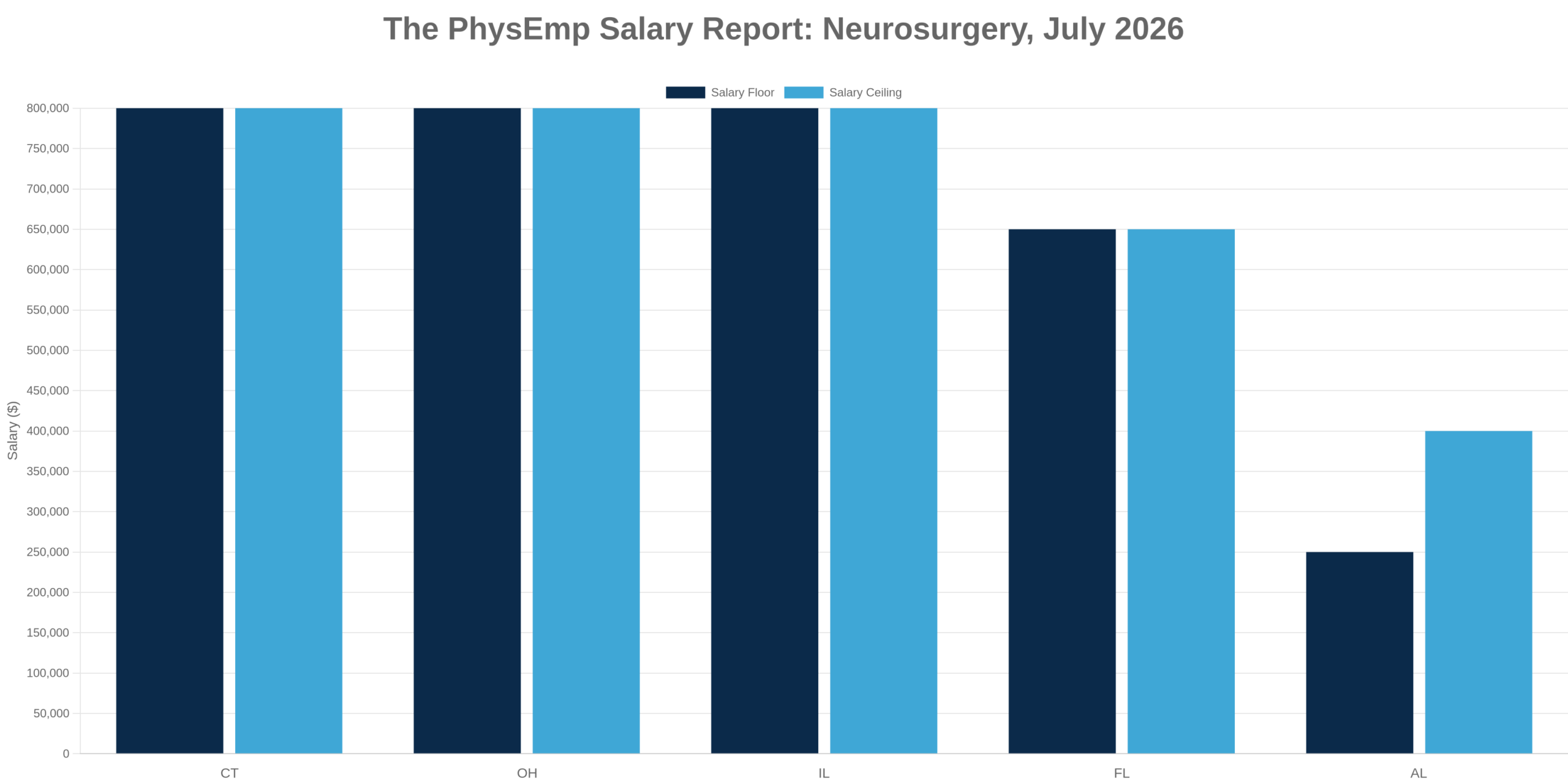
Connecticut is offering neurosurgeons up to $1,100,000 annually while Alabama tops out at $400,000 for the same specialty. The 68-listing national Neurosurgery market spans 26 states, with only 6 postings disclosing compensation (a transparency problem we will address shortly). The full range runs from $250,000 to $1,100,000, with an average band of $705,000 to $808,333 among those willing to show their cards. The data reveals a market where location determines whether you earn like a specialist or like a very confused primary care physician.
👉 Explore Neurosurgery job market insights and trends
The Neurosurgery Job Market at a Glance
Sixty-eight total listings. Six with salary data. Full range: $250,000 to $1,100,000. Average range: $705,000 to $808,333.
The spread is wide enough to park a small hospital system inside it. The $850,000 gap between floor and ceiling reflects everything from subspecialty focus to geographic desperation to the eternal mystery of why some markets refuse to acknowledge supply and demand. The average range sits comfortably in the mid-seven figures, which is precisely where neurosurgeons expect to live (and where their malpractice carriers expect them to afford premiums).
States represented: Alabama, Arkansas, California, Connecticut, Florida, Georgia, Idaho, Illinois, Indiana, Iowa, Kentucky, Michigan, Mississippi, Missouri, Nebraska, New Jersey, New York, North Carolina, Ohio, Oregon, Pennsylvania, Texas, Virginia, Washington, West Virginia, and Wisconsin. Twenty-six states are hiring. Only six are saying what they pay.
👉 Browse Neurosurgery physician job opportunities
How States Stack Up
Overperformers: Connecticut leads the nation with a range of $800,000 to $1,100,000, proving that proximity to hedge fund managers raises all compensation boats. Illinois averages $815,000 to $900,000 across two listings, a strong showing for the Midwest that suggests real investment in neurosurgical talent. Ohio posts a flat $900,000, no range, no negotiation, just a clean nine-figure offer that makes the case for the Rust Belt.
Near-average performers: Florida lists one position at $650,000, which falls below the national average but remains respectable for a state where the primary job requirement is occasionally treating jet ski injuries.
Underperformers: Alabama offers $250,000 to $400,000, a figure so far below the national average that it raises questions about scope, support, or whether the listing was meant for a different specialty entirely.
Volume leaders: Florida leads with 7 listings, followed by Indiana, Alabama, and Pennsylvania with 5 each, then Ohio and Illinois with 4 apiece. Florida’s volume dominance does not translate to compensation dominance, as its single disclosed salary sits $55,000 below the national average low. Alabama posts 5 listings but pays catastrophically below market, a combination that will require recruiters to lead with lifestyle, mission, or the word “opportunity” repeated until it loses meaning.
👉 Compare Neurosurgery compensation and opportunities by region
What This Means If You’re a Physician
If your priority is maximum compensation: Connecticut, Illinois, and Ohio are your only rational choices. The highest-paying listing is in Hartford, Connecticut, offering $800,000 to $1,100,000 with the top end reaching $1,100,000. Ohio’s flat $900,000 removes negotiation friction. Illinois averages $815,000 to $900,000 across two roles, suggesting consistency.
If your priority is maximum optionality: Florida offers 7 listings, the most in the nation, though you will trade volume for a $55,000 pay cut relative to the national average low. Indiana, Alabama, and Pennsylvania each post 5 listings, but only Alabama discloses salary, and that disclosure is a cautionary tale.
If your priority is balance: Florida at $650,000 offers reasonable compensation in a no-state-income-tax environment with high listing volume, making it the pragmatic middle ground for neurosurgeons who want options without chasing the absolute top dollar. The cost-of-living advantage partially offsets the below-average salary, though not enough to close the gap entirely.
👉 Search Neurosurgery jobs by location and compensation
What This Means If You’re a Recruiter
The salary transparency rate is 8.8 percent (6 listings with data divided by 68 total listings). This is not a transparency problem. This is a transparency catastrophe. Eighty-eight percent of neurosurgery listings are asking candidates to express interest before learning whether the offer is $400,000 or $1,100,000, a spread that represents the difference between comfortable and generationally wealthy.
Candidate pipelines will thin in proportion to opacity. High-volume states without disclosed compensation (Indiana with 5 listings and zero salary data, Pennsylvania with 5 and zero) will struggle to convert interest into applications. Alabama’s 5 listings include one disclosed salary that sits $305,000 below the national average low, meaning recruiters will need to lead with mission, community need, or the phrase “quality of life” deployed with maximum conviction. Florida’s volume advantage buys some forgiveness for below-average pay, but not indefinitely.
👉 Post Neurosurgery positions on PhysEmp
What’s Driving the Numbers
Subspecialty and scope command inconsistent premiums: The $650,000 epilepsy neurosurgeon role in Florida suggests subspecialization does not automatically elevate compensation, or that Florida’s market dynamics suppress even niche roles. Ohio’s flat $900,000 and Connecticut’s $1,100,000 ceiling likely reflect general neurosurgery with full scope and call responsibility, though without granular job descriptions it is impossible to confirm whether leadership, partnership track, or surgical volume expectations are baked into those figures. The data hints that geography and institutional desperation matter more than subspecialty credentialing.
Part-time roles do not appear to distort the floor: All disclosed salaries appear to reflect full-time positions, meaning Alabama’s $250,000 low is not the result of a 0.5 FTE role being annualized incorrectly. This is simply what one employer believes a neurosurgeon is worth in that market, a belief that will be tested by the complete absence of applicants.
Underserved markets do not reliably price in scarcity: Alabama posts 5 listings, suggesting demand, yet offers compensation $305,000 below the national average low. This defies the standard underserved-market playbook, where scarcity drives premium pay. Either the market is more saturated than listing volume suggests, or employers are betting that mission-driven candidates will absorb the discount. The latter is a bet with poor historical odds.
The volume-pay relationship is inverted: Florida leads in listings but trails in compensation. Connecticut posts 2 listings and leads in pay. Illinois posts 4 listings and averages $857,500 at the midpoint. The typical volume-pay correlation (more jobs, higher competition, higher pay) does not hold. Instead, lower-volume markets are outbidding higher-volume states, suggesting that institutional resources and cost structures matter more than raw demand.
The Bottom Line
The Neurosurgery job market is robust, well-compensated, and almost entirely opaque. Six listings out of 68 disclose salary, leaving 91.2 percent of the market in a state of compensatory mystery that benefits no one except recruiters who prefer to negotiate from information asymmetry. For physicians, Connecticut, Illinois, and Ohio represent the disclosed top tier. Florida offers volume. Alabama offers a salary so low it functions as a market anomaly rather than a legitimate data point. The transparency crisis will resolve when employers realize that neurosurgeons have options and no patience for compensation hide-and-seek.
Neurosurgeons are expensive because brains are complicated and mistakes are permanent, but apparently some markets believe they are less expensive than the data suggests they should be.
👉 Browse all Neurosurgery physician jobs
👉 Upload your CV to get matched with opportunities
👉 Set alerts for new Neurosurgery roles
Salary data based on 6 listings with disclosed compensation. Figures may reflect part-time or specialized roles. This report is informational and should not replace professional judgment or financial planning.