
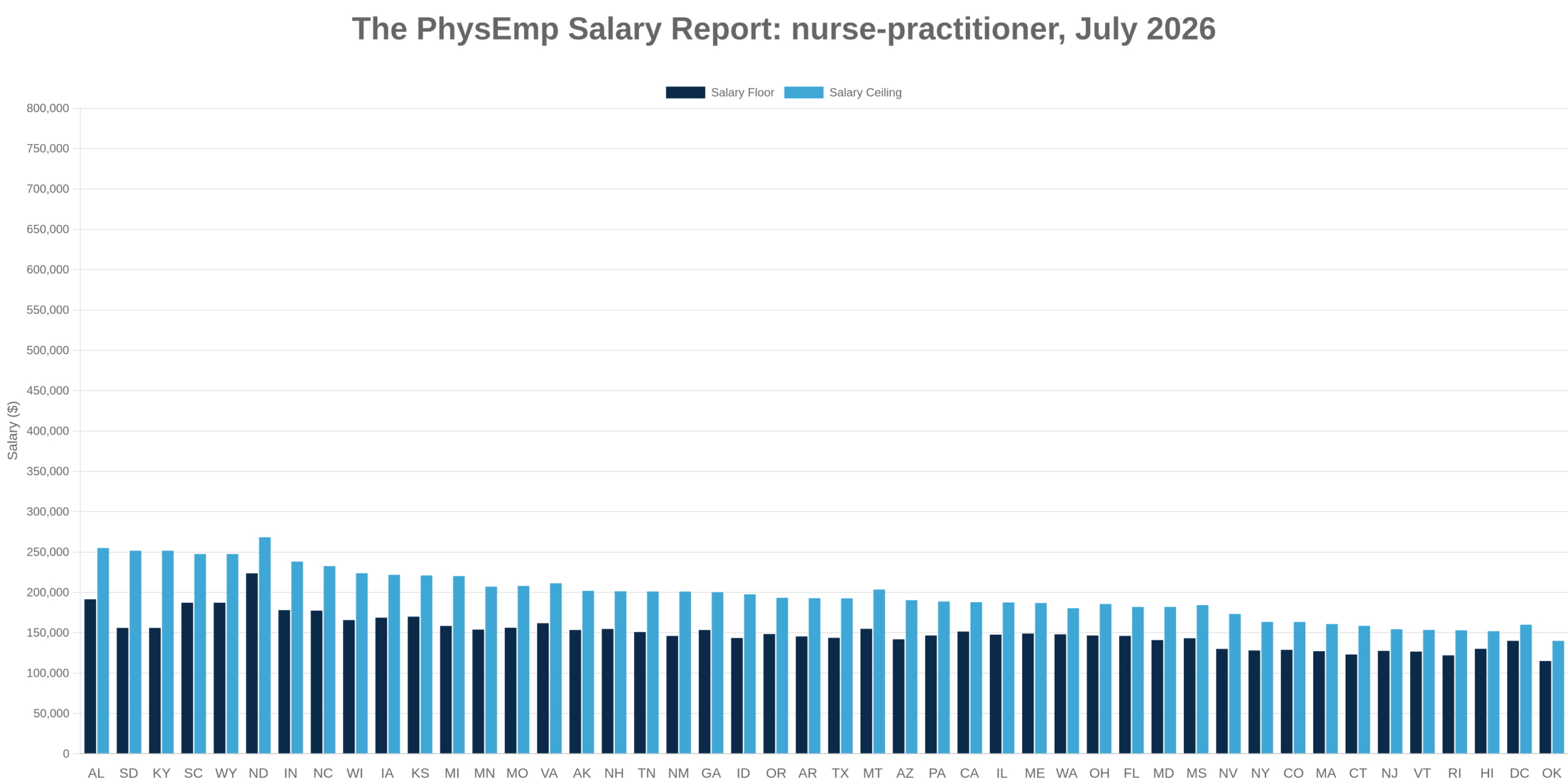
North Dakota — a state with exactly two nurse practitioner listings — is paying an average of $223,600 to $268,320 per year. Meanwhile, Oklahoma, with five times the volume, offers $115,000 to $140,000. The nurse practitioner market spans 1,786 listings across all 50 states and the District of Columbia, with compensation ranging from $90,000 to $400,000 annually. The data reveals a market where scarcity, not volume, often dictates price — and where geography matters more than logic would suggest.
👉 Explore Nurse Practitioner job market insights and trends
The Nurse Practitioner Job Market at a Glance
Total listings: 1,786. Listings with salary data: 771. Full salary range: $90,000 to $400,000. Average salary range: $144,722 to $185,194.
The spread is wide enough to fit three separate careers inside it. The floor has risen (no one is working for $45,000 anymore, despite what the raw data might have suggested), but the ceiling remains aspirational for most. The majority of full-time roles cluster between $105,000 and $250,000, which is both competitive and table stakes depending on where you stand. The $400,000 outlier likely reflects a specialized or leadership role, but it skews the average high into irrelevance for most practitioners evaluating realistic offers.
States represented:
- Alaska
- Alabama
- Arkansas
- Arizona
- California
- Colorado
- Connecticut
- District of Columbia
- Delaware
- Florida
- Georgia
- Hawaii
- Iowa
- Idaho
- Illinois
- Indiana
- Kansas
- Kentucky
- Louisiana
- Massachusetts
- Maryland
- Maine
- Michigan
- Minnesota
- Missouri
- Mississippi
- Montana
- North Carolina
- North Dakota
- Nebraska
- New Hampshire
- New Jersey
- New Mexico
- Nevada
- New York
- Ohio
- Oklahoma
- Oregon
- Pennsylvania
- Rhode Island
- South Carolina
- South Dakota
- Tennessee
- Texas
- Utah
- Vermont
- Virginia
- Washington
- Wisconsin
- West Virginia
- Wyoming
👉 Browse Nurse Practitioner physician job opportunities
How States Stack Up
Overperformers: North Dakota leads at $223,600 to $268,320, though with only two listings, it’s more of a data point than a market. Alabama averages $191,500 to $255,000 across two listings — high pay, low volume, classic scarcity pricing. South Carolina and Wyoming both average $187,200 to $247,520, with South Carolina offering six listings and Wyoming just one. Indiana posts $178,050 to $238,175 across eight listings, a rare combination of decent volume and top-tier pay. North Carolina averages $177,412 to $232,593 with 17 salary-disclosed listings out of 121 total — high volume, high pay, and the closest thing this market has to a no-brainer. Delaware comes in at $182,000 to $228,800 with four listings, another low-volume, high-pay outlier.
Near-average performers: Maryland averages $140,900 to $182,076 across 10 listings, landing squarely in the national average range. Arizona posts $141,895 to $190,354 with 13 salary listings out of 66 total, offering solid mid-market compensation with reasonable volume. Texas averages $143,743 to $192,550 across 32 listings, a high-volume state that pays exactly what you’d expect. New Mexico comes in at $146,092 to $200,991 with 13 listings, slightly above average but not enough to move the needle. Ohio averages $146,589 to $185,657 across 15 listings, the definition of a benchmark market.
Underperformers: Oklahoma posts the lowest average at $115,000 to $140,000, nearly $30,000 below the national average floor — one listing, one data point, one warning sign. Rhode Island averages $122,000 to $153,000 across five listings, underperforming despite its proximity to higher-paying New England neighbors. Connecticut comes in at $123,071 to $158,593 with 28 listings, a high-volume state paying below-average wages. West Virginia averages $123,280 to $152,680 across five listings, consistent with its cost of living but lagging the national norm. Vermont posts $126,683 to $153,492 with 13 listings, another New England state that doesn’t pay like one. New Jersey averages $127,560 to $154,394 across 25 listings — high cost of living, below-average pay, a mismatch worth noting. Colorado averages $128,788 to $163,401 with 14 listings, underperforming given its desirability and cost structure. New York averages $128,068 to $163,482 across 105 listings, a volume leader that pays below the national average (though metro-area roles likely skew higher than the statewide mean suggests).
Volume leaders: California leads with 194 listings, averaging $151,500 to $187,912 — solid pay, massive volume, and the kind of market where you can afford to be selective. New York follows with 150 listings but averages just $128,068 to $163,482, a rare case where high volume coincides with below-average pay. North Carolina posts 121 listings and averages $177,412 to $232,593, the best combination of volume and compensation in the country. Washington offers 95 listings at $148,074 to $180,407, respectable on both fronts. Oregon has 93 listings averaging $148,414 to $193,323, another West Coast market with strong fundamentals. Massachusetts posts 84 listings at $127,175 to $160,849, high volume but middling pay. Florida rounds out the leaders with 82 listings averaging $146,111 to $182,011, near-average pay in a no-income-tax state.
👉 Compare Nurse Practitioner compensation and opportunities by region
What This Means If You’re a Physician
If your priority is maximum compensation: North Dakota, Alabama, South Carolina, Wyoming, and Indiana lead the pack, though volume is thin and you’ll need to be comfortable with limited optionality. The highest individual listing identified is a dermatology NP role in Plattsburgh, NY, offering $150,000 to $250,000 — not the $400,000 ceiling, but the most concrete top-end offer in the dataset.
If your priority is maximum optionality: California, New York, and North Carolina dominate by sheer volume, with North Carolina offering the added benefit of above-average pay. Washington and Oregon provide strong West Coast alternatives with better compensation than New York and fewer listings than California.
If your priority is balance: North Carolina offers 121 listings with an average of $177,412 to $232,593, the rare market where you don’t have to choose between opportunity and pay. Indiana, with eight salary listings averaging $178,050 to $238,175, offers a smaller but still viable middle ground. California remains the safe bet for practitioners who want options, competitive pay, and the ability to move laterally without leaving the state.
Cost-of-living mismatches worth scrutiny: New Jersey, Colorado, and New York all post below-average pay despite above-average living costs. Connecticut underperforms relative to its cost structure. Conversely, North Carolina, Texas, and Florida offer near-average or above-average pay in states with lower costs and no income tax (in the case of the latter two).
👉 Search Nurse Practitioner jobs by location and compensation
What This Means If You’re a Recruiter
Salary transparency rate: 43.2% (771 listings with disclosed compensation out of 1,786 total). That’s low enough to create friction in candidate pipelines and high enough to set expectations that will be hard to manage when compensation isn’t competitive.
Candidate pipeline implications: High-volume states with below-average pay — New York, Connecticut, Massachusetts — will struggle to convert interest into offers unless they lead with non-financial value propositions. North Carolina’s combination of volume and pay makes it a magnet market; recruiters elsewhere will need to explain why candidates should look past it. Low-volume, high-pay states like North Dakota and Alabama will attract opportunistic candidates but lack the depth to build sustained pipelines.
Volume-pay misalignments: New York’s 150 listings at below-average pay suggest either a highly segmented market (with metro roles paying more than the statewide average indicates) or a systemic undervaluation of NP labor. California’s 194 listings at above-average pay reflect a market where demand consistently outstrips supply. North Carolina’s 121 listings at $177,412 to $232,593 represent the market’s most efficient equilibrium — high demand met with competitive pay. Recruiters in underperforming high-volume states will need to lead with schedule flexibility, loan repayment, benefits, and career development rather than base salary.
👉 Post Nurse Practitioner positions on PhysEmp
What’s Driving the Numbers
Scarcity commands a premium, but only in markets willing to pay for it.
North Dakota, Alabama, Wyoming, and South Dakota all post top-decile compensation with minimal volume. These aren’t accidents — they’re deliberate pricing decisions in underserved markets where replacing a nurse practitioner is harder than hiring one. Indiana and North Carolina, by contrast, pay well despite having more listings, suggesting structural demand that hasn’t been met by supply growth. Oklahoma’s $115,000 floor, meanwhile, shows what happens when a market either can’t or won’t compete: it prices itself out of contention.
High-volume states don’t automatically pay more, and when they don’t, they lose.
New York’s 150 listings at $128,068 to $163,482 average and California’s 194 listings at $151,500 to $187,912 tell two different stories. New York has volume but not urgency; California has both. The difference shows up in the averages and in the likelihood that a given listing converts to a hire. Massachusetts, Connecticut, and New Jersey all suffer from the same dynamic — high cost of living, high listing volume, middling pay. Candidates will apply, but they won’t stay unless the role offers something compensation can’t capture.
The $400,000 ceiling is real, but it’s not representative.
The highest salary in the dataset is an outlier, likely tied to a specialized role (dermatology, aesthetics, or a leadership position with significant RVU upside). It skews the average high to $185,194, a figure that doesn’t reflect the experience of the median nurse practitioner. The more useful range is $105,000 to $250,000, which captures the vast majority of full-time roles and excludes the part-time, travel, and ultra-specialized positions that distort the floor and ceiling.
Geography matters more than credentials in this market.
A nurse practitioner in North Dakota earns $80,000 more on average than one in Oklahoma. A practitioner in North Carolina earns $50,000 more than one in New York. The role is the same; the market is not. Cost of living explains some of this, but not all of it — North Carolina’s pay advantage over New York persists even after adjusting for housing and tax differences. The implication: where you work matters as much as what you do, and practitioners who are geographically flexible will capture significantly more value over the course of a career.
The Bottom Line
The nurse practitioner market is large, liquid, and unevenly distributed. North Carolina offers the best combination of volume and pay. California offers the most optionality. North Dakota offers the highest average compensation (if you can find the listings). New York, Connecticut, and New Jersey offer the most listings per dollar of purchasing power, which is to say: they don’t offer much. The $90,000 floor is higher than it used to be, but the $400,000 ceiling remains aspirational for all but a few. Choose your geography carefully, because it will determine your comp more than your résumé will.
There is a lot of opportunity available for nurse practitioners, but not all of it pays the same — or even close.
👉 Browse all Nurse Practitioner physician jobs
👉 Upload your CV to get matched with opportunities
👉 Set alerts for new Nurse Practitioner roles
Salary data based on 771 listings with disclosed compensation. Figures may reflect part-time or specialized roles. This report is informational and should not replace professional judgment or financial planning.