
Wyoming — a state with more antelope than people — is offering Otolaryngology physicians $650,000 to fix ears, noses, and throats. The market for ENT specialists spans 186 listings across more than 35 states, with 37 providing salary data ranging from $270,235 to $778,000. The national average sits between $493,889 and $551,099, but the spread tells a more interesting story: geography matters, volume doesn’t guarantee premium pay, and the highest compensation requires a willingness to follow the money into unexpected places.
👉 Explore Otolaryngology job market insights and trends
The Otolaryngology Job Market at a Glance
186 total listings. 37 with salary data. Full range: $270,235 to $778,000. Average range: $493,889 to $551,099.
The half-million-dollar gap between floor and ceiling reflects more than just market variation. The bottom of the range likely captures part-time arrangements, academic positions, or roles with restricted scope. The top end represents full-partnership track opportunities in underserved markets willing to pay scarcity premiums. The average range clusters comfortably above $490,000, confirming that Otolaryngology remains one of the better-compensated procedural specialties. But the 20% salary transparency rate means most employers are still playing cards close to the vest.
👉 Browse Otolaryngology physician job opportunities
States represented:
- Alabama
- Arizona
- Arkansas
- California
- Colorado
- Connecticut
- Florida
- Georgia
- Illinois
- Indiana
- Kansas
- Kentucky
- Maine
- Maryland
- Massachusetts
- Michigan
- Minnesota
- Missouri
- Montana
- Nebraska
- Nevada
- New Hampshire
- New Jersey
- New Mexico
- New York
- North Carolina
- North Dakota
- Ohio
- Oklahoma
- Oregon
- Pennsylvania
- South Carolina
- South Dakota
- Tennessee
- Texas
- Utah
- Vermont
- Washington
- West Virginia
- Wisconsin
- Wyoming
How States Stack Up
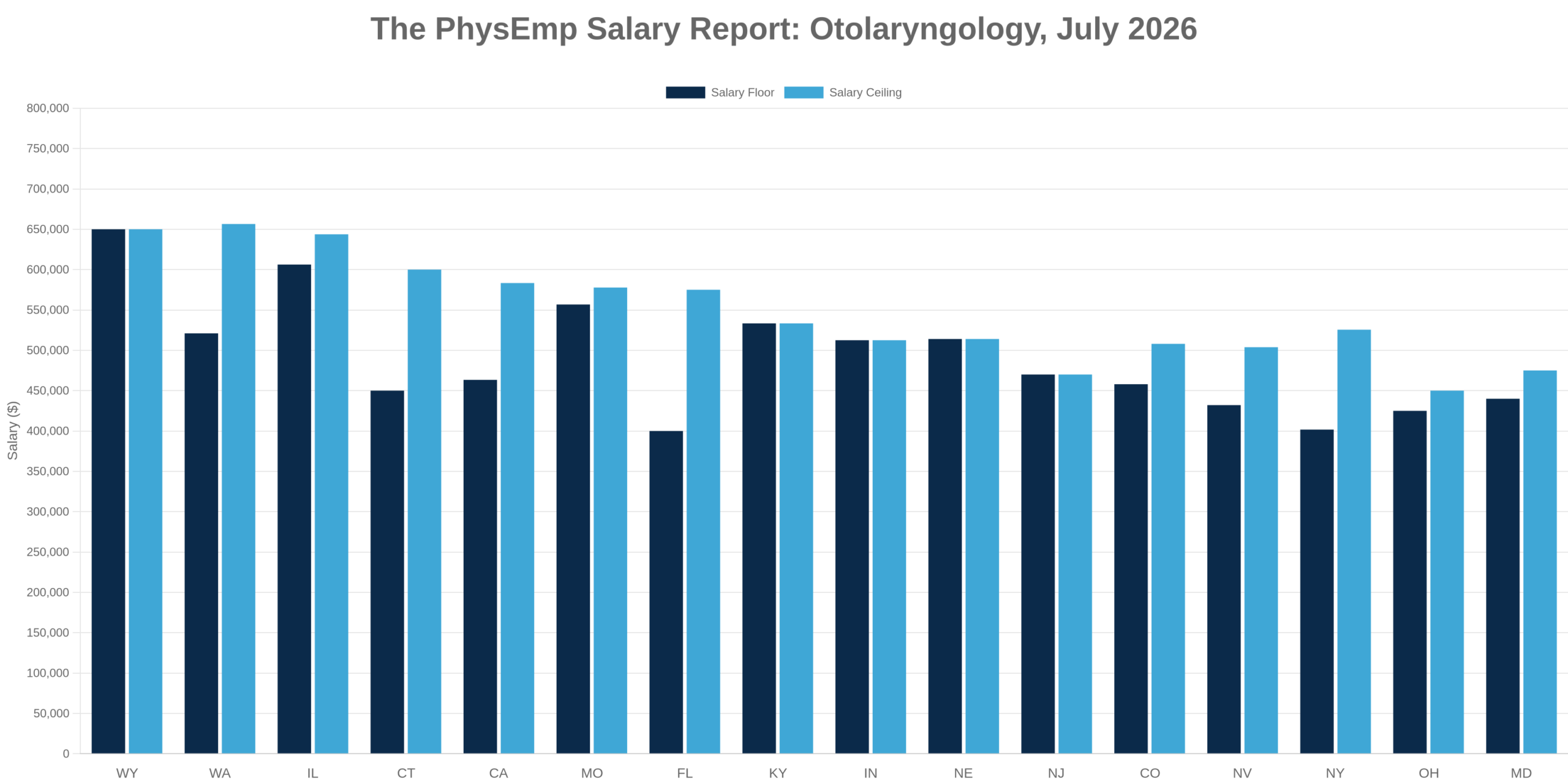
Overperformers: Wyoming ($650,000 average) proves that low population density commands a premium when no one else wants to live there. Washington ($521,000–$656,500 average) combines Pacific Northwest appeal with genuine compensation leadership. Illinois ($606,250–$643,750 average) pays top-tier money and delivers 13 listings, making it the rare market that offers both volume and premium rates. Missouri ($556,750–$577,750 average) outperforms its Midwest peers by a meaningful margin across four salary listings. Kentucky ($533,333 average) quietly sits above the national average with three salary data points and six total openings.
Near-average performers: Indiana ($512,500 average) lands squarely at the national midpoint with two salary listings and six total positions. Nebraska ($514,000 average) mirrors Indiana almost exactly, though with just one salary listing to support the figure. Connecticut ($450,000–$600,000 average) shows a wide range from a single data point but centers near national norms. Colorado ($458,000–$508,000 average) tracks slightly below average across two salary listings. California ($463,360–$583,350 average) delivers predictable compensation across eight listings and four salary disclosures, neither leading nor lagging.
Underperformers: New York ($401,745–$525,558 average) posts 11 listings but compensates below the national average, a cost-of-living mismatch worth scrutinizing. New Jersey ($470,000 average) follows the same pattern: 9 listings, below-average pay, expensive ZIP codes. Ohio ($425,000–$450,000 average) sits at the bottom of disclosed markets despite reasonable job availability. Nevada ($432,067–$503,867 average) underperforms across three salary listings in a state with no income tax. Maryland ($440,000–$475,000 average) lags despite proximity to high-cost Mid-Atlantic metros. Florida ($400,000–$575,000 average) shows a single data point with a floor that ranks among the lowest nationally.
Volume leaders: Illinois leads with 13 listings and above-average pay. New York follows with 11 listings but below-average compensation. Missouri, New Jersey, Pennsylvania, and Wisconsin each post 9 listings. Missouri pays well; New Jersey pays below average; Pennsylvania and Wisconsin disclosed no salary data. Tennessee (7 listings), New Hampshire (7 listings), and Massachusetts (7 listings) all withheld compensation information entirely.
👉 Compare Otolaryngology compensation and opportunities by region
What This Means If You’re a Physician
If your priority is maximum compensation: Washington offers the highest disclosed salary in the dataset — $512,000 to $778,000 in Prosser, a small city in the Yakima Valley wine country (population: 6,000). Wyoming’s single listing at $650,000 and Illinois’s $606,250–$643,750 average also represent the top tier. Expect rural or underserved settings at these pay levels.
If your priority is maximum optionality: Illinois combines 13 listings with premium pay, making it the rare market where volume and compensation align. New York offers 11 listings but at below-average rates. Pennsylvania and Wisconsin deliver 9 listings each but no disclosed salary data, requiring direct negotiation.
If your priority is balance: California ($463,360–$583,350 average) offers near-average pay, eight listings, and lifestyle appeal. Kentucky ($533,333 average) sits above the national midpoint with six openings. Indiana ($512,500 average) provides six listings and cost-of-living advantages. All three deliver predictable compensation without requiring geographic sacrifice.
👉 Search Otolaryngology jobs by location and compensation
What This Means If You’re a Recruiter
Salary transparency rate: 19.9% (37 listings with data divided by 186 total listings). That means four out of five Otolaryngology postings withhold compensation information, forcing candidates to apply blind or walk away. In a specialty with a narrow candidate pipeline and long training timelines, this approach risks losing prospects to the one-in-five employers willing to lead with numbers.
High-volume states like Pennsylvania (9 listings, zero salary data), Wisconsin (9 listings, zero salary data), and Tennessee (7 listings, zero salary data) will need to lead with lifestyle, partnership track, or procedural volume instead of pay. New York and New Jersey post strong listing counts but compensate below the national average in expensive markets, a combination that requires selling institutional reputation or subspecialty training opportunities. Illinois proves the counter-case: transparency, volume, and premium pay create a talent magnet.
👉 Post Otolaryngology positions on PhysEmp
What’s Driving the Numbers
Geographic scarcity commands a measurable premium. Washington and Wyoming lead compensation nationally, and neither is a high-density market. Missouri outpays both coasts despite lower cost of living. The pattern is consistent: underserved regions price in the difficulty of recruitment. Employers in these markets understand they are competing against lifestyle preferences, not just other job offers.
High-volume markets do not reliably pay more. Illinois combines 13 listings with top-tier compensation, but New York posts 11 listings at below-average rates and New Jersey follows the same pattern. Volume signals demand, but it does not guarantee premium pricing. In fact, saturated markets may suppress wages through competition among candidates rather than employers.
The $270,235 floor suggests part-time or restricted-scope roles are distorting the lower bound. No full-time, full-scope Otolaryngology position should pay half the national average in the current market. The bottom quartile likely includes academic positions, part-time clinical arrangements, or roles with significant non-clinical responsibilities. Recruiters should clarify FTE and scope expectations when advertising below $400,000.
Cost-of-living mismatches create arbitrage opportunities for candidates. New York, New Jersey, Maryland, and Nevada all pay below the national average despite high living costs and tax burdens. Meanwhile, Missouri, Kentucky, and Indiana pay at or above average in low-cost regions. Physicians willing to optimize for purchasing power rather than geography will find meaningful financial advantages in the Midwest and Mountain West.
The Bottom Line
The Otolaryngology job market offers strong compensation, broad geographic distribution, and enough variation to reward strategic decision-making. Premium pay flows to underserved markets, not prestigious ZIP codes. Volume does not predict salary leadership. And the 20% transparency rate means most employers are still making candidates guess.
There is a lot of money available for people who can fix sinuses in Wyoming.
👉 Browse all Otolaryngology physician jobs
👉 Upload your CV to get matched with opportunities
👉 Set alerts for new Otolaryngology roles
Salary data based on 37 listings with disclosed compensation. Figures may reflect part-time or specialized roles. This report is informational and should not replace professional judgment or financial planning.