
This analysis synthesizes sources published the week ending August 24, 2026. Editorial analysis by the PhysEmp Editorial Team.
The FDA’s decision to solicit public comment on competency-based testing for generative AI medical devices represents a regulatory inflection point with direct consequences for Physician Compensation & Demand. By proposing that AI systems demonstrate clinical competency through mechanisms analogous to physician board examinations, regulators are setting up a way to compare algorithmic performance to human clinical judgment — and that comparison will rearrange how health systems value, deploy, and pay their physicians.
The immediate question isn’t whether autonomous AI will enter practice. It’s whether physicians stay primary decision-makers with pay to match, or shift into supervisory roles paid like oversight.
Competency equivalence as a compensation benchmark
The FDA’s idea of “clinician-style” tests creates a clear performance standard that didn’t exist for medical AI. If an AI clears the same bar expected of a practicing physician, employers suddenly have a defensible reason to redesign workflows and reallocate pay.
Physician pay has long been linked to clinical decision-making: RVU models, productivity bonuses, specialty differentials all assume the physician is the cognitive hub. A regulatory standard that says an AI can meet those clinical thresholds undermines that assumption.
When regulators test AI against physician competency standards, they create a benchmark that employers can use to justify workflow redesigns—and the compensation adjustments that follow. The testing framework itself becomes a negotiating tool in contract discussions.
Health systems are already modeling scenarios where AI handles diagnostic reads, treatment protocol selection, or documentation — tasks currently bundled into physician pay. Contract talks will hinge on what share of a physician’s pay represents work a certified AI can do.
The supervision premium and its limits
Supporters say physicians will move into oversight, keeping authority while AI handles routine cognitive work. The history of supervision in medicine offers little cheer: supervising non-physician providers is usually paid less than doing the clinical work oneself.
That suggests physicians who mainly validate algorithmic outputs could see pay pressure even as they retain malpractice exposure. Existing contracts rarely tie compensation to new liability created by AI. Physicians should expect new language about AI-assisted care and watch whether pay follows any added risk.
Frameworks from the AMA and DiMe try to preserve physician authority by insisting on human oversight. But guidance doesn’t set reimbursement. If CMS or commercial payers reimburse AI-assisted encounters at lower rates, health systems will have a financial reason to minimize physician involvement.
Liability without autonomy
Here is a practical tension: physicians could be held responsible for AI recommendations without seeing matching autonomy or pay. Recruiters and executives must decide whether to attract clinicians with higher pay or promise roles where physician judgment stays central. The first raises labor costs; the second may slow the efficiency gains driving AI adoption.
Specialty-specific exposure
Not all fields face the same risk. The FDA’s focus points to specialties with heavy diagnostic imaging, pattern recognition, and standardized protocols.
Radiology and pathology are the obvious examples. Dermatology, ophthalmology, and cardiology subspecialties that rely on images follow. Primary care faces a different set of pressures: AI that improves documentation and decision support could raise throughput and preserve or even boost earnings through volume.
Specialties where AI can show board-equivalent competency on discrete tasks face the most immediate compensation pressure. Specialties where value comes from long-term relationships, procedural skill, or complex coordination stand on firmer ground.
Expect compensation stratification to widen. Procedural fields and those with unavoidable hands-on components — surgery, interventional cardiology, gastroenterology — may see relative gains as cognitive-heavy specialties face substitution. Trainees choosing specialties should factor regulatory trends into career planning.
Contract negotiations in an uncertain regulatory environment
The FDA’s comment period and forthcoming guidance create real uncertainty for multi-year contracts. Agreements signed now might not anticipate workflow changes that regulators enable later in the term.
Physicians negotiating offers should ask for clauses about: scope-of-practice changes if AI tools gain autonomous authorization; compensation adjustment mechanisms tied to productivity shifts from AI; and explicit liability allocation for AI-assisted decisions. Employers wanting flexibility should expect physicians to ask for premium pay to accept vague future role changes.
Those with the strongest leverage will be physicians whose day-to-day work resists AI equivalency testing — complex surgical skill, rare-disease expertise, or patient populations poorly represented in typical training data. Recruiters targeting these clinicians should expect compensation demands to reflect that insulation.
Forward trajectory
The FDA’s approach will take years to play out, but the standard being sketched now will influence employment models for the next generation. Health systems are already folding AI assumptions into workforce planning and budgets. Physicians who ignore these dynamics risk signing contracts that look worse as adoption accelerates.
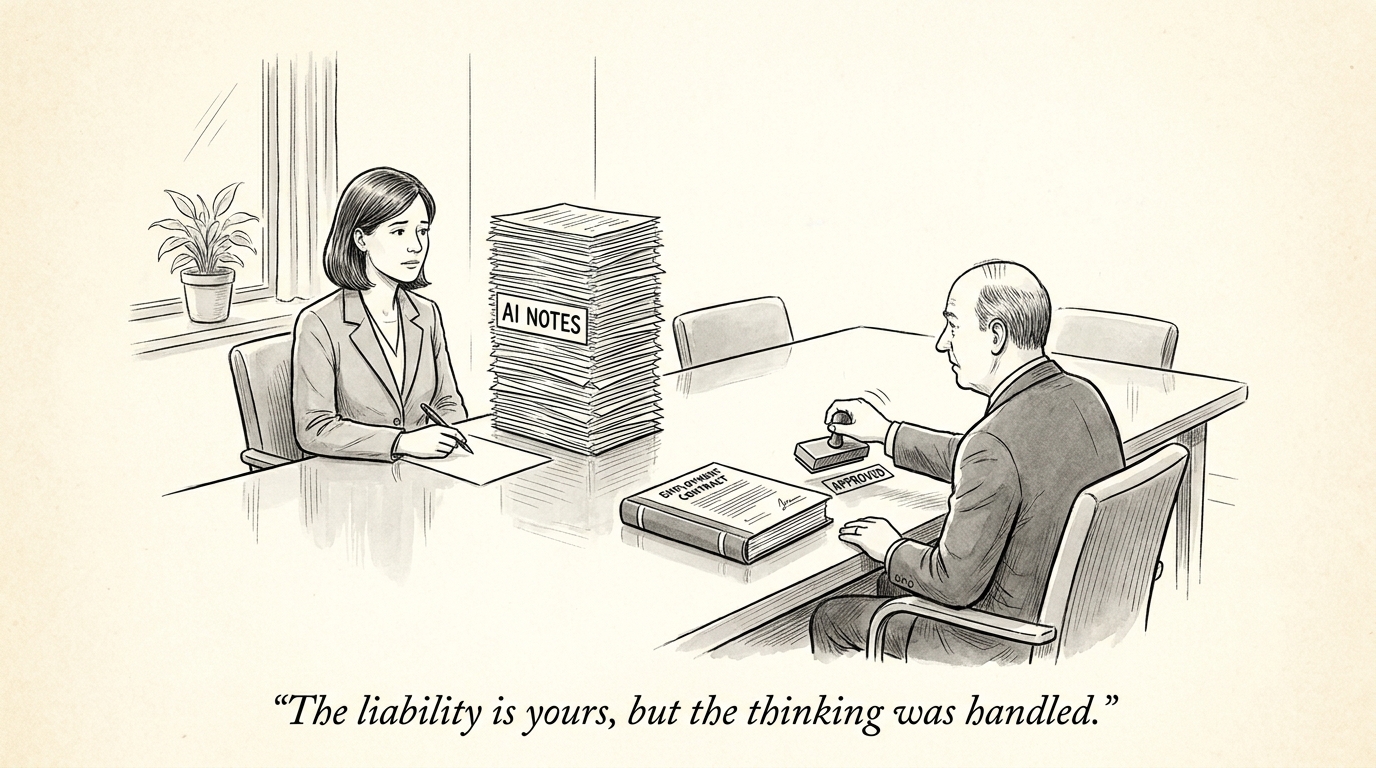
What matters most is who writes the billing rules. Payers could decide that AI-assisted care deserves lower reimbursement. If they do, the compensation system will split: some physicians will command premiums for irreplaceable expertise, while others compete with algorithms for oversight roles paid at lower rates. Imagine a signing room where a physician is asked to guarantee thousands of AI-generated notes, keep legal exposure, and accept a lower rate because “AI handled it.” That image feels less like a negotiation and more like a cliff the profession will have to explain to itself.
Sources
FDA Seeks Public Feedback to Inform Regulatory Approach for Generative AI-Enabled Medical Devices – U.S. Food and Drug Administration
FDA’s Rick Abramson: Generative AI guidances are coming – STAT
Doctors, AI Advocates Clash Over Who Should Make Clinical Decisions – eMarketer
Ezekiel Emanuel: We’re going to have autonomous clinical AI – Chief Healthcare Executive
Viewpoint: Autonomous AI could outperform human physicians – Becker’s Hospital Review
As AI advances, debate grows over future role of physicians – Fierce Healthcare
FDA Weighs Clinician-Style Tests for Generative AI Medical Devices – PYMNTS
FDA considers doctor competency-based tests for medical generative AI – Nextgov
Defining the physician’s role in the digital and AI era of medicine – American Medical Association
AMA, DiMe launch AI framework for physicians amid rapid tech progress – TechTarget (HealthTech Analytics)
Healthcare AI sandbox points to the next regulatory test: autonomous medicine – Digital Journal