
This analysis synthesizes 7 sources published the week ending Aug 21, 2026. Editorial analysis by the PhysEmp Editorial Team.
The healthcare staffing market’s return to modest growth hides a sharper split: psychiatric mental health nurse practitioners are expanding far faster than the broader recovery, while physician retention efforts often stall at the organizational level. That gap creates distinct opportunities on Physician & Advanced Practice Jobs—but only for clinicians who know which specialties and practice models are actually absorbing demand versus those merely participating in aggregate recovery numbers.
Staffing Industry Analysts data show healthcare staffing has emerged from its post-pandemic contraction and most segments are back in positive territory. The growth, however, concentrates in advanced practice nursing roles, especially behavioral health. Headline recovery and specialty-specific acceleration tell very different stories about where pay is rising and where it remains flat.
Where Growth Actually Concentrates
Advanced practice nurses rank among the fastest-growing staffing categories, but combining NPs and PAs into one figure masks the specialty splits driving hiring. PMHNPs are at the sharp end of that expansion. Telehealth-enabled practice models open geographic arbitrage that procedure-dependent specialties simply can’t access.
State scope-of-practice differences create a clear regulatory map for PMHNP demand. Full practice authority states—where PMHNPs can evaluate, diagnose, and prescribe independently—generate outsized telehealth openings because employers can deploy clinicians without physician supervision limits on schedules or pay. PMHNPs licensed in restrictive states who add licensure in full-practice-authority states can access remote roles that pay premiums their home markets do not offer.
Telehealth-enabled PMHNP roles in full practice authority states now set a compensation benchmark that forces in-person psychiatric positions to explain why they pay less. Clinicians negotiating local offers should reference these remote rates explicitly.
Mainstream coverage often treats APP demand as uniform. The behavioral health subset is growing faster than primary care APP roles, and within behavioral health, telehealth-capable positions are growing faster than facility-based ones. Recruiters chasing PMHNPs increasingly lead with flexibility and autonomy rather than standard benefits, because clinicians know these roles exist.
OB-GYN Staffing Gaps Follow Different Logic
Obstat’s nationwide push to address OB-GYN shortages shows a parallel but different pattern. Obstetric care is procedure-anchored and place-dependent. Those gaps don’t yield to remote work—they require clinicians on-site in underserved communities, which limits the compensation arbitrage available.
That distinction matters for APPs weighing specialty choices. Certified nurse midwives and women’s health NPs face steady demand but less geographic flexibility than PMHNPs. The trade-off is practical: OB-GYN-focused APPs may get stable, facility-based roles with predictable schedules; PMHNPs can chase higher pay, often by holding multiple state licenses.
Executives hiring for OB-GYN coverage should remember the competitive set differs from behavioral health. Candidates are comparing facility offers to other on-site positions, so traditional retention levers—call schedules, delivery volume, practice culture—carry more weight than in psychiatric hiring.
Retention Rhetoric Versus Structural Investment
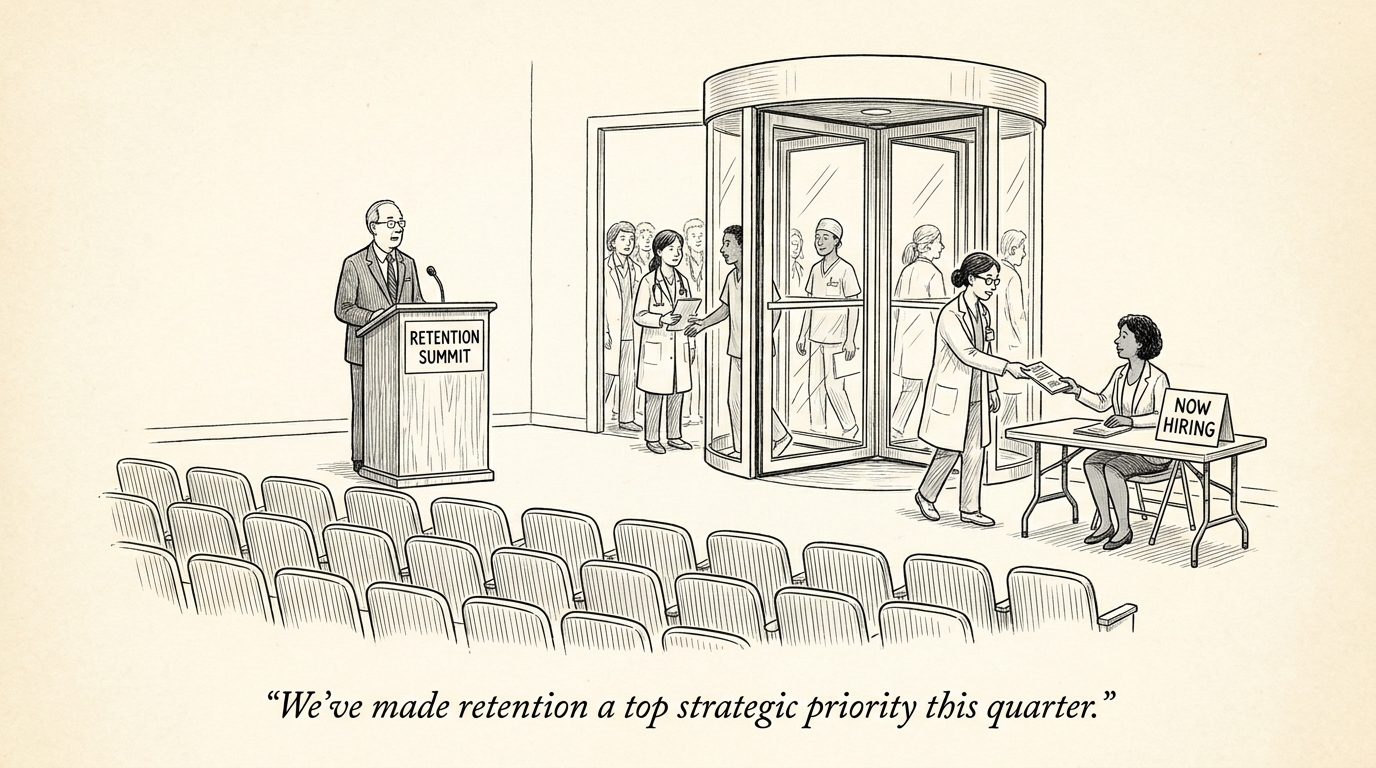
The American Medical Association’s analysis of physician retention shows a gap between organizational rhetoric and real investment. Many health systems say retention is a priority while underfunding the schedule changes, administrative burden reduction, and pay transparency that actually lower turnover.
This helps explain why physician and APP job postings stay elevated even as staffing firms report recovery. Systems that cycle clinicians because they can’t keep them create ongoing demand that inflates posting volumes without representing genuine net growth. Candidates should try to tell apart roles created by expansion from roles created by churn.
When an employer touts retention as a strategic priority but can’t say how much turnover they’ve had or point to initiatives launched in the past year, the retention language is marketing, not practice.
The staffing industry’s consolidation—with Medical Solutions now among the nation’s top five largest healthcare staffing firms—reflects this dynamic. Persistent turnover keeps demand for contingent staffing high, which means staffing firms benefit from the same retention failures that frustrate employed clinicians. This is not a critique of the firms so much as an observation about market incentives.
Licensing Strategy as Career Positioning
For PMHNPs, multi-state licensure has shifted from convenience to a compensation strategy. The Nurse Licensure Compact covers 41 states, but scope-of-practice differences mean compact membership doesn’t automatically grant full practice authority. Clinicians need to map both licensure portability and practice authority to find the state combinations that open the most remote opportunities.
That mapping creates a knowledge advantage. PMHNPs licensed in high-population, full-practice-authority states can reach the largest telehealth patient pools and command higher rates. Those tied to restricted states often compete for supervised roles with compressed pay.
Psychiatric physicians face a different calculation. Telehealth has raised demand for psychiatrists willing to supervise APPs in restricted states, but supervision comes with administrative overhead that can eat into any premium. Hybrid models—mixing direct patient care with selective supervision—look cleaner than pure supervisory roles for many psychiatrists.
What the Recovery Data Doesn’t Show
Aggregate recovery figures hide specialty-specific compression. Some segments still lag 2021 peaks; others now exceed them. Treating the recovery as uniform leads to misaligned expectations—clinicians in truly high-demand specialties underprice themselves while those in stabilized segments expect premiums that aren’t there.
Behavioral health demand shows few signs of normalizing; payer expansion and employer investment in mental health suggest sustained growth. OB-GYN gaps look structural given training pipeline limits. Primary care APP demand has mostly stabilized without the psychiatric acceleration.
For clinicians considering a specialty change or move, specificity matters: specialty certification in high-demand areas beats a generic APP title, and strategic licensure in states with practice authority matters more than vague geographic flexibility. The recovery is real, but opportunities are uneven and will stay that way for a while.
Sources
Healthcare staffing returns to modest growth across most segments – Staffing Industry Analysts
Advanced practice nurses among fastest-growing roles – Staffing Industry Analysts
PMHNP Telehealth Opportunity Map – Nurse.org
PMHNP Scope of Practice by State – Nurse.org
Obstat expands nationwide to address OB-GYN staffing gaps – FemTech Insider
Medical Solutions Ranks Among Nation’s Top 5 Largest Healthcare Staffing Firms – PR Newswire
How to tell when physician retention gets more lip service – American Medical Association (AMA)