
We pulled this piece together by tracking what residents actually posted online this week—166 real threads and comments from Reddit and similar corners of the internet. AI helped us spot the patterns hiding in the noise. Then a human editor made the final call on what was worth your time, and shaped those signals into the article you’re about to read.
A neurology resident described her training as brutal—80-hour weeks, near-constant pager anxiety, depression so severe she questioned whether she could keep going. She finished. She earned a fellowship. She negotiated her first attending job. And gradually, after months, she started to feel human again. But no one warned her about this: the transition out of residency didn’t come with automatic restoration. The fog didn’t lift on graduation day. For many physicians, it tends to get worse before it gets better.
Two months after finishing internal medicine residency, another physician posted that she couldn’t shake burnout. Even with time off, a supportive spouse, and already on an SSRI, she couldn’t find joy in anything. A third graduate described living in a haze—going through the motions, eating poorly, sleeping erratically, unable to reconnect with the person she was before medical school.
These aren’t outliers. It’s a pattern many physicians encounter: finishing training doesn’t fix you. Sometimes it reveals how broken you’ve become.
Why Relief Shows Up as Emptiness
Finishing residency carries big psychological weight. For three to seven years you tell yourself life starts after training. The exhaustion will pass. Once you’re done, you’ll have time to exercise, cook real food, see friends, feel like yourself again.
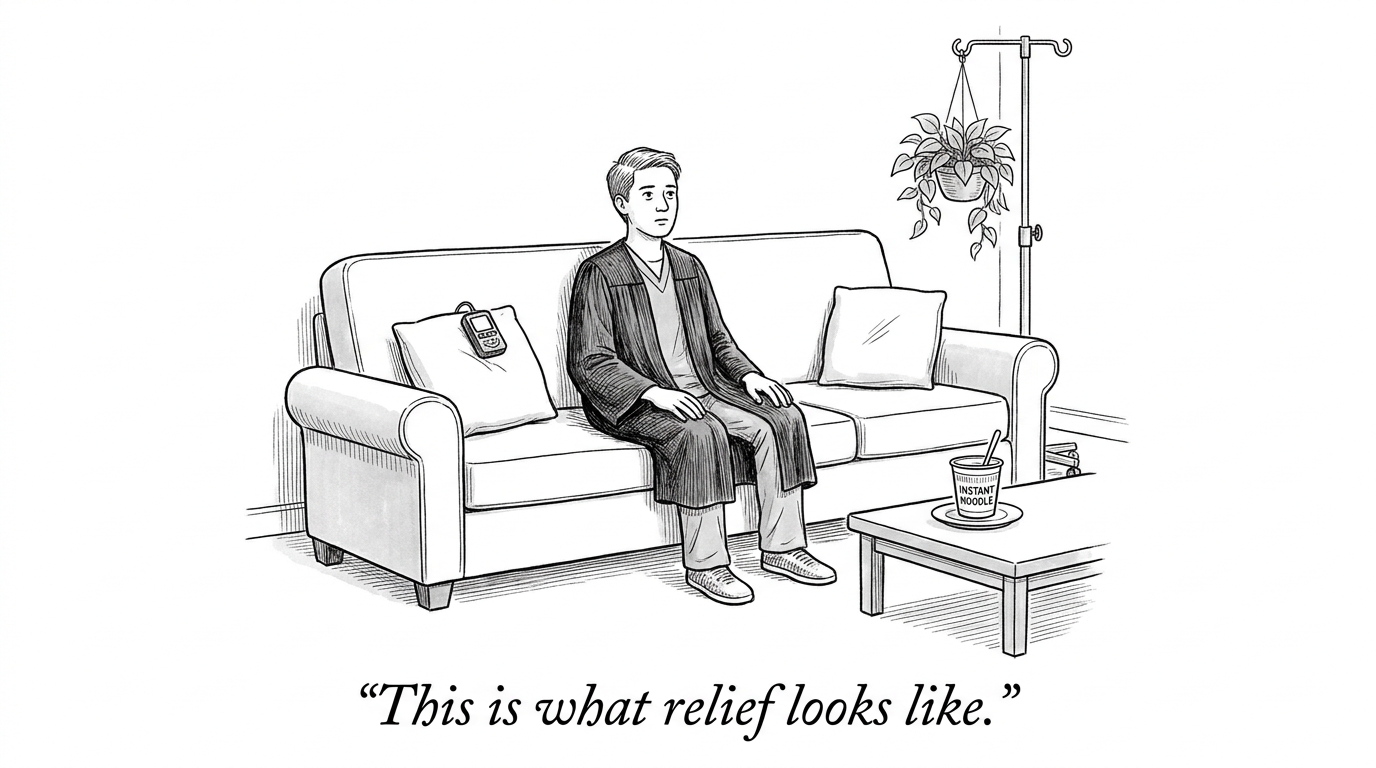
Then you finish. The relief you expect shows up as something else—emptiness, disorientation, or a depression you can’t name. This isn’t weakness. It’s the predictable result of operating in survival mode for years, then suddenly having the threat removed.
Residency trains your nervous system to stay on high alert. You learn to function on little sleep, to suppress hunger, to ignore fatigue signals, to defer every non-urgent need. These habits helped during long shifts, but they don’t reverse when training ends. Your body doesn’t automatically know the war is over.
What you’re left with are survival habits that no longer help. You also lack practice in the skills you actually need for life after residency. One resident said bluntly that residency ruined her ability to have an unproductive day off. She couldn’t sit still without guilt. She couldn’t enjoy leisure without the nagging thought that she should be doing something productive. The hypervigilance that carried her through training had become her default state.
The Identity Problem Nobody Talks About
Beyond the physiological aftermath, there’s a subtler loss: identity itself. For years, resident defined you. Someone else set your schedule. Your goals came from outside—pass boards, finish rotations, survive evaluations. Most of your social world consisted of other residents going through the same thing.
Then you graduate, and that structure vanishes. You’re supposed to be an attending now, but you don’t feel like one. You’re meant to have a life outside medicine, but you’ve forgotten what that looks like. One physician described losing basic life skills outside work—spending so long optimizing for survival that she forgot how to cultivate hobbies, friendships, or simply be a person rather than a trainee.
This identity vacuum is disorienting in ways hard to put into words. You achieved the thing you worked toward for a decade, and instead of feeling triumphant, you feel lost. The absence of external structure that once felt oppressive now feels like vertigo.
When Malaise Becomes Something More
Post-residency adjustment happens. Some disorientation is normal. But there is a line between adjustment and clinical depression, and residency culture makes it hard to see it.
If you’re two months out and still unable to experience pleasure, if you’re sleeping 12 hours and waking up exhausted, or if you’re having thoughts about not wanting to be here, and your functioning is declining rather than improving, that’s not adjustment. That’s a medical condition that requires treatment, not just time.
The neurology graduate who recovered described reaching a point where she wasn’t sure she could keep going. She sought help, found a therapist who understood physician culture, and negotiated a first job that prioritized schedule flexibility above pay. The recovery was slow and intentional, not automatic.
A Framework for Intentional Recovery
Waiting for time to heal you is a strategy that doesn’t work well. Those survival patterns from training run deep. They won’t fade on their own. Recovery needs deliberate steps.
Physical restoration comes first. Your body has been running a deficit for years. Sleep, nutrition, and movement aren’t wellness buzzwords—they’re the foundation everything else depends on. If you’re still eating like a resident—erratic, whatever’s available, often standing up—start there. If you haven’t exercised in months, begin with walking. The goal isn’t optimization; it’s reversing the physiological debt you’ve accumulated.
Reconnect with your pre-medicine identity. You were a person before medical school. You had interests, relationships, and ways to spend time that had nothing to do with medicine. Those parts aren’t gone—they’ve atrophied. Rebuilding them takes intentional effort. Reach out to friends you’ve neglected. Pick up a hobby you abandoned. The discomfort of doing non-productive things is part of recovery.
Use your first job as a recovery tool. The job you take after training shapes your recovery path. A role that pays well but has brutal call schedules can extend burnout. A job with a bit less pay but better work-life boundaries could make the difference between a successful first year and burning out early. This is a legitimate factor in negotiating a job, not a sign of weakness.
Get professional help if you need it. Therapy isn’t a luxury or a last resort. Finding a therapist who understands physician culture—the perfectionism, the delayed gratification, the identity fusion with work—can accelerate recovery. If you’re on medication and it’s not helping, that’s information to discuss with a psychiatrist, not proof you’re beyond help.
The Long Game
Those who recover well after residency aren’t the ones who grit their way through post-training malaise hoping it will fade. They understand that residency changed them in ways that call for active steps to reverse.
The neurology graduate who endured brutal training also described what came after: a fellowship she genuinely enjoyed, a first job she negotiated with boundaries, and a gradual return to feeling like a person again. It took time. It took intention. It meant acknowledging that finishing training was the start of recovery, not the end of the problem.
If you’re still in the fog now—two months, six months, or a year out—and waiting for relief to arrive, stop waiting. Relief won’t arrive on its own. Recovery is something you build, not something that happens to you. What will your first concrete step look like this week?
P.S. PhysEmp keeps job listings and salary reports by specialty on hand — not urgent today, but worth knowing where it lives when the job hunt starts: physemp.com. And DocCommons is building a community for residents and attendings who’d rather not do this alone; waitlist’s open at doccommons.com