
This piece started with what residents were actually saying online this week — 166 real posts across Reddit and the other corners where people talk candidly. We used AI to sift through the noise and surface the themes that kept showing up. Then a human editor made the final call on what was worth your attention, and that’s what you’re about to read.
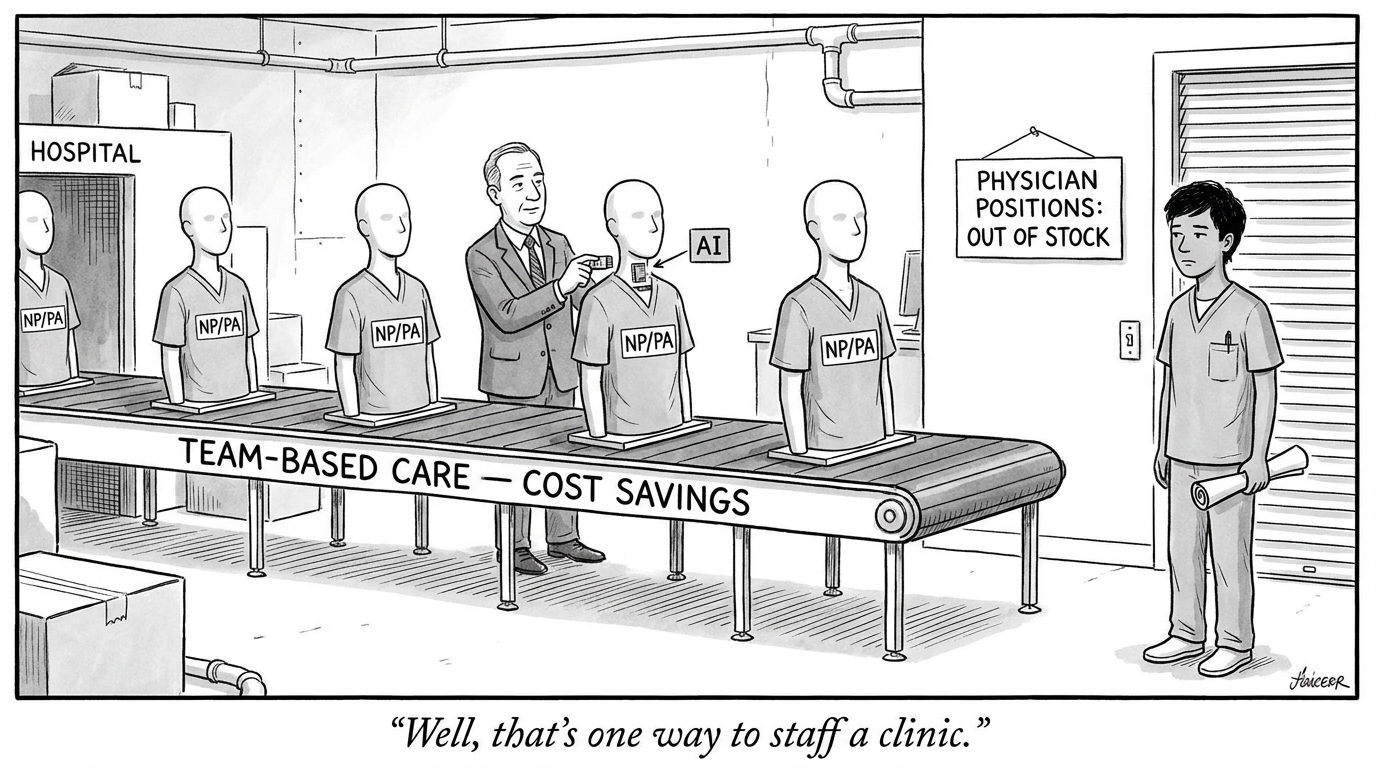
Twenty-six states now allow nurse practitioners to practice independently without physician oversight. In the time it takes you to complete residency, that number will likely grow. Meanwhile, hospital systems are quietly restructuring care delivery models around “team-based care”—which, translated from administrator-speak, often means replacing physician positions with lower-cost midlevel providers wherever possible. If you’re in the middle of navigating residency while watching these policy changes unfold, you’re right to wonder what it means for the job you’re training for.
This isn’t about whether NPs and PAs are good or bad clinicians. It’s about understanding where the job market is actually shifting, where physician training retains clear differentiation, and how to position yourself accordingly.
Where the Competition Is Real
The threat isn’t evenly distributed. Primary care, urgent care, and lower-acuity outpatient settings are where midlevel expansion has the most direct impact on physician employment. In these environments, the clinical complexity is often manageable within NP/PA scope, and the cost differential is substantial—a family medicine NP might cost a health system 40-50% less than a family medicine physician when you factor in salary, benefits, and malpractice.
Urgent care has already shifted dramatically. Many chains are now staffed primarily by NPs and PAs, with physicians serving as medical directors or backup rather than frontline providers. Retail clinics are almost entirely midlevel-staffed. If you’re going into primary care, the question isn’t whether you’ll compete with midlevels—it’s how you’ll differentiate yourself from them.
The pattern extends to certain outpatient subspecialties too. Allergy/immunology, some areas of dermatology, and straightforward chronic disease management are all seeing increased midlevel penetration. The common thread: conditions with established protocols, predictable presentations, and lower procedural complexity.
Where Physician Training Still Clearly Differentiates
Complex inpatient medicine, procedural specialties, and subspecialties requiring extensive pattern recognition remain physician-dominated for structural reasons, not just political ones. When the differential diagnosis is broad, when the procedure requires years of technical training, or when the stakes of a missed diagnosis are catastrophic, the depth of physician training matters in ways that are hard to replicate with shorter educational pathways.
Surgical specialties, interventional cardiology, critical care, complex oncology, high-risk obstetrics—these areas aren’t seeing the same competitive pressure. The training gap is too wide, the liability too high, and the technical skills too specialized. This doesn’t mean midlevels don’t work in these areas; they do, often as valuable team members. But they’re not replacing attending physicians in the same way they’re replacing primary care docs in urgent care settings.
If you’re choosing a specialty with market durability in mind, procedural complexity and diagnostic uncertainty are your friends. The harder it is to protocolize, the more secure the physician role.
The AI Complication
Here’s what makes the current moment different from past scope-of-practice debates: AI is entering the picture as a potential equalizer. The argument goes like this—if AI can assist with differential diagnosis and clinical decision-making, it narrows the gap between physician-level training and midlevel training. An NP with a good AI diagnostic support tool might perform closer to physician-level on certain metrics.
Whether this plays out remains to be seen. But it’s worth noting that the combination of independent practice authority plus AI assistance is a different competitive playing field than either factor alone. The residents asking about this aren’t being paranoid; they’re thinking structurally about where the market is heading.
Positioning Yourself in This Market
If you’re in a specialty facing real midlevel competition, your job market strategy needs to account for it. A few practical considerations:
Practice setting matters. Hospital employment often means working within team-based care models where midlevel utilization is a cost-saving strategy. Independent practice or physician-owned groups may offer more control over your scope and patient panel, but come with their own financial and administrative burdens. Neither is universally better—but know what you’re walking into.
Geographic variation is significant. States with full NP independent practice (California isn’t there yet; Arizona, Colorado, and most of New England are) have different market dynamics than restrictive states. If you’re flexible on location, this is a real variable in your job search calculus.
Subspecialization creates differentiation. A general internist faces more direct competition than a rheumatologist. A family medicine physician faces more competition than a sports medicine fellowship-trained family medicine physician. Additional credentials create distance from the midlevel scope of practice.
Complex patient populations are physician territory. Practices serving patients with multiple comorbidities, diagnostic uncertainty, or high-acuity needs are less amenable to midlevel-heavy staffing models. Seeking out these practice environments—whether in underserved areas, academic settings, or specialty practices—can insulate you from direct competition.
The Value Proposition Question
The underlying anxiety here is whether the years of residency training will be valued by employers and patients. The honest answer: it depends on where you practice and how you position yourself. In settings where the clinical work is protocolized and the cost pressure is high, the market may not pay a premium for physician training. In settings where complexity, uncertainty, and high-stakes decision-making are the norm, it will.
Your job is to understand which market you’re entering and position accordingly—not to assume that the credential alone will do the work for you. The rest of the story will be written in the choices you make next year, in patient rooms you build or watch slip away.
P.S. PhysEmp has job listings and salary reports broken down by specialty — not urgent today, but worth knowing about when the job hunt eventually shows up: physemp.com. And DocCommons is building a community for residents and attendings who’d rather not navigate all of this in isolation — waitlist’s open at doccommons.com.