
This analysis draws on PhysEmp editorial coverage from March through May 2026 spanning Medicare reimbursement, blended compensation structures, and emergency medicine contract dynamics. Editorial analysis by the PhysEmp Editorial Team.
The signing bonus used to be a flourish. A little something extra at the end of the offer letter, the recruiting equivalent of a mint on the pillow. In 2026, it’s table stakes — and like most things that become table stakes, it has quietly stopped meaning what physicians think it means.
Industry data now shows that bonus pay has moved from exceptional incentive to standard component, with signing bonuses, productivity incentives, and quality metrics embedded in baseline offers across specialties. That sounds like good news. The headline number on your offer is bigger than it used to be. The check at signing is real money. Your spouse is impressed. The problem is everyone else’s spouse is also impressed, because everyone is getting one, which means the bonus is no longer doing the thing a bonus is supposed to do — namely, distinguish a great offer from an average one. The broader physician compensation and demand landscape explains why: shortages have made the bonus universal, which has made it strategically inert.
What you’re actually being paid for
Signing bonuses don’t appear out of generosity. They appear when health systems need to solve a specific structural problem, and right now the problem is that the math on physician recruitment has gotten ugly.
Medicare physician reimbursement has fallen 33% in inflation-adjusted terms since 2001, which means the specialties most exposed to federal payment policy — psychiatry, neurology, urology, gastroenterology, primary care — are the hardest to recruit into precisely when systems can least afford to pay competitive base salaries. The answer many systems have landed on is a guaranteed salary plus a signing bonus, sometimes with loan repayment stapled on top, because they need warm bodies in clinic rooms next quarter and the alternative (sustained base salary increases) eats into margins they don’t have.
This is useful to know when you’re negotiating. A signing bonus isn’t a reward for being you. It’s an admission that the underlying compensation structure can’t compete on base, and the system is paying upfront to close the gap.
Read the repayment clause first, the dollar amount second
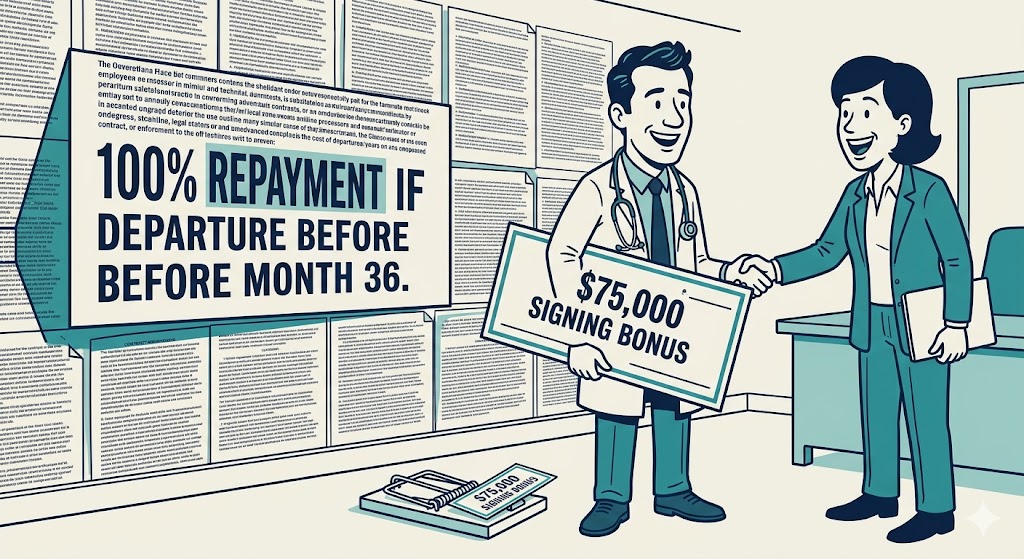
The most consequential paragraph in any offer letter with a signing bonus is not the one with the number. It’s the one explaining what happens if you leave.
Standard structures vary. Some bonuses vest linearly over two to four years, prorated month by month. Others vest in cliff increments — 50% at eighteen months, the rest at thirty-six. The harshest are 100% repayable through a specified term, often three years, with no proration. Same dollar figure on the offer letter. Wildly different actual value depending on how confident you are that you’ll still be there in year three.
The blended compensation structural shift has made this worse, not better. As health systems have moved away from pure productivity models toward guaranteed base salaries with productivity incentives layered on, the signing bonus has become a retention lever — a way to lock you in long enough to either build a panel that justifies the guarantee or to discover that the productivity thresholds were calibrated to historical highs in a practice environment that no longer exists. If you leave during that discovery period, the bonus comes back.
The four flavors of incentive (and what each one is actually doing)
The recruitment incentive package usually contains some combination of four components, and they are not interchangeable.
Upfront lump-sum signing bonuses are the most flexible from the physician’s standpoint and the most expensive from the employer’s. They pay taxes immediately at your top marginal rate. They almost always carry repayment obligations. They’re best understood as a loan with favorable terms, not income.
Retention bonuses trigger at specified anniversaries — typically year two, year three, year five. These are cheaper for the employer because the money is contingent on you still being there to collect it, and the IRS treats the payment as ordinary income in the year received. They’re a tell that the employer expects retention to be a problem.
Loan repayment packages are increasingly common, especially in shortage specialties and rural markets. The structure varies enormously — direct payments to your loan servicer, taxable income deposited to you, employer-side tax treatment of varying generosity. The headline number can be impressive. The after-tax value to you can be 30-40% lower than the headline suggests.
Productivity guarantees are the quietest and often the most valuable. A guarantee floor for the first 12-24 months — protection against the patient panel taking longer to build than projected — can be worth more than a six-figure signing bonus and doesn’t come with repayment risk. These are also the easiest to negotiate because they cost the employer nothing if you perform.
The negotiation that actually matters
The instinct when an offer arrives with a signing bonus is to negotiate the bonus up. Sometimes that works. More often, the employer has already calibrated the bonus to the specialty and market and isn’t going to move much on the headline figure. What they will move on, often substantially, are the terms around it.
Specific things worth pressing on: shorter repayment terms, monthly proration instead of cliff vesting, exclusion of repayment obligation in cases of employer-side breach (failure to provide promised staffing, equipment, call coverage), and conversion of part of the signing bonus into a guaranteed minimum compensation floor for the first contract period.
The PeaceHealth dispute in Eugene showed the larger pattern: when physicians read contracts as the structural documents they are — not as ceremonial paperwork attached to a job offer — they tend to do considerably better than physicians who read the dollar amount, sign, and frame the check.
The signing bonus is real money. It is also, increasingly, a sophisticated piece of compensation engineering designed to solve the employer’s problems. Knowing which problem yours is solving is the difference between a great offer and an expensive one.
Primary Sources:
- Physician bonus pay becomes the norm: 6 things to know — Becker’s Hospital Review
- The Four Forces Reshaping Physician Compensation in 2026 — Medical Economics
- The Productivity Trap in Comp Plans — JD Supra
- Medicare Physician Pay Has Fallen 33 Percent Since 2001 — KevinMD
- Orthopedic compensation, by the numbers: May 2026 — Becker’s Spine Review
Drawn From PhysEmp Analysis
- Emergency Medicine Contract Battles Signal Physician Leverage Shift — PhysEmp, May 11, 2026
- Medicare Pay Erosion Reshapes Specialty Recruitment Economics — PhysEmp, May 25, 2026
- Blended Pay Models Reshape Physician Contract Negotiations — PhysEmp, March 30, 2026