
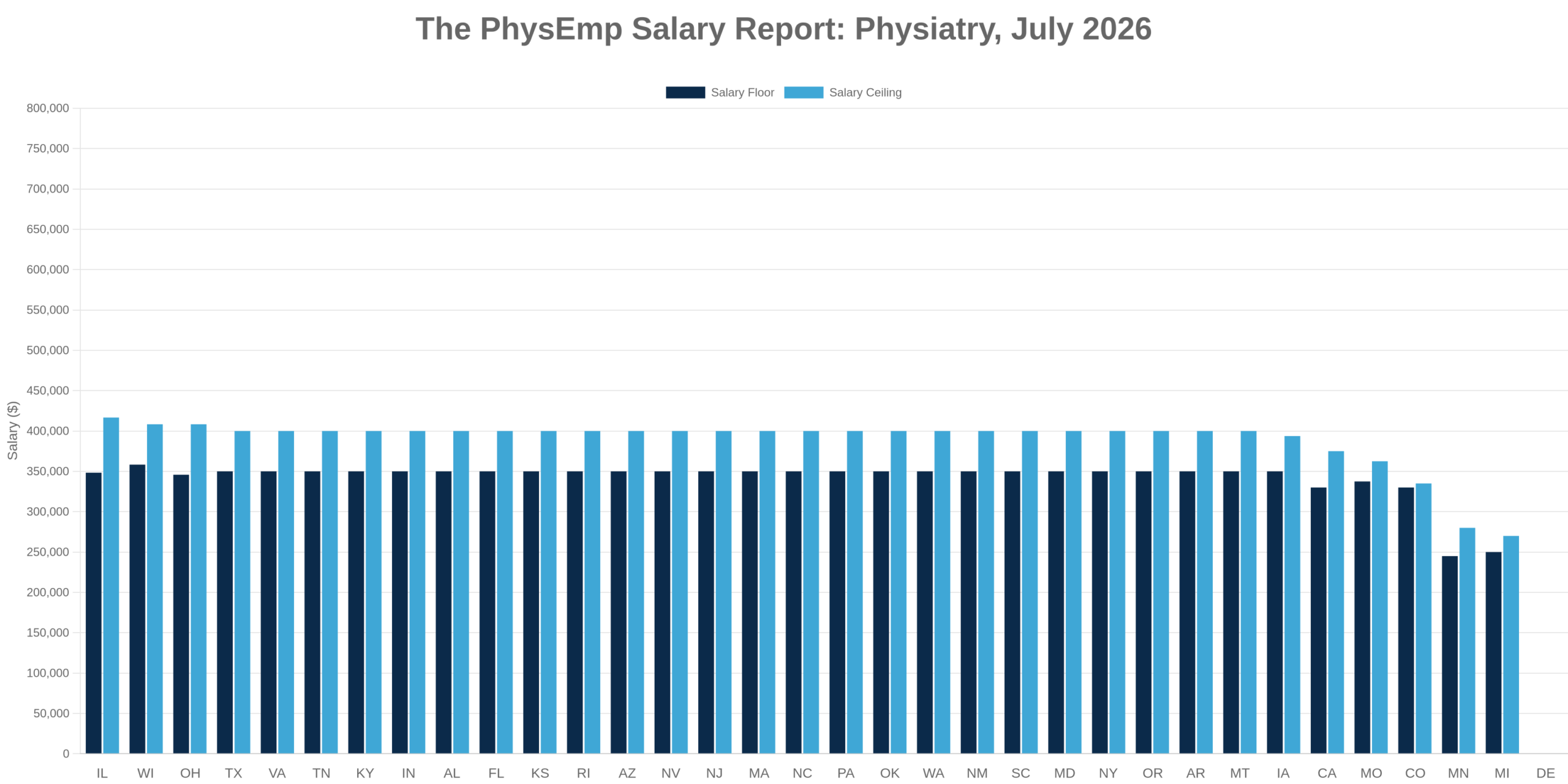
The gap between Michigan’s average Physiatry salary and Illinois’ ceiling is $136,667 per year. That’s enough to buy a Tesla annually and still have money left over for the insurance. The national Physiatry job market currently features 198 active listings across more than 35 states, with salary data disclosed for 100 positions. The data reveals a specialty with strong baseline compensation, tight geographic clustering around a dominant pay band, and two states so far below market they appear to be operating in a different economy entirely.
👉 Explore Physiatry job market insights and trends
The Physiatry Job Market at a Glance
Total listings: 198. Listings with salary data: 100. Full salary range: $140,000 to $475,000. National average range: $345,400 to $394,650.
The Physiatry market is remarkably consistent once you exclude the outliers. The vast majority of disclosed salaries fall into a narrow $350,000 to $400,000 band, creating a de facto national standard that holds across regions, practice settings, and employer types. The $140,000 floor is almost certainly a part-time or fellowship-adjacent role, while the $475,000 ceiling represents the upper boundary for premium markets or leadership-augmented positions. The average range sits comfortably in the mid-$300,000s to low-$400,000s, reflecting a specialty that commands strong compensation without the dramatic regional swings seen in procedural fields.
States represented: Texas, Virginia, Wisconsin, California, Minnesota, Tennessee, Kentucky, Indiana, Alabama, Florida, Kansas, Rhode Island, Ohio, Arizona, Nevada, New Jersey, Massachusetts, Missouri, North Carolina, Illinois, Pennsylvania, Michigan, Oklahoma, Washington, New Mexico, South Carolina, Maryland, New York, Oregon, Colorado, Delaware, Georgia, South Dakota, West Virginia, Louisiana, Arkansas, North Dakota, Montana, Iowa, Alaska, Idaho, Maine, New Hampshire.
👉 Browse Physiatry physician job opportunities
How States Stack Up
Overperformers: Illinois leads on ceiling at $348,333 to $416,667, offering the broadest upside of any state with meaningful volume. Wisconsin posts $358,333 to $408,333, combining above-average pay with solid listing count. Ohio reaches $408,333 on the high end despite a floor of $345,833, placing it in the top compensation tier.
Near-average performers: Texas, Florida, Tennessee, Virginia, Pennsylvania, New Jersey, New York, North Carolina, California, Kentucky, Indiana, Alabama, Kansas, Rhode Island, Arizona, Nevada, Massachusetts, South Carolina, Maryland, Washington, New Mexico, Oklahoma, Oregon, Arkansas, Montana, and Iowa all cluster tightly around $350,000 to $400,000, representing the market’s gravitational center. Colorado sits slightly below at $337,500 to $362,500, a modest but not disqualifying departure. Missouri averages $330,000 to $375,000, trending lower but not dramatically so.
Underperformers: Michigan posts $245,000 to $280,000, making it the lowest-paying state with disclosed data by a significant margin. Delaware follows at $250,000 to $270,000, similarly underperforming the national baseline by more than $75,000 on the floor. Minnesota’s single listing at $330,000 to $335,000 places it below average but not catastrophically so.
Volume leaders: Florida dominates with 19 listings, followed by Texas with 17, California and Tennessee tied at 15 each, Wisconsin and Pennsylvania at 9 apiece, and Ohio and Illinois both at 8. Florida and Texas lead on volume but pay exactly average, offering no compensation premium despite their market depth. Wisconsin stands out as the rare state combining meaningful volume with above-average salaries.
👉 Compare Physiatry compensation and opportunities by region
What This Means If You’re a Physician
If your priority is maximum compensation: Target Illinois, Wisconsin, and Ohio, which offer the highest average ceilings and meaningful job volume. The single highest-paying listing in the dataset reaches $475,000 per year, though specific city and employer details are not disclosed in the raw data. Listings in Dallas, TX and Fredericksburg, VA reach $400,000, representing the upper end of the dominant pay band.
If your priority is maximum optionality: Florida, Texas, and California offer the deepest job markets with 19, 17, and 15 listings respectively, though none pay above the national average. Tennessee ties California at 15 listings and matches the standard $350,000 to $400,000 range. Wisconsin and Pennsylvania provide mid-tier volume (9 listings each) with Wisconsin offering a meaningful salary premium.
If your priority is balance: Wisconsin delivers the rare combination of above-average pay and solid listing volume. Ohio similarly offers strong compensation with 8 listings. Avoid Michigan and Delaware unless non-financial factors are compelling; their $245,000 to $280,000 and $250,000 to $270,000 ranges respectively represent a $100,000+ annual haircut compared to Illinois or Wisconsin (and Michigan’s cost of living does not justify the gap).
👉 Search Physiatry jobs by location and compensation
What This Means If You’re a Recruiter
Salary transparency rate: 50.5% (100 listings with disclosed compensation divided by 198 total listings). This is a coin-flip market for candidates evaluating opportunities, meaning half of all postings require a phone screen just to determine if the role is financially viable. For recruiters, this creates friction in the top of the funnel and extends time-to-fill for non-disclosed roles.
Candidate pipeline implications: Florida, Texas, and California will generate the most inbound interest by volume alone, but none offer compensation differentiation. Recruiters in these states will need to lead with lifestyle, partnership track, or case mix rather than salary. Michigan and Delaware face a structural disadvantage; at $100,000+ below market, recruiters will need to emphasize loan repayment, cost of living, or practice autonomy to compete. Illinois and Wisconsin recruiters can lean into compensation as a primary selling point.
👉 Post Physiatry positions on PhysEmp
What’s Driving the Numbers
Volume and pay are uncorrelated in Physiatry. Florida leads the nation with 19 listings but pays exactly average. Texas posts 17 jobs with the same $350,000 to $400,000 band. Wisconsin bucks the trend, combining 9 listings with above-average compensation, but it’s the exception. High-volume states are not bidding up salaries, suggesting either deep candidate supply in those markets or standardized health system compensation structures that resist regional premiums.
The $350,000 to $400,000 band functions as a national cartel. More than two-thirds of disclosed listings fall into this exact range, regardless of state, employer type, or market size. This suggests widespread use of MGMA benchmarking, private equity-backed MSO standardization, or both. The tight clustering makes it difficult for individual employers to differentiate on compensation alone, shifting the recruitment battle to non-financial terms.
Michigan and Delaware are pricing themselves out of the candidate pool. Both states pay $100,000+ below the national average floor, a gap large enough to overcome most lifestyle or cost-of-living arguments. Unless these roles are part-time, offer ownership, or include significant non-clinical income, they represent a structural mismatch between what employers are willing to pay and what the national market has established as baseline. Recruiters in these states will struggle.
The $140,000 floor and $475,000 ceiling are both real, but neither is representative. The low end almost certainly reflects a part-time, academic, or fellowship-adjacent role. The high end likely includes medical directorship, ASC ownership, or a scarcity premium in an underserved market. The true functional range for full-time clinical Physiatry is $330,000 to $420,000, with most roles landing in the $350,000 to $400,000 band.
The Bottom Line
The Physiatry job market is geographically broad, numerically deep, and compensation-wise remarkably boring. Fifty percent of employers disclose salary, two-thirds of those that do offer the same $350,000 to $400,000 range, and the states with the most jobs pay exactly average. Illinois and Wisconsin offer the best combination of upside and volume. Michigan and Delaware offer a salary 30% below market and no clear explanation for why.
Physiatry pays well, consistently, and almost everywhere—unless you’re in Michigan, in which case it pays like a different specialty entirely.
👉 Browse all Physiatry physician jobs
👉 Upload your CV to get matched with opportunities
👉 Set alerts for new Physiatry roles
Salary data based on 100 listings with disclosed compensation. Figures may reflect part-time or specialized roles. This report is informational and should not replace professional judgment or financial planning.