
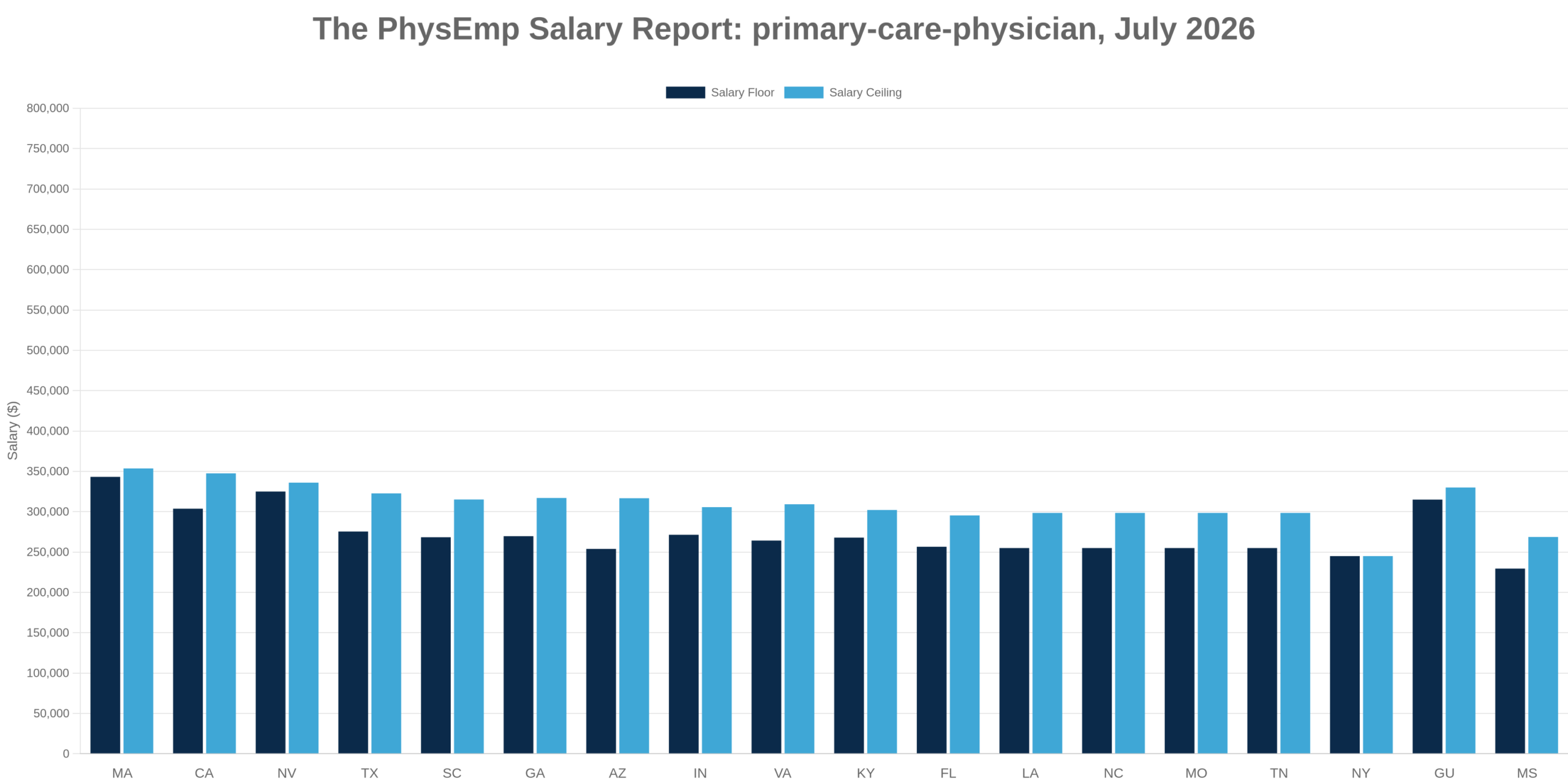
New York pays primary care physicians $245,000 on average. Massachusetts pays $348,400. They are separated by 215 miles and a $103,400 reality check. The national primary care market now features 146 active listings across 26 states and territories, with salary data disclosed in 104 postings. The full range spans $220,000 to $410,000, but the data tells a more specific story: geography matters more than volume, and corporate standardization has flattened much of the middle.
👉 Explore Primary Care Physician job market insights and trends
The Primary Care Physician Job Market at a Glance
Total listings: 146. Listings with salary data: 104. Full range: $220,000 to $410,000. Average range: $267,138 to $308,391.
The spread is wide but not wild. The floor sits at $220,000, which is respectable for primary care but unremarkable in a specialty market where proceduralists routinely clear seven figures. The ceiling reaches $410,000, driven by a single Sunnyvale listing that appears to be pricing in Silicon Valley cost of living and possibly equity upside. The average range clusters tightly around $267,000 to $308,000, a function of high-volume employers like Centerwell and Conviva deploying uniform pay scales across the Southeast.
The middle is crowded. The extremes are where the value hides.
States represented: New York, Kentucky, Texas, Florida, South Carolina, Louisiana, Indiana, California, North Carolina, Nevada, Georgia, Missouri, Virginia, Arizona, Massachusetts, Mississippi, Guam, Tennessee, Connecticut, New Mexico, Alabama, Colorado, Michigan, Ohio, Arkansas, Wyoming.
👉 Browse Primary Care Physician physician job opportunities
How States Stack Up
Overperformers: Massachusetts leads at $343,200 to $353,600, though it is a single-listing market and therefore more anecdote than trend. Nevada averages $325,000 to $336,000 across two postings, making it the most reliable high-compensation state with multiple data points. Guam pays $315,000 to $330,000, which is either a scarcity premium or hazard pay for practicing 6,000 miles from the mainland. California averages $303,750 to $347,500 across four listings, anchored by the Sunnyvale outlier but still competitive without it.
Near-average: Texas averages $275,458 to $322,713 across 19 salary-confirmed listings, placing it slightly above the national midpoint despite being the second-highest volume state. Georgia comes in at $269,686 to $317,000 across seven postings, offering both volume and modestly above-average pay. Indiana ($271,400 to $305,660), Kentucky ($267,900 to $302,130), South Carolina ($268,364 to $315,136), and Virginia ($264,250 to $309,250) all hover near the national mean and represent stable, if unspectacular, markets.
Underperformers: Mississippi bottoms out at $229,500 to $268,700, the only state averaging below $240,000 on the low end. New York averages $245,000 flat across two postings, a striking underperformance for a state where a studio apartment costs what most Americans spend on a car. Arizona averages $253,900 to $316,700, dragged down by a low-end outlier but recovering on the high side. Florida ($256,557 to $295,389), Louisiana ($255,000 to $298,500), North Carolina ($255,000 to $298,500), Missouri ($255,000 to $298,500), and Tennessee ($255,000 to $298,500) all reflect corporate pay standardization and sit below the national average despite high listing volume in Florida’s case.
Volume Leaders:
- Florida: 28 listings
- Texas: 25 listings
- South Carolina: 14 listings
- California: 10 listings
- Georgia: 8 listings
- Louisiana and Virginia: 7 listings each
Florida leads the nation in job postings and pays below the national average. Texas follows the same pattern. Meanwhile, Nevada and Massachusetts post the highest salaries with a combined three listings. Volume is not value.
👉 Compare Primary Care Physician compensation and opportunities by region
What This Means If You’re a Physician
If your priority is maximum compensation: Focus on California, Nevada, and Massachusetts. The highest-paying listing in the dataset is a Primary Care Physician role in Sunnyvale, CA, offering $390,000 to $410,000 annually. Massachusetts and Nevada offer the next tier down, both clearing $325,000 on average. Guam is also in play if you are willing to relocate to the Western Pacific.
If your priority is maximum optionality: Florida and Texas dominate by volume, with 28 and 25 listings respectively. Both states pay near or slightly below the national average, so you are trading compensation ceiling for job selection. California offers a middle path with 10 listings and top-tier pay.
If your priority is balance: California and Georgia offer the best combination of competitive salaries and meaningful job volume. Texas also merits consideration for physicians willing to accept near-average pay in exchange for a deep candidate market. Avoid New York unless you have non-financial reasons to be there (the cost-of-living-to-compensation mismatch is among the worst in the dataset).
👉 Search Primary Care Physician jobs by location and compensation
What This Means If You’re a Recruiter
Salary transparency rate: 71.2% (104 of 146 listings disclosed compensation). That is strong relative to most physician specialties and suggests primary care employers understand they are competing on concrete terms.
Candidate pipeline implications: High-volume states like Florida and Texas are paying below the national average, which will require recruiters to lead with lifestyle, partnership track, or operational autonomy rather than base compensation. New York’s underperformance is a structural problem that will cost you candidates to neighboring states unless you can credibly pitch equity, loan repayment, or expedited partnership.
Volume-pay misalignments: Florida has 28 listings and averages $275,973 (midpoint). Nevada has 2 listings and averages $330,500. If you are recruiting in Florida, you are competing with Nevada on pay and losing. Lead with patient panel size, call schedule, or benefits. If you are recruiting in Nevada, you have pricing power. Use it.
👉 Post Primary Care Physician positions on PhysEmp
What’s Driving the Numbers
Corporate standardization is compressing the middle.
The clustering of Louisiana, North Carolina, Missouri, Tennessee, and Florida around $255,000 to $298,500 is not coincidence. It reflects the footprint of large senior care and value-based care employers deploying uniform pay scales across regions. This creates stability and predictability, but it also means physicians in these states are unlikely to negotiate materially above the stated range. The upside is capped. The downside is known.
Geography commands a larger premium than volume.
Nevada and Massachusetts pay 20% to 30% above the national average despite minimal job volume. Florida and Texas pay near or below average despite accounting for more than one-third of all listings. Scarcity and cost of living drive compensation more than labor market depth. Physicians optimizing for income should target low-volume, high-pay states. Physicians optimizing for choice should target high-volume states and plan to negotiate harder.
The floor is higher than it used to be, but the ceiling has not moved.
The $220,000 floor is a meaningful improvement over primary care compensation a decade ago, when sub-$200,000 offers were common in rural and underserved markets. But the $410,000 ceiling remains an outlier, not a trend. Primary care physicians are being paid more consistently, but they are not being paid dramatically more at the top end. The value proposition has stabilized, not transformed.
New York is underpricing itself into irrelevance.
A $245,000 average in a state where the median home price in desirable markets exceeds $750,000 is a recruitment crisis in waiting. Either New York employers do not understand the competitive landscape, or they are betting on non-financial factors (prestige, proximity to family, cultural amenities) to close the gap. That is a bet that will lose more often than it wins, particularly as telemedicine and remote work reduce the need to be physically present in high-cost metros.
The Bottom Line
The primary care physician market is geographically bifurcated, volume-saturated in the middle, and top-heavy in states that have either priced in scarcity or cost of living. Florida and Texas offer the most jobs. California, Nevada, and Massachusetts offer the most money. The gap between the two is not closing.
Primary care pays well enough everywhere and exceptionally well in three places.
👉 Browse all Primary Care Physician physician jobs
👉 Upload your CV to get matched with opportunities
👉 Set alerts for new Primary Care Physician roles
Salary data based on 104 listings with disclosed compensation. Figures may reflect part-time or specialized roles. This report is informational and should not replace professional judgment or financial planning.