
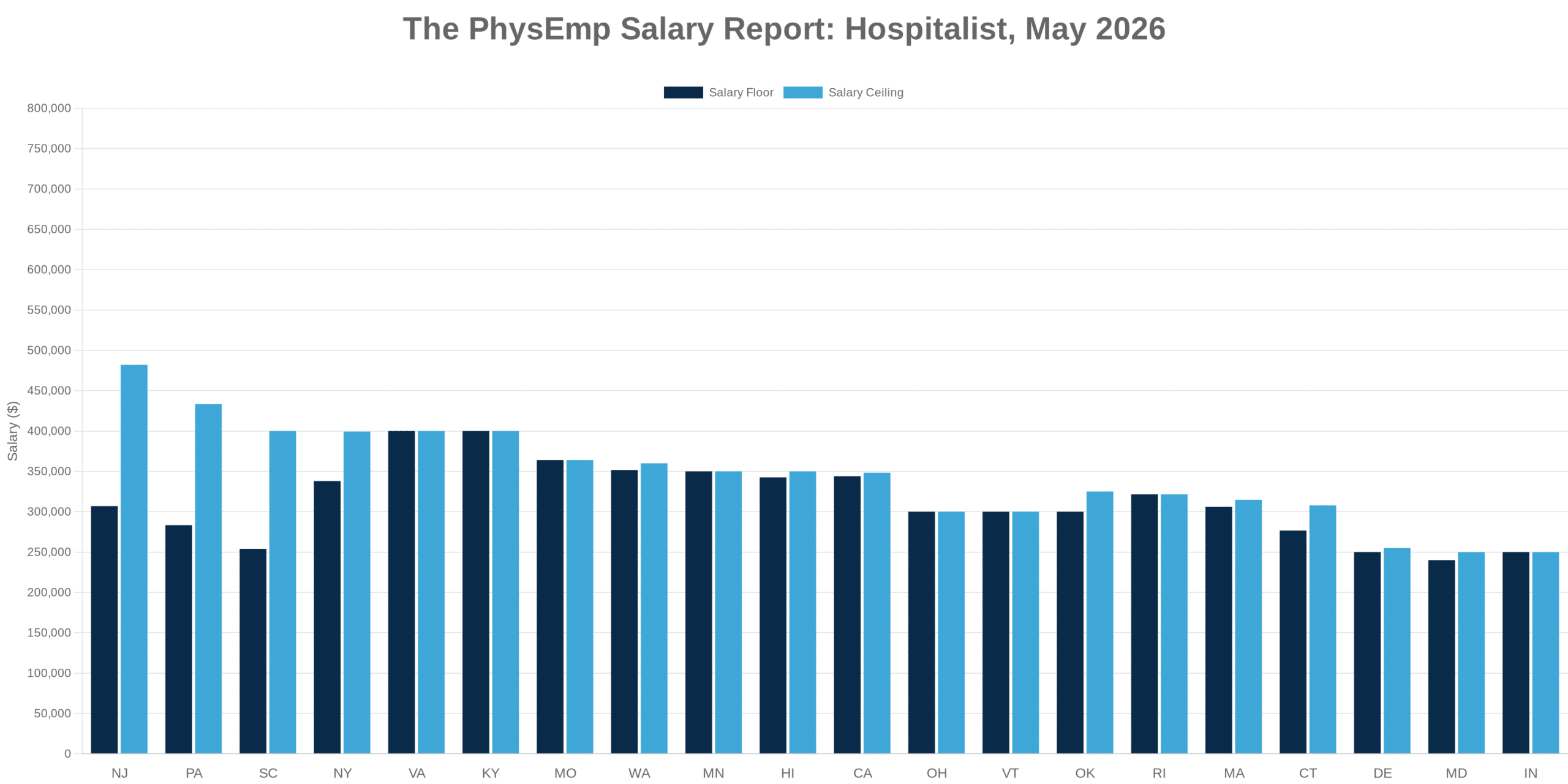
Somewhere in Corning, New York — a town better known for glassware than for medical bidding wars — a hospital is offering a Hospitalist $600,000 a year. Roughly 200 miles south, in Brooklyn, another hospital is offering $210,000 for what is, on paper, the same job. Same state. Same specialty. Nearly triple the pay. Welcome to the Hospitalist market, where 465 active listings stretch from Alaska to Alabama, and where geography is doing more work than the residency program ever did. The data shows a specialty in high demand, broadly distributed, and quietly inconsistent about what it thinks the work is worth.
👉 Explore Hospitalist job market insights and trends
The Hospitalist Job Market at a Glance
Total listings: 465
Listings with disclosed salary: 48
Full salary range: $210,000 to $600,000
National average range: $321,069 to $356,058
The spread tells the story. A $390,000 gap between the floor and ceiling is wide even by physician standards, and the average range — a relatively tight $35,000 band — suggests that most employers are clustered in a fairly predictable middle while a handful of outliers (Corning, we see you) drag the ceiling skyward.
States represented: RI, OK, NY, MO, DE, IN, MA, CA, PA, CT, MD, VT, TN, NC, SC, AL, VA, OR, LA, NJ, ND, TX, FL, CO, OH, GA, IL, WI, SD, WV, NM, IA, AZ, HI, AR, WA, MS, NV, WY, NH, KY, AK, MN, ID, NE, KS, MI, MT, UT, ME.
That is 50 states’ worth of demand for someone to round on the medicine floor. The Hospitalist is, structurally, the load-bearing wall of American inpatient care, and the listing volume reflects it.
👉 Browse Hospitalist physician job opportunities
How States Stack Up
Overperformers:
- New Jersey ($307,000–$482,000): a wide range driven by premium outliers, and the highest average ceiling in the country.
- Virginia ($400,000): flat, generous, and singular.
- Kentucky ($400,000): same flat $400,000, suggesting rural scarcity pricing rather than urban bidding.
- Pennsylvania ($283,333–$433,333): a tale of two job markets in one state.
- Missouri ($364,000): consistent and well above the national midpoint.
- Washington ($351,667–$360,000): quietly outpacing most coastal peers.
- Minnesota ($350,000): a single data point, but a strong one.
- California ($344,000–$348,333): high volume and high pay, an unusual combo.
- Hawaii ($342,500–$350,000): paradise, modestly priced.
- New York ($338,038–$399,288): the headline outlier ($600,000) lives here, but so does the floor ($210,000).
Near-average:
- Rhode Island ($321,500): sits on the national average like it was placed there.
- Massachusetts ($306,000–$314,800): high volume, middle pay.
- Connecticut ($276,667–$307,833): trails the midpoint, slightly.
- Oklahoma ($300,000–$325,000): predictable and steady.
- Ohio ($300,000): exactly that.
- Vermont ($300,000): also exactly that.
Underperformers:
- Maryland ($240,000–$250,000): the lowest disclosed average in the country.
- Delaware ($250,000–$255,000): tight, low, and unambiguous.
- Indiana ($250,000): one listing, and it is not generous.
- South Carolina ($254,000–$400,000): a range so wide it is almost two markets.
Volume leaders: Tennessee (32), North Carolina (27), Massachusetts (26), California (26), Florida (22), South Carolina (22), Alabama (20). Of those seven, four — Tennessee, North Carolina, Florida, Alabama — disclosed no salary data at all. The states with the most jobs are, in many cases, the states telling you the least about what those jobs pay.
👉 Compare Hospitalist compensation and opportunities by region
What This Means If You’re a Physician
If your priority is maximum compensation: Corning, NY, at $600,000 a year is the listing of record — roughly 1.7x the national average ceiling and a strong argument for the Finger Lakes. New Jersey, Virginia, Kentucky, and the high end of Pennsylvania round out the premium tier.
If your priority is maximum optionality: Tennessee, North Carolina, Massachusetts, and California are where the listings live. Just understand that in the Carolinas and Tennessee, you are negotiating compensation in the dark.
If your priority is balance: California and Massachusetts both deliver high volume with disclosed, competitive pay. New York offers the widest spread in the country — meaning the upside is real, but so is the floor.
One cost-of-living flag: Brooklyn at $210,000 is not a bargain. It is a math problem.
👉 Search Hospitalist jobs by location and compensation
What This Means If You’re a Recruiter
Salary transparency rate: 48 of 465 listings, or 10.3%. Roughly nine out of ten Hospitalist postings disclose nothing about pay.
That is a pipeline problem. Candidates who can compare offers from California, New York, and New Jersey on the same screen are not going to email Tennessee for a number. They are going to swipe past.
The volume-pay misalignment is sharpest in the Southeast: Tennessee (32 listings), North Carolina (27), Florida (22), and Alabama (20) collectively post over 100 jobs and disclose zero salary figures. If those markets are competitive, the listings do not say so. Recruiters in those states will need to lead with culture, caseload, call structure, loan forgiveness, and lifestyle — because the candidate has nothing else to evaluate before the first call.
👉 Post Hospitalist positions on PhysEmp
What’s Driving the Numbers
Scarcity is pricing rural and mid-market states above the coasts. Kentucky and Virginia both flat-line at $400,000, and Missouri sits at $364,000. These are not legacy high-cost markets. They are markets where the supply of willing Hospitalists is thin enough that employers have stopped pretending otherwise.
The volume-pay relationship is broken in the Southeast. Tennessee and North Carolina lead the country in listings and disclose nothing. That is not a coincidence — it is a strategy. When demand is high and transparency is low, the employer keeps leverage. The candidate, in turn, keeps scrolling.
Wide intra-state ranges signal a two-tier market. Pennsylvania ($283,333–$433,333), South Carolina ($254,000–$400,000), and New York ($210,000 to $600,000 on the extremes) are not single markets. They are academic-versus-community, urban-versus-rural, employed-versus-contracted, all rolled into one ZIP code lottery.
Single-listing states distort the read. Maryland, Delaware, Indiana, Kentucky, Virginia, and Minnesota each have one disclosed salary doing all the work. Treat their averages as directional, not definitive.
The Bottom Line
The Hospitalist market in 2026 is large, hungry, and geographically scrambled. The pay ceiling is climbing in places no one expected (Corning, Kentucky, rural Virginia), the pay floor is holding firm in places everyone expected to be richer (Brooklyn, Maryland, Indiana), and the highest-volume markets in the country have collectively decided that disclosing a salary is optional. The result is a specialty where the work is consistent, the demand is universal, and the compensation is a function of who is willing to say a number out loud.
The Hospitalist job is the same in every state. The pay is not, and 90% of employers would prefer you not notice.
👉 Browse all Hospitalist physician jobs
👉 Upload your CV to get matched with opportunities
👉 Set alerts for new Hospitalist roles
Salary data based on 48 listings with disclosed compensation. Figures may reflect part-time or specialized roles. This report is informational and should not replace professional judgment or financial planning.