
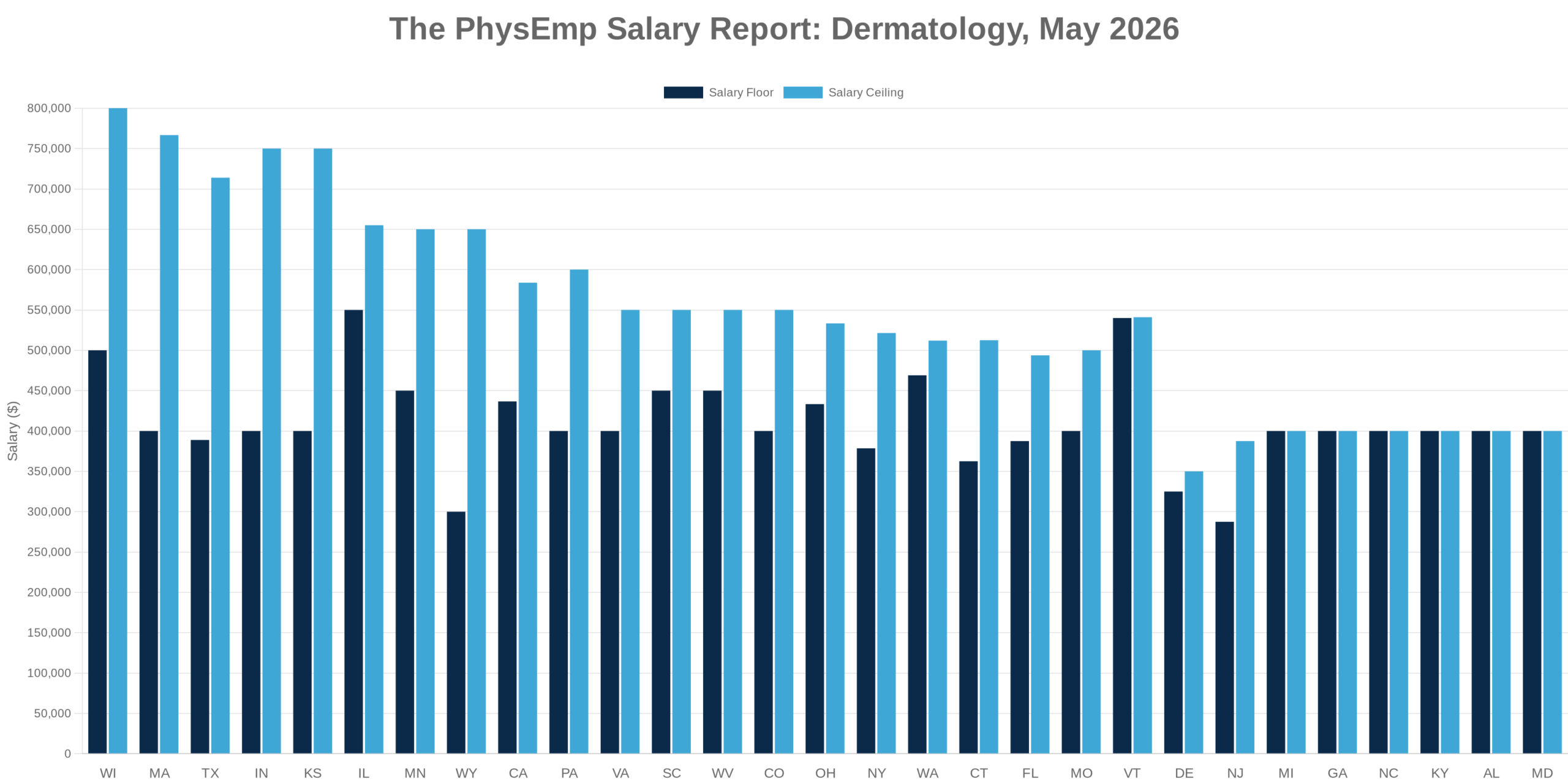
Somewhere in Wisconsin, a dermatologist is being offered $850,000 a year to look at skin. Somewhere else, presumably also in America, a dermatologist is being offered $100,000 to do the same job. Both listings are real. Both are in our dataset. Neither, apparently, requires a different medical degree. Across 290 active Dermatology listings spanning more than 40 states, the market reveals a specialty operating at the intersection of cosmetic demand, geographic scarcity, and an apparently bottomless willingness among employers to pay for someone willing to relocate. The thesis is simple: in Dermatology, compensation is less about credentials than about coordinates.
👉 Explore Dermatology job market insights and trends
The Dermatology Job Market at a Glance
Total listings: 290
Listings with salary data: 100
Full national range: $100,000 to $850,000
National average range: $417,140 to $575,380
The spread here is the story. An $750,000 gap between the floor and the ceiling is not noise — it is the entire market. The $100,000 figure almost certainly represents a part-time or hybrid arrangement (no full-time dermatologist in 2026 is accepting that number with a straight face), while the $850,000 ceiling reflects what happens when private equity, rural scarcity, and Mohs-level scope collide in the same job description.
The average floor of $417,140 tells you the realistic starting conversation. Anything below $400,000 should trigger questions, not signatures.
States represented: CA, TX, DE, WI, PA, OH, MI, IL, NY, MA, FL, GA, CT, MN, NC, SC, KY, WA, IN, KS, VA, NJ, MO, CO, WV, LA, AZ, VT, AL, NH, ND, ID, SD, OR, TN, NE, MD, IA, WY, AK, ME, RI.
👉 Browse Dermatology physician job opportunities
How States Stack Up
Overperformers
- Wisconsin: Average range of $500,000 to $800,000 — the highest-paying state in the country, and it is not particularly close.
- Massachusetts: $400,000 to $766,667, with a ceiling that quietly punches above its Boston-coded reputation.
- Illinois: $550,000 to $655,000, the most consistently high-paying state in the dataset.
- Texas: $388,889 to $713,889, where the upper end is national-elite even if the floor wobbles.
- Vermont: $540,000 to $541,000 from a single listing — narrow, but firmly above average.
- Indiana and Kansas: Both report ranges up to $750,000 from single listings (small sample, large signal).
- Minnesota: $450,000 to $650,000.
Near-Average
- Virginia: $400,000 to $550,000, textbook benchmark.
- Pennsylvania: $400,000 to $600,000, a solid mid-market.
- Ohio: $433,333 to $533,333, predictable in the best sense.
- Washington: $469,000 to $512,000, tight band, stable market.
- California: $436,667 to $583,750, remarkable given the volume.
- West Virginia and South Carolina: Both around $450,000 to $550,000.
- Colorado: $400,000 to $550,000.
- Missouri: $400,000 to $500,000.
- Georgia, North Carolina, Alabama, Kentucky, Maryland, Michigan: All cluster at flat $400,000 reports — benchmark floor, no upside disclosed.
Underperformers
- New Jersey: $287,500 to $387,500 — the entire range sits below the national floor.
- Delaware: $325,000 to $350,000, the most compressed range in the dataset.
- Connecticut: $362,500 to $512,500, trailing every other Northeast market.
- New York: $378,571 to $521,429, a below-average floor that deserves scrutiny given the cost of living.
- Wyoming: $300,000 to $650,000 — the widest single-state spread in the country, which is its own kind of warning label.
Volume leaders: California (48), New York (24), Florida (18), Texas (16), Illinois (16), Massachusetts (14), Pennsylvania (12), Connecticut (12), North Carolina (12), Wisconsin (11).
Florida deserves a flag: 18 listings, but an average range of $387,500 to $493,750 — high volume, below-average pay. Illinois is the inverse: mid-tier volume, top-tier compensation.
👉 Compare Dermatology compensation and opportunities by region
What This Means If You’re a Physician
If your priority is maximum compensation: Wisconsin and Texas. The highest disclosed listing in the dataset is $850,000, associated with both states. Wisconsin’s average ceiling of $800,000 across six salary-reported listings is not a fluke — it is the market.
If your priority is maximum optionality: California (48 listings), New York (24), and Florida (18). California is the rare volume leader that also pays competitively. New York and Florida offer depth, but you are accepting a below-average floor in exchange for density — and in Manhattan, that math is worth running twice.
If your priority is balance: Illinois. Sixteen listings, an average range of $550,000 to $655,000, and a cost-of-living profile that is not Manhattan or coastal California. Massachusetts and Wisconsin also qualify, with the caveat that Boston cost-of-living eats into that $766,667 ceiling faster than it should.
Cost-of-living flags: New York and New Jersey both pay below the national floor while sitting in two of the most expensive metro areas in the country. Run the net number before the gross one.
👉 Search Dermatology jobs by location and compensation
What This Means If You’re a Recruiter
Salary transparency rate: 100 of 290 listings disclosed compensation. That is 34.5%.
Two-thirds of Dermatology listings are asking candidates to inquire — which, in a specialty where physicians have leverage and inboxes full of options, is a pipeline tax. The candidates with the most options are the ones least willing to email for a number.
Volume-pay misalignments are concentrated in three markets: Florida (18 listings, $387,500 to $493,750), New York (24 listings, below-floor average), and New Jersey (7 listings, the lowest range in the dataset). Recruiters in these states cannot lead with money. They will need to lead with patient mix, partnership track, equity, schedule flexibility, or cosmetic procedure volume — anything that translates into lifestyle or upside the salary line cannot.
Wisconsin, Illinois, and Texas recruiters have the opposite problem: they should be leading with the number, loudly, and they often are not.
👉 Post Dermatology positions on PhysEmp
What’s Driving the Numbers
Scope and scarcity command the premium. The $850,000 ceilings in Wisconsin and Texas are not happening in dense urban markets. They are happening where dermatologists are scarce, Mohs-capable physicians are scarcer, and health systems have stopped pretending they can recruit at metro rates. Scarcity pricing is the dominant force at the top of this market.
Part-time roles are distorting the floor. The $100,000 listing is real, but it is not a full-time offer at full-time scope. The same is likely true for several of the flat $400,000 single-listing reports clustered across Georgia, North Carolina, Alabama, and Kentucky — these are floor numbers, not range midpoints, and they pull the national average downward in ways that misrepresent the actual full-time market.
Underserved markets price in scarcity — unevenly. Wyoming’s $300,000 to $650,000 spread is the cleanest example: one listing, $350,000 of variance, depending entirely on what the employer is asking for. Vermont, West Virginia, and Kansas all show above-average ceilings from single listings. Rural Dermatology is a sellers’ market, but only if the seller knows it.
The volume-pay relationship breaks in the Northeast. California holds the line: high volume, competitive pay. New York, New Jersey, Connecticut, and Florida do not. In those markets, supply has caught up with demand, and compensation has compressed accordingly. Geography is doing more work than specialty here.
The Bottom Line
Dermatology in 2026 is a specialty where the average floor sits north of $400,000, the ceiling reaches $850,000, and the difference between the two is largely a question of zip code. The coasts offer volume and prestige but compress on pay. The Midwest and selected rural markets are quietly writing the largest checks in the specialty. And one-third of employers are still hiding the number, which in a candidate-driven market is its own form of self-sabotage.
In Dermatology, the money is not in the skin — it is in the map.
👉 Browse all Dermatology physician jobs
👉 Upload your CV to get matched with opportunities
👉 Set alerts for new Dermatology roles
Salary data based on 100 listings with disclosed compensation. Figures may reflect part-time or specialized roles. This report is informational and should not replace professional judgment or financial planning.