
Somewhere in Prosser, Washington — a town better known for wine grapes than wire-guided catheters — a hospital is willing to pay a cardiologist up to $835,000 a year. That is the current ceiling of the U.S. Cardiology market, and it is not in Manhattan, Boston, or Chicago. It is in a town of roughly 6,000 people. Across the country, PhysEmp tracked 292 active Cardiology listings spanning 47 states, with compensation ranging from $233,388 to that eye-watering Prosser figure. The thesis: in Cardiology, the heart of the money is rarely where the heart of the volume is.
👉 Explore Cardiology job market insights and trends
The Cardiology Job Market at a Glance
Total listings: 292
Listings with salary data: 66
Full salary range: $233,388 to $835,000
National average range: $476,960 to $549,387
The spread is enormous — a delta of roughly $600,000 between the floor and the ceiling. That is not a market; that is two markets wearing the same lab coat. The average range itself is comfortably above what most specialties command, which tracks for a field where the patients tend to be acutely motivated to keep their appointments.
States represented: New York, Illinois, Maryland, Washington, New Jersey, Nevada, Minnesota, California, Connecticut, Missouri, Colorado, Kentucky, Wisconsin, Ohio, Delaware, Vermont, New Hampshire, Florida, Indiana, Alabama, Kansas, Oregon, North Carolina, Pennsylvania, Nebraska, Arizona, Alaska, Texas, Maine, West Virginia, Idaho, Oklahoma, New Mexico, Mississippi, Massachusetts, Georgia, South Dakota, Michigan, Tennessee, South Carolina, Montana, Louisiana, Virginia, North Dakota, Arkansas, Iowa, Utah, and Wyoming.
👉 Browse Cardiology physician job opportunities
How States Stack Up
Overperformers
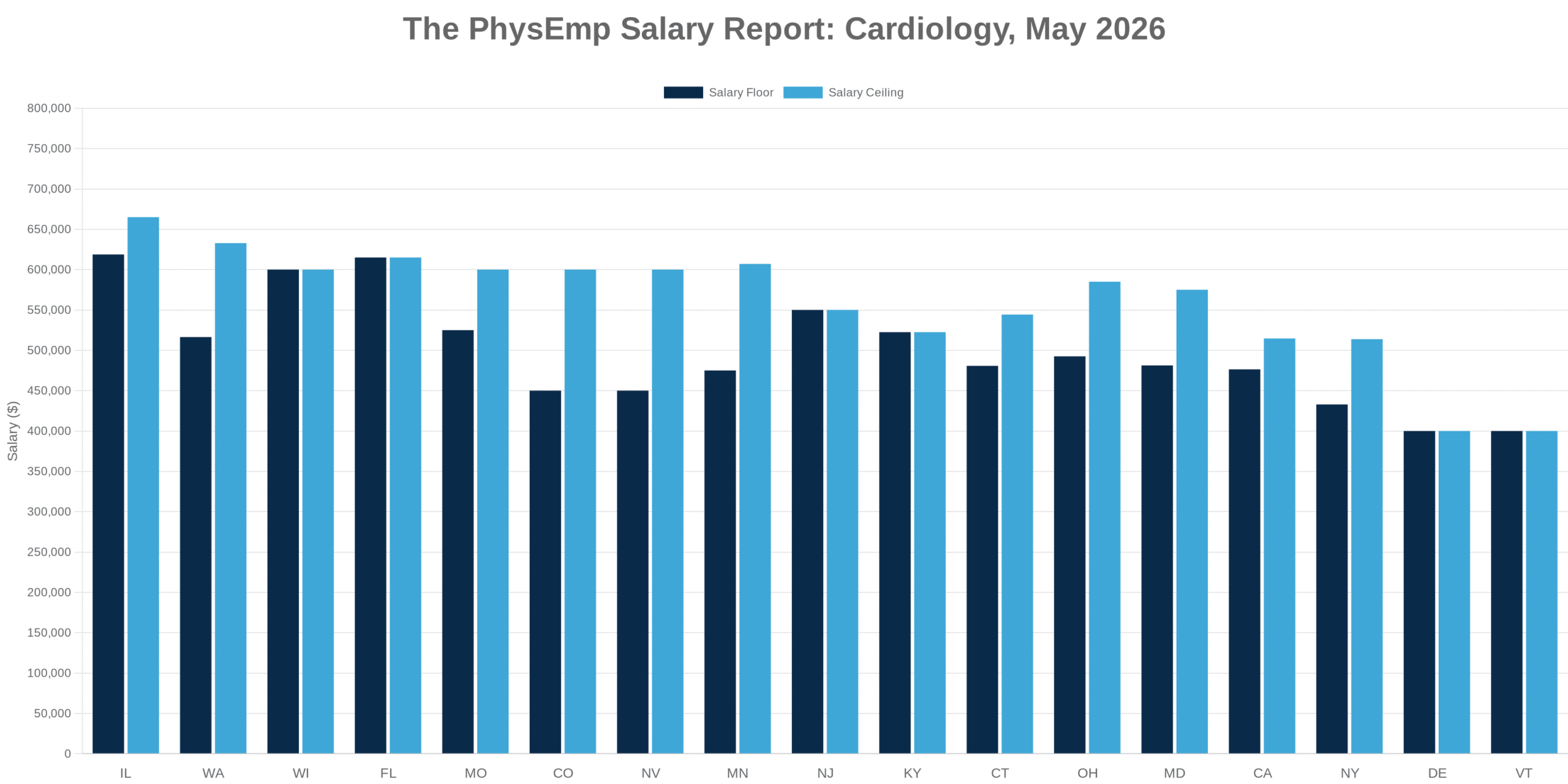
- Illinois: Leads the nation with an average range of $618,750 to $665,000 across four salary-disclosed listings — small sample, big number.
- Florida: Posts a $615,000 average, though built on a single disclosed listing among 15 (asterisk noted).
- Wisconsin: $600,000 average from one listing — directionally bullish, statistically lonely.
- Washington: $516,400 to $632,800 across five disclosed listings, the most credibly high-paying market in the dataset.
- Missouri: $525,000 to $600,000, two disclosed listings.
- Nevada: $450,000 to $600,000 from a single listing, but the high end is real.
- Minnesota: $475,000 to $607,044 across two listings, sneaking into premium territory.
- New Jersey: A single $550,000 listing, lonely but lucrative.
Near-average
- California: $476,400 to $514,625 across five listings — exactly average pay, decidedly above-average rent.
- Connecticut: $480,714 to $544,286 across seven listings, the closest thing to a benchmark in this report.
- Maryland: $481,250 to $575,000, four listings, comfortably mid-pack.
- Kentucky: $522,500 flat, two listings.
- Ohio: $492,500 to $585,000, two listings.
- Colorado: $450,000 to $600,000, one listing.
Underperformers
- Delaware: $400,000 average — about $77,000 below the national low-end benchmark.
- Vermont: Also $400,000, also one listing, also a long winter.
- New York: $432,899 to $513,781 — the highest-volume state in America, paying below the national average.
Volume leaders: New York (30), Washington (16), Florida (15), Arizona (13), California and North Carolina (12 each), Connecticut (11), Indiana, New Mexico, Massachusetts, Georgia (9 each), Tennessee (8). New York sits atop the volume chart and below the salary average — a familiar pattern. Washington is the rare state that combines volume and pay, which is why it deserves a star next to its name.
👉 Compare Cardiology compensation and opportunities by region
What This Means If You’re a Physician
If your priority is maximum compensation: Look hard at Prosser, WA, where a single listing tops out at $490,000 to $835,000 — the national ceiling, located in a town most coastal physicians could not find on a map. Illinois, Wisconsin, and the upper end of Washington and Minnesota all offer realistic paths to $600,000-plus.
If your priority is maximum optionality: New York posts 30 listings, more than any other state. The trade-off is compensation that runs roughly $40,000 below the national average low — and a cost-of-living delta that is, to put it gently, unkind. Brooklyn listings as low as $300,000 to $325,000 should be scrutinized accordingly.
If your priority is balance: Washington is the answer. Sixteen listings, an average high of $632,800, and scenery that does not require a parking garage.
👉 Search Cardiology jobs by location and compensation
What This Means If You’re a Recruiter
Salary transparency rate: 66 of 292 listings disclosed compensation, or 22.6%. That means roughly three out of four Cardiology postings ask candidates to inquire — a posture that worked in 1994 and works less every year. Pipeline implications are direct: high-earning candidates increasingly filter by disclosed pay, and opaque listings simply do not surface in their search.
The biggest misalignment is New York. Thirty listings, sub-average pay, and the highest cost-of-living in the dataset. Recruiters in NY, DE, and VT will need to lead with case mix, call structure, academic affiliation, partnership track, or lifestyle — because the comp line will not carry the pitch on its own.
👉 Post Cardiology positions on PhysEmp
What’s Driving the Numbers
Scope and setting command the premium. The $835,000 ceiling in Prosser is not a metro phenomenon; it is a scarcity-and-scope phenomenon. Rural and small-market hospitals are paying interventional-tier compensation to secure coverage that larger systems take for granted. The premium is for being the cardiologist, not a cardiologist.
Small samples inflate the top. Florida, Wisconsin, Nevada, and New Jersey each post averages above $550,000 built on a single disclosed listing. Those numbers are real, but they are not yet a market — they are a data point with ambition. Washington’s average is more credible because it survives five listings instead of one.
Underserved markets price in scarcity. The states paying at or near the top — Illinois (outside Chicago), Washington (outside Seattle), Missouri, Wisconsin — share a pattern. Cardiology demand is not concentrated in big cities; it is concentrated where aging populations meet thin specialist supply. The money follows the gap.
The volume-pay relationship breaks cleanly. New York leads volume and trails pay. Illinois leads pay and trails volume. Only Washington meaningfully holds both. For Cardiology, the inverse correlation is real enough to plan a career around.
The Bottom Line
Cardiology in 2026 is a high-paying specialty with two distinct economies: a metropolitan market with abundant openings and modest premiums, and a scarcity market in mid-sized and rural geographies where the right candidate can clear $700,000 without a celebrity patient list. The volume is in New York. The money is in Prosser.
In Cardiology, the highest bidder is rarely the loudest city.
👉 Browse all Cardiology physician jobs
👉 Upload your CV to get matched with opportunities
👉 Set alerts for new Cardiology roles
Salary data based on 66 listings with disclosed compensation. Figures may reflect part-time or specialized roles. This report is informational and should not replace professional judgment or financial planning.