
PHYSICIAN JOB MARKET ANALYSIS REPORT: INTERNAL MEDICINE
(PhysEmp Market Intelligence | physemp.com)
THE HOOK
Somewhere in Oklahoma, an Internal Medicine physician is being offered $170,000 to manage the chronic conditions of an entire town. Somewhere in Louisiana, another is being offered $465,000 to do roughly the same thing. Both jobs are listed on the same national board, in the same specialty, in the same calendar year. Across 1,415 active Internal Medicine listings — 442 of them with disclosed compensation — the spread between the floor and the ceiling is wider than the GDP of several small nations (figuratively, but only barely). The data shows an Internal Medicine market that is enormous, geographically scattered, and priced with a logic that occasionally borders on whimsical.
THE NATIONAL SNAPSHOT
Total listings: 1,415
Listings with salary data: 442
Full salary range: $120,000 to $600,000
National average range: $260,915 to $299,211
Concentrated band: $220,000 to $375,000
The headline number is the spread. A $480,000 gap between the lowest and highest disclosed salary in a single specialty suggests that “Internal Medicine physician” is less a job title than a category of jobs that happen to share a board certification.
The average range is tighter and more honest. Most Internal Medicine physicians with disclosed salaries are landing somewhere between $260,915 and $299,211 — a respectable, if not glamorous, middle.
States represented in the dataset: Georgia, California, North Dakota, Indiana, Connecticut, Massachusetts, New York, Virginia, Colorado, Florida, North Carolina, Kentucky, Maine, Texas, Vermont, Illinois, South Carolina, Louisiana, Nevada, Iowa, Alabama, Washington, Maryland, New Hampshire, Ohio, New Mexico, Tennessee, Wisconsin, New Jersey, Pennsylvania, Oklahoma, Missouri, Wyoming, Arizona, Michigan, Rhode Island, South Dakota, Mississippi, Oregon, Arkansas, Hawaii, Utah, Idaho, West Virginia, Montana, Kansas, Nebraska, Minnesota, Alaska, and the District of Columbia.
STATE BY STATE
Overperformers:
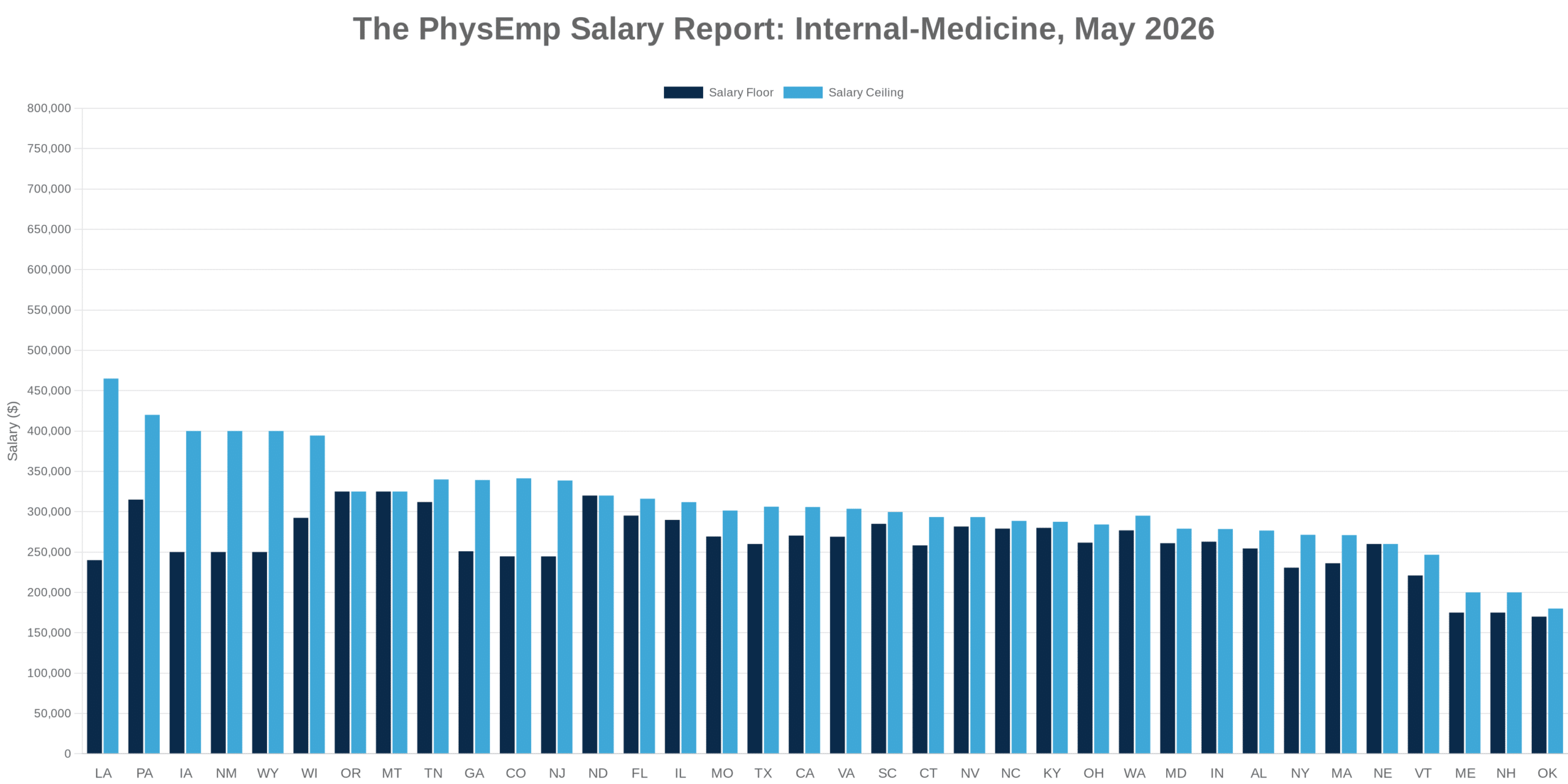
Louisiana ($240,000–$465,000) leads on the high end, though the spread is wide enough to suggest a single outlier is doing a lot of work. Pennsylvania ($315,000–$420,000) is the most consistently generous market in the dataset. Wisconsin ($292,400–$394,400) quietly outperforms states twice its size. Tennessee ($312,000–$340,000) pays like a coastal market without behaving like one. North Dakota ($320,000 flat on both ends) offers the rare gift of compensation certainty. Oregon and Montana ($325,000 each) suggest the Pacific Northwest and the Mountain West have noticed they need internists. Colorado ($244,667–$341,333) and Illinois ($289,813–$311,875) round out the high tier. Florida ($295,188–$316,125) is the rare state that combines volume and pay.
Near-average:
Indiana ($262,857–$278,571), Maryland ($261,000–$279,000), Ohio ($261,667–$284,167), Missouri ($269,286–$301,429), Virginia ($269,000–$303,667), Connecticut ($258,291–$293,387), Texas ($259,999–$306,250), South Carolina ($285,000–$299,615), North Carolina ($279,091–$288,636), Alabama ($254,444–$276,667), Washington ($276,886–$295,079), Kentucky ($280,000–$287,500), Nevada ($281,667–$293,333), Georgia ($250,982–$339,273), Minnesota ($309,000), and Nebraska ($260,000) all sit close enough to the national average to function as benchmarks.
Underperformers:
Oklahoma ($170,000–$180,000) is the lowest-paying market in the dataset by a meaningful margin. Maine and New Hampshire ($175,000–$200,000 each) are tied for second-lowest and presumably hoping no one notices. Vermont ($221,000–$246,667) underperforms but at least clears the $200,000 mark. Massachusetts ($236,154–$271,000) and New York ($230,688–$271,375) underperform relative to their size, prestige, and cost of living — a recurring theme in the Northeast. New Jersey ($244,625–$338,675) splits the difference.
Volume leaders: California (179), New York (103), Florida (102), Connecticut (99), Texas (82), Massachusetts (76), Georgia (73), Indiana (47), North Carolina (46), South Carolina (42).
New York is the cleanest example of volume-pay misalignment in the dataset: 103 listings, average salary below the national floor.
FOR PHYSICIANS
If your priority is maximum compensation:
Look at Pennsylvania, Wisconsin, Tennessee, and Louisiana. The highest-paying individual listings identified nationally are in Atlanta, Georgia and Greeley, Colorado, both at $250,000 to $400,000 for full-time Internal Medicine roles. Crescent City, California ($312,000–$375,000) is the next tier. Greeley is not Aspen. Crescent City is not San Francisco. Cost-of-living arbitrage is doing real work here.
If your priority is maximum optionality:
California (179 listings), New York (103), and Florida (102) offer the deepest pools. Florida is the only one of the three where the pay matches the volume.
If your priority is balance:
Florida and Texas. Indiana, Missouri, and Virginia for predictable mid-market outcomes without the Northeast tax-and-rent penalty.
Worth scrutinizing: New York and Massachusetts post hundreds of listings at salaries that, after cost of living, function as a pay cut. Warrenton, Virginia ($194,000–$252,000) and Freeport, New York ($220,000–$240,000) are the lowest disclosed listings — read the scope language carefully.
FOR RECRUITERS AND HEALTHCARE EXECUTIVES
Salary transparency rate: 442 ÷ 1,415 = 31.2%.
Roughly seven out of ten Internal Medicine listings disclose no compensation at all. In a specialty where the disclosed range spans $480,000, candidate skepticism is not a bug — it is the rational response. Pipelines narrow when physicians have to guess.
The volume-pay misalignment is most acute in New York, Massachusetts, and Connecticut: deep listing counts, sub-average pay, expensive geography. Recruiters in those markets cannot lead with compensation. Lead with academic affiliation, schedule structure, patient panel size, loan forgiveness, or anything that does not require a calculator and a tax accountant.
Arizona, Michigan, Mississippi, and South Dakota collectively post 89 listings with zero disclosed salaries. That is not transparency. That is a black box.
MARKET FORCES
Geography prices in scarcity, but only sometimes.
North Dakota, Montana, Oregon, and Tennessee all clear $320,000+ averages with modest listing counts — a rural premium that behaves the way economic theory says it should. Oklahoma and Maine, equally rural and equally underserved, do not. Scarcity pricing in Internal Medicine is real but inconsistent, which suggests employer behavior matters as much as market conditions.
The Northeast underprices its own desirability.
New York, Massachusetts, Connecticut, Vermont, Maine, and New Hampshire all sit at or below the national average. The region’s hospital systems appear to be pricing in the assumption that physicians will accept less to live there. The volume of listings suggests they are not entirely wrong, but the gap between cost of living and compensation is the widest in the country.
Salary spreads are signaling part-time and scope variation.
Louisiana’s $240,000–$465,000 range and Iowa’s, New Mexico’s, and Wyoming’s identical $250,000–$400,000 ranges (each from a single listing) almost certainly reflect a mix of part-time, hospitalist, and leadership roles being averaged together. The $120,000 floor in the national dataset is almost certainly part-time. The $600,000 ceiling is almost certainly leadership or productivity-heavy.
Volume does not equal pay.
California, New York, Connecticut, and Massachusetts collectively account for 457 listings — nearly a third of the market — at compensation levels that range from average to underwhelming. Florida is the lone high-volume state where the pay keeps up. The takeaway: the biggest markets are biggest because they have the most hospitals, not because they pay the most.
THE BOTTOM LINE
Internal Medicine is the largest, broadest, and most geographically diffuse specialty on the board, and the data reflects exactly that: a market where the same credentials can earn $170,000 in Oklahoma or $600,000 somewhere with a leadership title attached. Volume is concentrated on the coasts. Pay is concentrated almost everywhere else. Transparency is concentrated nowhere.
Internal Medicine pays the middle reliably, the top selectively, and the bottom shamelessly — and three out of every ten employers will tell you which one before you apply.
Salary data based on 442 listings with disclosed compensation. Figures may reflect part-time or specialized roles. This report is informational and should not replace professional judgment or financial planning.