
This analysis synthesizes sources published the week ending August 8, 2026. Editorial analysis by the PhysEmp Editorial Team.
Health systems are deploying ambient AI scribes, automated inbox management, and patient-facing interpretation tools at unprecedented scale—and the compensation structures built around physician time are struggling to keep pace. What began as efficiency pilots has turned into a systemwide renegotiation of what counts as physician productivity, with direct implications for Physician Compensation & Demand. Contracts and pay models are being tested in real time.
The Productivity Paradox: More Throughput, Same RVU Framework
Veterans Affairs has rolled out AI medical scribes across clinical operations. The Pentagon is doing the same in military treatment facilities. Cleveland Clinic is building what it calls a “new primary care workforce” that pairs AI with dedicated “inboxologist” roles. And the country’s largest health system is scaling ambient AI at speed—these tools have left pilot mode.
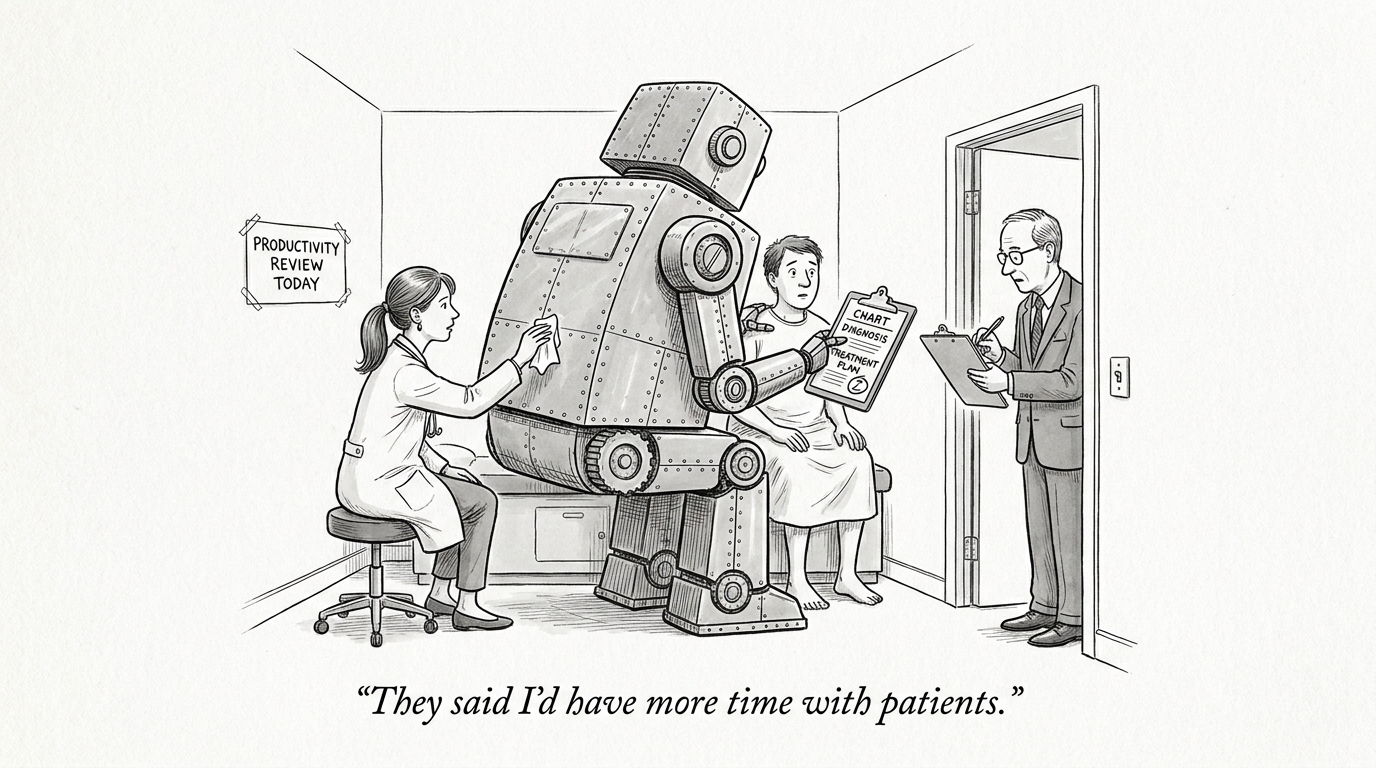
If AI scribes trim documentation time by 30–40%, physician encounter capacity goes up. RVU-based pay, though, was built around a world where documentation ate a lot of each visit. Systems that capture those time savings face a choice: expect higher volume with the same RVU targets, or reset productivity benchmarks and pay formulas. The short-term result is obvious; who benefits depends on contract language and local market dynamics.
Physicians on productivity models tied to collections or visit volume could see faster documentation boost take-home pay—if demand fills those slots. In capped panels or fixed schedules, faster notes just let systems push more appointments into the same day, and per-encounter pay can feel smaller.
Inbox Management and the Unbundling of Physician Work
HSHS discovered that AI alone couldn’t fix the in-basket crisis. The fix required new workflows and new support roles—a reminder that AI often moves tasks around rather than making them disappear.
Cleveland Clinic’s “inboxologist” experiment is a clear example: work that lived inside physician time is being carved out and handed to others. That can free clinicians from unpaid administrative labor, but it also changes what employers count as clinician productivity. Physicians who can show that their clinical judgment—distinct from routine message triage—adds measurable value gain bargaining power. Those whose value rested partly on handling the full scope of patient communication may lose part of that implicit premium. Expect candidates to ask about AI deployment and inbox support during hiring talks; these are compensation-adjacent items now.
Patient AI Use as a Consultation Variable
Patients increasingly show up having already queried AI about test results or symptoms—sometimes before the physician has seen the same data. The Wall Street Journal captured clinician frustration with this shift; patient behavior is unlikely to reverse.
These visits are different. Some take less time because basic findings have already been explained by a chatbot; others take longer because the clinician must untangle AI-generated misunderstandings or address alarms the patient now believes. If encounters with AI-primed patients routinely require extra time to correct or contextualize AI output, standard productivity measures stop matching clinical reality.
Liability and the Clinical Judgment Premium
Automation bias is cropping up: when AI supplies draft notes, suggested diagnoses, or treatment plans, clinicians face pressure—explicit or implicit—to accept algorithmic output. Several physician commentators worry that this will erode autonomy rather than enhance it.
Liability follows. If malpractice systems hold physicians responsible for AI-assisted errors, the risk profile of practice changes. Many contracts don’t yet address indemnity for AI-related harms. Negotiations increasingly need to cover who bears what risk when an algorithm contributes to care decisions.
Enterprise Platforms and Employer Power
Doximity’s move into hospital enterprise AI platforms points to consolidation. As systems standardize on particular vendors, opting out becomes harder. Employers can require AI tools while capturing any productivity gains those tools enable.
That matters for job-seeking physicians. Some will favor employers where AI and inbox support reduce paperwork. Others will prefer settings that delay adoption and preserve older practice rhythms. The pay premium—if any—for AI-heavy workplaces hasn’t settled. That uncertainty creates opportunities for physicians who can make clear what they want.
Recruiters should expect AI tool provisions to appear in offers more often. Signing bonuses and base guarantees may need to account for productivity assumptions tied to AI—assumptions that are risky if tools underperform or arrive late. Those gaps are contract risks neither side prices well yet.
What Remains Unresolved
AI is deploying faster than compensation schemes are adapting. RVU frameworks, productivity benchmarks, and malpractice norms reflect workflows that are changing underfoot. Health systems are reaping near-term efficiency; physician bargaining power will shift as markets learn to price AI-augmented productivity.
Some physicians are already carving AI clauses into new contracts—productivity floors, gain-sharing, liability carve-outs. Others are waiting, figuring current terms will hold. Both moves are bets. And somewhere between an offer letter and a signed start date, someone will have to explain whether a promise about “AI efficiency” was a deliverable or a sales pitch.
Sources
Cleveland Clinic is building a new primary care workforce powered by AI, ‘inboxologists’ and more – Becker’s Hospital Review
Doctors Don’t Want Patients to Read Test Results With AI. They’re Doing It Anyway – The Wall Street Journal
Patients are consulting AI before their physicians – Becker’s Hospital Review
The Benefits and Hidden Costs of AI Scribes – Healthcare Brew
When AI Helps — What Happens to Clinical Skills? – Medscape
Opinion: AI Won’t Enhance Physician Autonomy — It Will Further Diminish It – STAT
In-basket management is a killer: What HSHS did when AI couldn’t fix the whole problem – Becker’s Hospital Review
Doximity bets big on hospital enterprise AI platforms as it ramps tech investment – Fierce Healthcare
Pentagon rolls out AI medical scribe in clinical care – GovCIO Media & Research
How the country’s largest health system is scaling ambient AI at speed – Becker’s Hospital Review
Automation bias in medicine already has doctors deferring – KevinMD
Clinical Judgment Is What Turns Information Into Medicine – KevinMD
How AI can educate patients and strengthen physician-patient relationships – Becker’s Hospital Review