
PHYSICIAN JOB MARKET ANALYSIS REPORT: NEPHROLOGY
(PhysEmp Market Intelligence | physemp.com)
THE HOOK
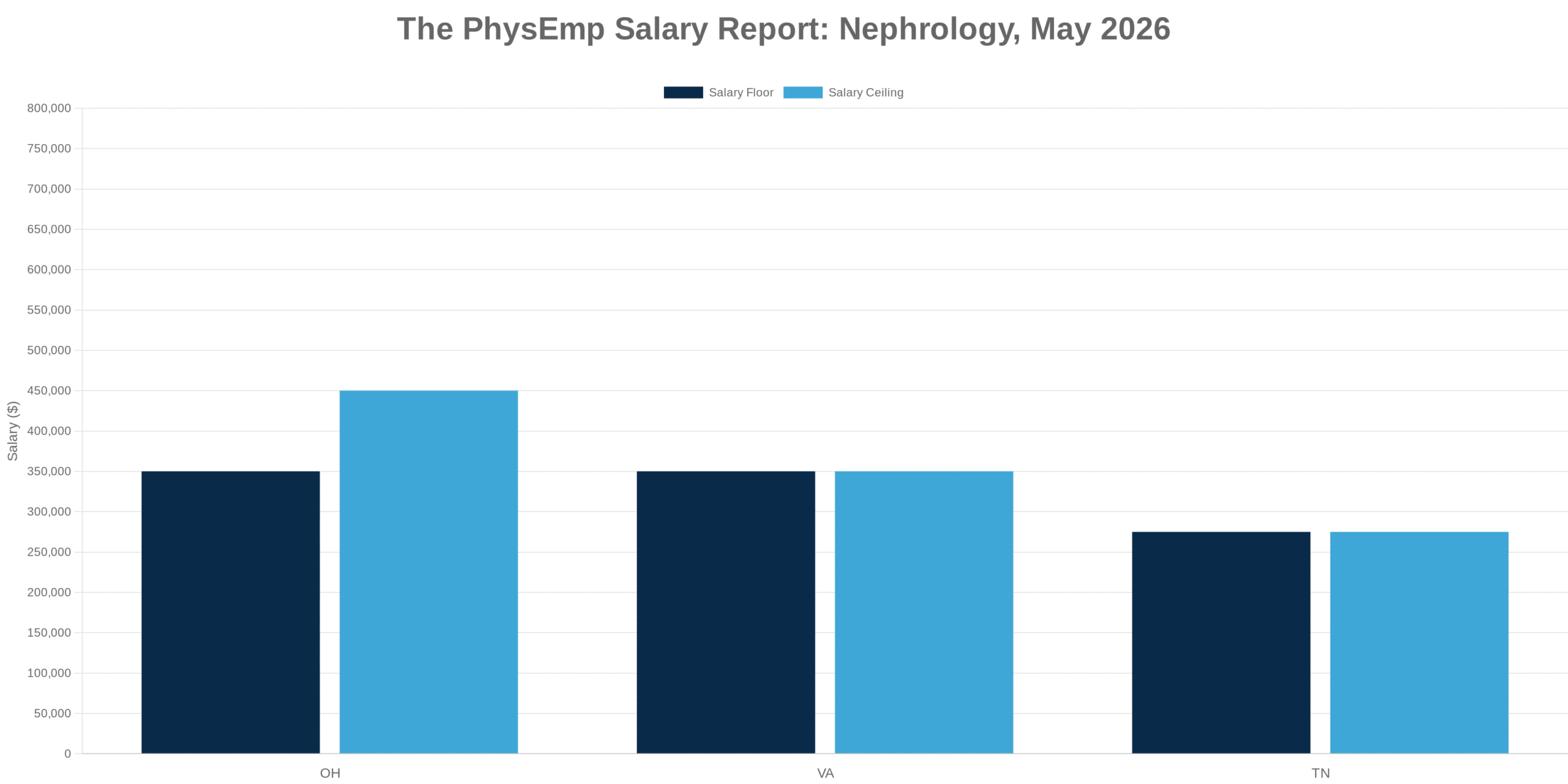
Three. Out of forty-nine. That is the number of Nephrology listings willing to put a salary figure in writing — a transparency rate that would make a kidney blush, if kidneys could blush. The rest of the market prefers the time-honored tradition of “competitive compensation, inquire within,” which is recruiter-speak for “let’s see what you’ll accept.” Across 21 states, the documented numbers swing from $275,000 to $450,000, a $175,000 spread built on a sample size smaller than a fellowship cohort. The thesis: Nephrology demand is broad, geographically scattered, and almost entirely opaque on pay.
THE NATIONAL SNAPSHOT
Total listings: 49
Listings with salary data: 3
Full salary range: $275,000 – $450,000
Average salary range: $325,000 – $358,333
Forty-nine jobs. Three salaries. The math is the story.
The states represented: Tennessee, Kentucky, Illinois, Pennsylvania, New Mexico, California, Nevada, Ohio, Texas, Indiana, Virginia, Missouri, Maryland, South Carolina, Arizona, Louisiana, Wisconsin, Oklahoma, New Jersey, Florida, and Georgia.
The disclosed range is wide because it has to be — three data points cannot form a tight cluster, only a triangle. Ohio anchors the top at $450,000. Virginia sits in the middle at $350,000. Tennessee defines the floor at $275,000. Everything else in this market is a black box, which is not unusual for a subspecialty where comp packages depend heavily on call structure, dialysis rounding volume, and whether the practice owns its own access center (the answer to that last one tends to move the number considerably).
STATE BY STATE
Overperformers:
Ohio — $350,000 to $450,000 across three listings, the only state combining volume and disclosure, and the clear standout.
Virginia — $350,000 flat for a Transplant Nephrologist role in Western Virginia, proving subspecialty scope still moves the needle.
Near-average:
Virginia again sits at the lower bound of the national range, functioning as the unofficial benchmark for what “normal” looks like in this specialty.
Underperformers:
Tennessee — $275,000, a full $50,000 below the average floor, and the only documented data point in a state with four open roles.
Volume leaders: Kentucky (5), California (5), Tennessee (4), Wisconsin (4), Ohio (3), Indiana (3), Maryland (3). Kentucky and California tie for the most listings and disclose precisely zero dollars between them. Tennessee leads on volume in the Southeast and posts the lowest disclosed number nationally — a pairing recruiters there will want to think about.
FOR PHYSICIANS
If your priority is maximum compensation: Ohio. The highest-paying listing in the country is a Nephrology position in Ohio at up to $450,000 annually, and Ohio is the only state where high volume and transparent pay coexist. Cost of living is reasonable. The math is clean.
If your priority is maximum optionality: Kentucky and California, tied at five listings each. Neither discloses salary, which means you will negotiate blind — and in California’s case, against a cost-of-living curve that can quietly erase a $400,000 offer.
If your priority is balance: Virginia. The Transplant Nephrologist role at $350,000 in Western Virginia offers subspecialty work, a benchmark salary, and a region where the dollar still stretches. Scrutinize Tennessee carefully — four listings, one disclosure, and that disclosure is the lowest in the country.
FOR RECRUITERS AND HEALTHCARE EXECUTIVES
Salary transparency rate: 3 ÷ 49 = 6.1%.
That is not a typo. Ninety-four percent of Nephrology listings on the market right now do not show a number, which means candidate pipelines are running on inference, rumor, and the occasional LinkedIn DM. Physicians who have done their homework will assume the silence is strategic — and they will assume the worst.
The misalignment is structural: Kentucky and California lead on volume but lead on nothing else a candidate can see. Recruiters in those markets cannot lead with comp because there is no comp to lead with. Lead instead with case mix, call burden, partnership track, and dialysis ownership economics. Nephrologists know where the real money lives. Pretend they don’t at your peril.
MARKET FORCES
Subspecialty scope commands a premium, quietly. The Transplant Nephrologist role in Western Virginia hitting $350,000 is not an accident. Transplant work is a different animal — different training, different call, different referral economics — and even in a low-disclosure market, the number floats up to meet the scope. Expect that pattern to hold wherever transplant programs are hiring.
The disclosure floor is doing real damage. Tennessee’s $275,000 is the only number in a four-listing state, which means it sets the entire perception of that market whether it should or not. One listing should not define a state. It is, however, defining this one.
Underserved markets are not pricing in scarcity — at least not visibly. Kentucky and Wisconsin have nine listings between them and zero disclosed salaries. If scarcity premiums exist there, they are being negotiated in private, which favors the practice and disadvantages the candidate.
The volume-pay relationship is broken, or hidden. Ohio is the only state where volume and disclosed pay correlate cleanly. Everywhere else, the two variables refuse to be in the same room. Until disclosure rates rise, the relationship cannot be measured — only suspected.
THE BOTTOM LINE
Nephrology in 2026 is a market with real demand, real geographic spread, and almost no willingness to put a price tag on either. Ohio is the bright spot — high volume, high pay, full disclosure — and the rest of the country is asking candidates to take a leap of faith on a specialty that already requires one. Physicians with leverage should use it. Recruiters without numbers should bring everything else.
Forty-nine kidney jobs, three disclosed salaries, and a market that would rather you ask than tell.
Salary data based on 3 listings with disclosed compensation. Figures may reflect part-time or specialized roles. This report is informational and should not replace professional judgment or financial planning.