
This analysis synthesizes 7 sources published the week ending Aug 27, 2026. Editorial analysis by the PhysEmp Editorial Team.
Hospitals have stopped treating advanced practice providers as a bridge to physician hiring. With 97% of facilities now planning to maintain or expand APP staffing permanently, according to a CHG Healthcare survey of 327 healthcare facility leaders, the staffing model that once filled gaps during physician searches has become the baseline infrastructure around which physician recruitment must now be planned. This shift carries direct implications for Physician Recruiting & Staffing Insights — not because physicians are being replaced, but because the economics, timelines, and bargaining dynamics of physician placement have changed.
The divergence is stark. Gastroenterology searches now stretch to a median of 186 days with $46,000 signing bonuses before an offer is made, while APPs are being locked into permanent roles within weeks. Nearly one in six U.S. physicians—about 17% of the workforce—has done locum tenens work, with participation hitting 35% in radiology and 21% in emergency medicine. At the same time, hospitals are bringing emergency departments back in-house to regain control over staffing. These facts sit together uneasily. Physician hiring has become slower and costlier just as hospitals have found alternative coverage they’re reluctant to give up.
The Real Cost of Extended Time-to-Fill
Reports usually treat shortages as a simple supply problem—too few physicians for open posts. That framing misses how vacancy stretches create compounding costs beyond lost clinic revenue. A gastroenterology vacancy that runs 186 days racks up locum bills of $150 to $263 per hour (as much as $16,000 weekly in high-demand states like Texas and North Carolina). Credentialing delays can add another three to six months before the replacement can bill. Medicare enrollment timelines create permanent write-offs for claims filed before the effective billing date.
The KevinMD analysis of physician notice periods highlights a blind spot: many practices see departures as a recruiting problem when they’re actually three parallel clocks—credentialing, payer enrollment, and revenue recognition. Payer enrollment commonly runs three to six months. Medicare’s effective billing date ties to the filing date, not the start date—so every week between a signed offer and a filed CMS-855I can mean unrecoverable revenue. A standard 90-day notice covers, at best, half of that non-billable window.
For recruiting leaders, acquisition costs must include signing bonuses and search fees plus the locum coverage gap, credentialing delay, and Medicare enrollment lag. Organizations that measure only time-to-fill are missing most of the bill.
Retention Strategy Divergence by System Size
The AAPPR’s 2026 retention report exposes a pattern few workforce stories emphasize. Smaller health systems—those with 200 or fewer physicians—lean on compensation as a retention lever 89% of the time, versus 67% among systems with more than 1,000 physicians. But pay alone isn’t solving the problem. Bigger systems report far higher use of mentorship (75% vs. 44%), career development pathways (75% vs. 44%), and peer support and well-being initiatives (92% vs. 56%).
AAPPR calls this a resource gap; a sharper reading is that smaller systems are bringing one tool—money—to a multi-dimensional retention challenge. Two-thirds of gastroenterologists say they’d accept lower pay for better work-life balance, according to Medscape. That makes a compensation-only playbook a structural disadvantage when recruiting and keeping specialty physicians.
Where This Hits Rural Markets Hardest
The split in APP investment deepens the problem for rural hospitals. Urban and rural facilities are heading in different directions on workforce strategy. Rural hospitals face the tightest APP staffing while often lacking non-pay retention tools. Wyoming’s physician-to-demand adequacy sits at 33%, Nevada at 48%, and Alaska and Montana at 50% each. In those markets, long time-to-fill doesn’t just cost money—it creates coverage gaps that APPs can’t fully close in specialties like gastroenterology.
Hospital-Owned Models Shift Control Dynamics
The move toward hospital-owned emergency departments is a related rearrangement of who controls physician work. In-House Medical reports health-system-owned physician groups now cover about one-third of emergency visits nationally. Hospitals are bringing EDs in-house to tighten alignment, improve transparency, and increase staffing flexibility—the same goals APP permanence has addressed in other service lines.
Physicians evaluating offers should expect different bargaining dynamics in hospital-owned service lines than in contracted staffing arrangements. The employer controls more variables and also bears more direct accountability for retention. Contract terms, governance, and clear career pathways matter more in those settings than they might under a staffing contract.
The Medicus finding that 17% of physicians have done locum tenens—with rates above 20% in emergency medicine, pathology, and gastroenterology—shows physicians adapting. Many treat locum work as a hedge against the instability of permanent jobs rather than a temporary stopgap. Organizations that see locums as just a short-term labor pool are missing a broader behavior shift.
The Credentialing Constraint Nobody Budgets For
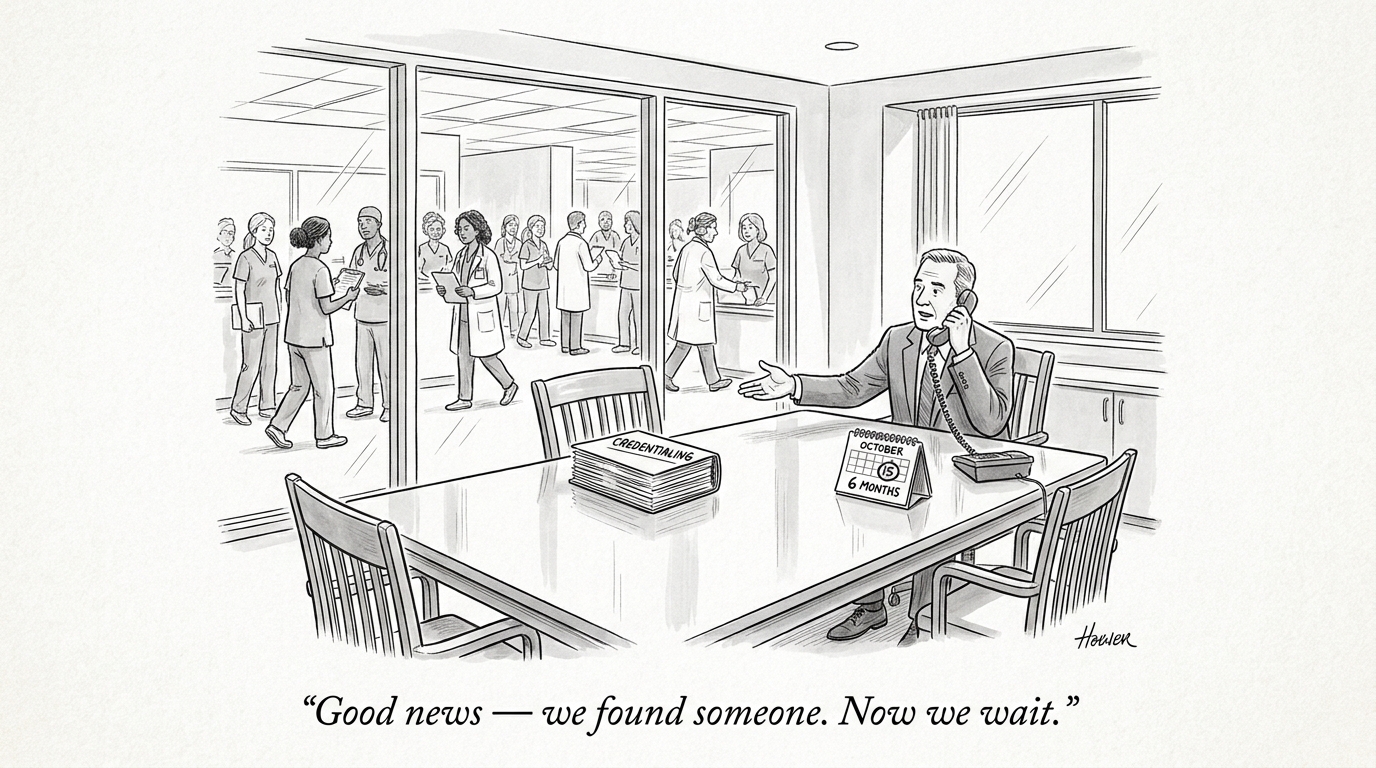
The revenue hole from physician departures doesn’t stop at the notice period. Commercial credentialing and payer enrollment for a physician joining a group commonly run three to six months, with the longer end normal for national networks and narrow-panel specialties. Even a 90-day notice covers, at best, half of that non-billable window—and only if a replacement is identified and signed the week the resignation lands on the desk.
Medicare rules make this worse. Under 42 CFR 424.520(d), the effective date of billing privileges is the later of the date the enrollment application was filed and approved, or the date the physician first began furnishing services. The 30-day retrospective billing allowance under 42 CFR 424.521(a)(1) applies only where circumstances prevented enrolling in advance—it is a conditional allowance, not an automatic grace period. Every week between a signed offer and a filed application becomes a permanent write-off.
Teams that treat credentialing as an afterthought are building revenue gaps into hiring. The filing date—not the approval date—is the only timeline the organization can control.
Looking Forward
APP staffing’s permanence doesn’t reduce physician demand; it reshapes physician roles. With 97% of hospitals locking in APP infrastructure, physician jobs are shifting toward higher complexity, greater autonomy, and higher pay—work APPs can’t take on. Yet the acquisition costs for those roles—186-day searches, $46,000 signing bonuses, six-month credentialing delays, and permanent Medicare gaps—are rising faster than most recruiting budgets.
Successful organizations will measure total acquisition cost, deploy non-pay retention tools no matter their size, and treat credentialing as part of recruiting rather than as an administrative afterthought. How many will make those changes before the next physician leaves and exposes the gap remains unsettled. It will look different in a rural ED than in a big system’s GI unit. It will be messy. It will involve people, paperwork, and politics.
Sources
97% of hospitals are locking in APP staffing for good — where does that leave physicians? – Medical Economics
The price of hiring a GI physician in 2026: 186 days and $46,000 upfront – Becker’s ASC Review
The changing physician workforce: What healthcare leaders need to know – Becker’s Hospital Review
The Physician Retention Gap – Becker’s ASC Review
Why Compensation Isn’t Enough to Keep Doctors – Medical Economics
The Revenue Gap: A Physician Notice Period Never Closes – KevinMD
Hospital-Owned Emergency Departments Gain Momentum as Hospitals Seek Greater Control and Sustainability – EIN Presswire