
This analysis synthesizes 9 sources published the week ending Aug 24, 2026. Editorial analysis by the PhysEmp Editorial Team.
Nearly half of employed physicians now say they would consider joining a union—a figure that would have seemed implausible five years ago. The 2026 PAI Employed Physician Survey finds 47% open to collective bargaining, with inadequate compensation (59%) and management issues (49%) driving the highest job-departure intent in recent memory. Yet the same week this data dropped, the Association for Advancing Physician and Provider Recruitment released findings showing only 39% of healthcare organizations have a formal, documented retention strategy. The collision of these two realities defines the current state of Physician Compensation & Demand: employers continue treating retention as an afterthought while physicians increasingly view collective action as the only lever capable of producing structural change.
The Ownership Vacuum
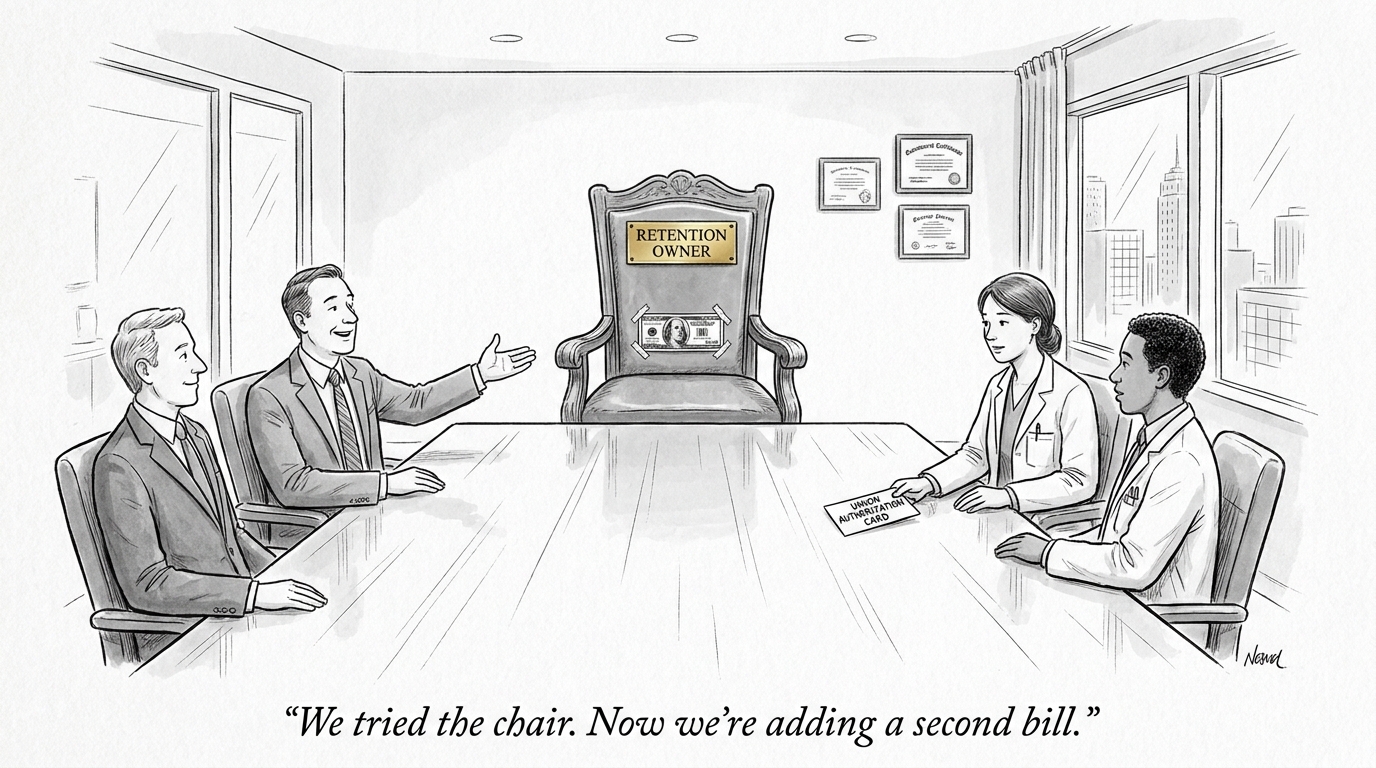
AAPPR’s 2026 retention report identifies a common failure: most organizations have no clear owner for physician retention. Programs exist—flexible scheduling, mentorship, wellness—but without documented goals, named accountability, or measured outcomes they stay tactical. “You can’t have a strategy if nobody owns it,” AAPPR CEO Carey Goryl told Medical Economics. Among organizations with 200 or fewer physicians, 51% rely on informal activities alone, and 89% lean on compensation as their primary retention tool—compared with 67% at systems with more than 1,000 physicians.
This produces a real cost asymmetry. Replacing a departing physician can exceed $1 million when you count recruitment fees, onboarding delays, locum coverage, and lost patient revenue. The investment to formalize retention—naming a champion, tracking cost-per-hire and days-to-fill, surveying clinical autonomy and EHR friction—is a small fraction of that. Smaller organizations often default to compensation because it avoids cross-functional work. That approach no longer moves the needle.
When 88% of employed physicians report some level of burnout and 44% are actively considering departure, the lack of a named retention owner becomes a structural vulnerability that worsens with every vacancy.
Why Pay Increases Fail to Retain
AAPPR data shows a gap between talk and action on pay. While 82% of organizations say compensation and benefits are part of their retention plan, only 53% report having concrete offerings in that category. “Competitive pay” often functions as a talking point rather than a benchmarked, regularly reviewed commitment. At the same time, physicians who once practiced independently are 67% more likely to cite loss of clinical autonomy as a reason for leaving—and they face non-compete agreements at higher rates (63% vs. 48%).
The employment shift is dramatic: in 2012, one in four physicians was employed; today, more than four in five are. Among physicians under 40, only about one in eight has ever worked in a physician-owned setting. This generation started their careers inside corporate employment and reports the highest burnout (36% at significant levels) and the greatest openness to unionization (51%). Pay bumps that ignore autonomy, workload, and voice won’t retain this cohort.
Unionization as an Economic Tool
The UC Doctors United campaign—nearly 10,000 physicians across the University of California system, including UCLA Health—represents the largest attending physician unionization effort in U.S. history. Organizers emphasize patient care over pay. “All the people involved in organizing this union, we don’t talk about money,” said Dr. Jacob Lentz, an attending physician in UCLA’s emergency department. “The only thing that people keep coming back to is patient care.”
Still, the mechanism physicians seek is economic. A union forces negotiation not only over compensation but also over how hospitals operate—staffing ratios, patient boarding protocols, clinical decision authority, and workload. At Banner Health in Phoenix, more than 240 primary care clinicians are voting on unionization after filing an unfair labor practice complaint that cites 15-minute visit windows, hours of unpaid administrative work, and turnover that harms continuity of care for over 500,000 patients annually. The vote results are expected September 2.
Physicians are treating unionization as a way to win formal input into operational decisions that affect both their work and patient outcomes.
The Autonomy Fault Line
The physicians most likely to leave corporate employment are those who remember what they lost. The 2026 PAI survey finds 35% of physicians with prior independent-practice experience cite lack of clinical autonomy as a departure driver—versus 21% of those who’ve never practiced outside a corporate structure. They’re also more likely to have patient-volume targets built into compensation (53% vs. 41%) and more likely to plan an exit from clinical practice entirely before retirement (20% vs. 12%).
For recruiters, this creates a segmentation problem. Doctors who joined systems for work-life balance, higher pay, or lower overhead may leave once they run into constrained autonomy, productivity targets, and limited input on operations. Retention approaches that suit physicians who’ve only known employment differ from those needed for physicians who chose employment after ownership. Systems that ignore that difference will keep cycling through costly replacements.
Where Retention Investment Actually Lands
Large systems have moved retention dollars into mentorship (75% vs. 44% at smaller organizations), career development pathways (75% vs. 44%), and peer support programs (92% vs. 56%). AAPPR frames this as a resource gap: many of these efforts require less capital than across-the-board pay increases. Smaller and rural hospitals could adopt similar tactics without matching big-system budgets, but doing so requires the cross-functional coordination and ownership most lack.
Clinical autonomy scores are similar across organization sizes (55%–67%), which suggests many treat it as a given rather than an active retention lever. Yet dissatisfaction concentrates among the physicians at highest risk of leaving. Organizations that document how clinical decision-making authority is preserved and create formal channels for physician input may find that approach more cost-effective than another round of signing bonuses.
September as a Test
The Banner Health vote on September 2 will show whether physician union momentum extends beyond academic centers into community-based corporate systems. A win would create Banner’s first physician union and Arizona’s first union representing physicians and advanced practice providers. UC Doctors United, still organizing, will need majority support and a petition to the California Public Employment Relations Board before formal recognition.
For health systems, the calculation is simple: formalize retention ownership now or bargain it away later. Formalizing means naming a champion, building a measurement framework, and enforcing cross-functional accountability. Bargaining means a legally binding contract that can limit operational flexibility for years. Physicians under 40—the group most open to unionization and actively job-hunting—will shape physician labor dynamics for the next two decades. How that plays out depends on choices made in executive suites this quarter.
Sources
How to tell when physician retention gets more lip service – American Medical Association
‘Someone needs to own the retention strategy’: Keeping physicians on the job — or not – Medical Economics
The Physician Retention Gap – Becker’s ASC Review
On Days to Fill, Cost to Hire and Developing a Physician Retention Strategy – Medical Economics
Nearly half of physicians would consider joining a union: survey – Becker’s ASC Review
Why Compensation Isn’t Enough to Keep Doctors – Medical Economics
‘We are not being heard’: Banner Health doctors push to unionize amid workload, patient care concerns – 12 News
UC physicians lead unionization push, cite degraded work, patient-care conditions – Daily Bruin
Former independent physicians most likely to walk away from corporate employment: Survey – Becker’s ASC Review