
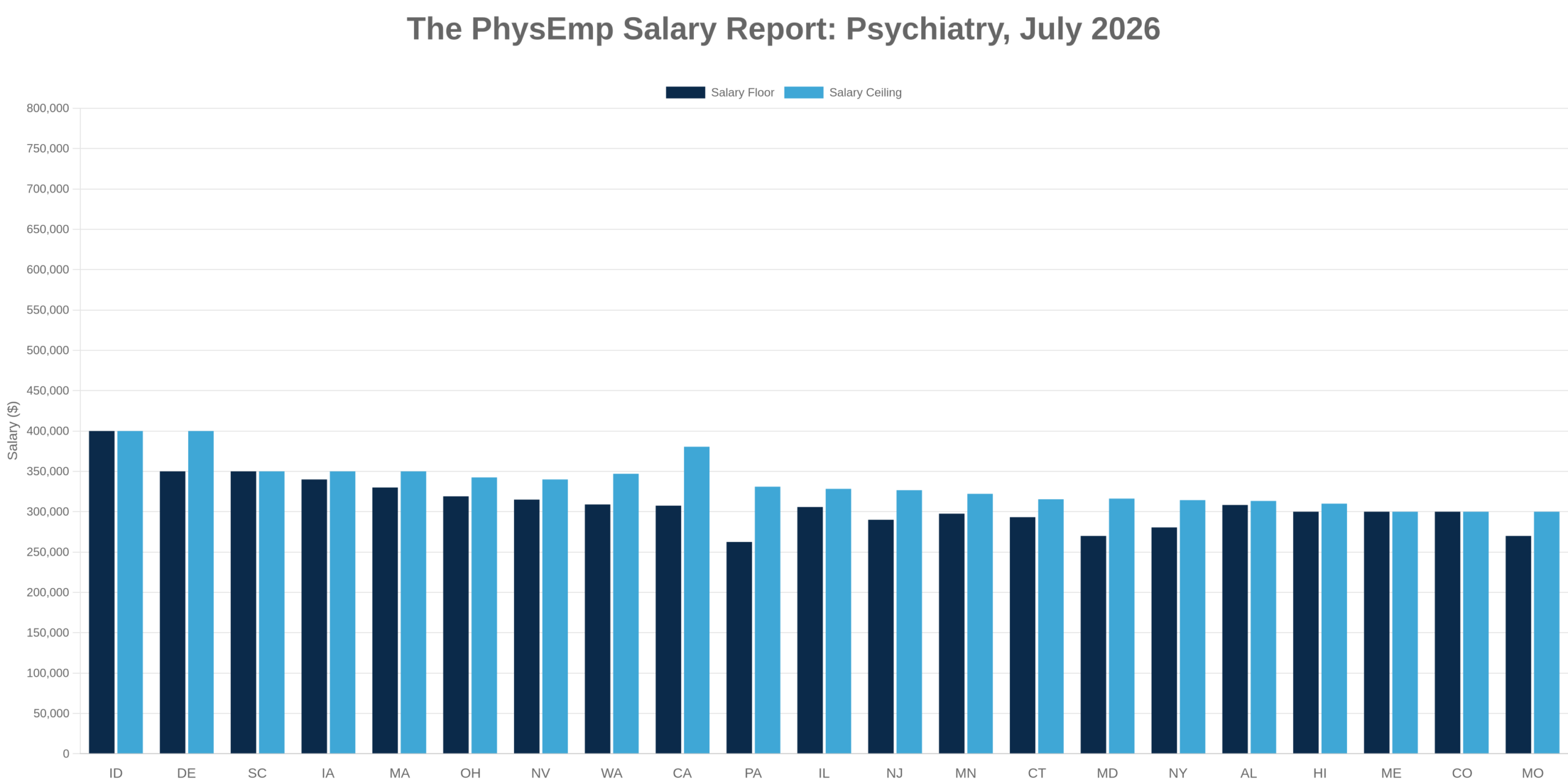
A Psychiatry position in New York pays $125,000. Another, two hours north in California, pays $550,000. Both are full-time. Both are posted in the same national market. The distance between them is not geographic—it is strategic. The current Psychiatry job market includes 504 active listings nationwide, with compensation data available for 147 of them. What the data reveals is a specialty where location, practice model, and negotiation matter more than almost any other variable.
👉 Explore Psychiatry job market insights and trends
The Psychiatry Job Market at a Glance
Total listings: 504. Listings with salary data: 147. Full national range: $125,000 to $550,000. Average salary range: $298,345 to $340,324.
That average conceals more than it reveals. The top quartile of Psychiatry positions pays nearly double the bottom quartile, and the gap is not explained by part-time work or niche subspecialties alone. Some of this is geography—rural and underserved markets are bidding aggressively. Some is employer type—private groups and locums agencies price differently than academic centers and large health systems. And some is simply transparency arbitrage: states with poor salary disclosure may be suppressing visible averages while paying competitively in private negotiations.
Listings appear in 47 states: California, New York, Pennsylvania, Indiana, Illinois, North Carolina, Connecticut, Kansas, Wisconsin, Florida, Texas, Arizona, Ohio, Missouri, Minnesota, Maryland, Alabama, Georgia, Tennessee, Washington, Massachusetts, New Jersey, New Mexico, Oregon, New Hampshire, North Dakota, Iowa, Virginia, South Carolina, Nevada, Delaware, Idaho, Hawaii, Arkansas, Maine, Oklahoma, Utah, Michigan, West Virginia, Mississippi, Alaska, Montana, Kentucky, South Dakota, Colorado, Nebraska, and Louisiana.
👉 Browse Psychiatry physician job opportunities
How States Stack Up
Overperformers: Idaho averages $400,000 (based on one listing, but still). Delaware ranges from $350,000 to $400,000, making it the most lucrative small market with disclosed data. South Carolina averages $350,000—a single data point, but one that signals aggressive pricing in a low-volume state. Massachusetts ranges from $330,000 to $350,000, proving that some urban markets can compete on pure compensation. Iowa averages $340,000 to $350,000, rewarding physicians willing to practice in the Midwest. Ohio ($319,083 to $342,494) and Washington ($309,000 to $347,000) both clear the national average with room to spare. Illinois averages $305,833 to $328,333 and pairs that with 23 listings, making it a rare high-volume, above-average state. California ($307,475 to $380,501) leads the nation in listings and still manages to beat the average—a remarkable combination. Alabama ($308,333 to $313,333) edges into overperformer territory despite limited transparency.
Near-average: Connecticut averages $293,222 to $315,444 across nine salary-reporting listings. Nevada ($315,000 to $340,000) and Hawaii ($300,000 to $310,000) both hover near the midpoint, though sample sizes are small. Minnesota ranges from $297,583 to $322,167, offering stable compensation in a mid-volume market. New Jersey ($290,000 to $326,667) sits squarely in the middle. Maine and Colorado both report $300,000 averages, though each is based on a single listing.
Underperformers: Pennsylvania averages $262,500 to $331,000 and has 30 listings but only four with salary data—a transparency problem masking what may be a compensation problem. New York averages $280,514 to $314,343 despite having 60 listings, the second-highest volume in the nation. Missouri ($270,000 to $300,000) and Maryland ($270,000 to $316,250) both fall well below the national average, with Maryland’s figure particularly surprising given proximity to high-cost urban centers.
Volume leaders: California (62 listings), New York (60), Pennsylvania (30), Indiana (24), Illinois (23), and North Carolina (21). New York and Pennsylvania both rank in the top three for volume but pay below the national average. Indiana and North Carolina offer no salary data at all despite strong listing counts, creating blind spots in two otherwise active markets.
👉 Compare Psychiatry compensation and opportunities by region
What This Means If You’re a Physician
If your priority is maximum compensation: The highest-paying disclosed position is in California, offering up to $550,000 annually. Idaho, Delaware, and South Carolina all report averages at or above $350,000, though sample sizes are thin. California remains the safest bet for combining high pay with high optionality—62 listings and an average ceiling above $380,000.
If your priority is maximum optionality: California and New York dominate the market with 62 and 60 listings, respectively. Illinois (23 listings) and Pennsylvania (30) offer volume, though Pennsylvania’s salary transparency is poor and its averages are low. If you want choices and are willing to dig for compensation details, these four states will give you the most at-bats.
If your priority is balance: Illinois pairs 23 listings with an average of $305,833 to $328,333—above the national mean and below the cost-of-living extremes of coastal markets. Ohio offers similar compensation ($319,083 to $342,494) with 10 listings. Minnesota ($297,583 to $322,167) provides stable pay in a livable market. The cost-of-living mismatch to watch: New York pays $280,514 to $314,343 on average, which is below the national average and well below what you would need to match the purchasing power of a $300,000 salary in Ohio or Alabama.
👉 Search Psychiatry jobs by location and compensation
What This Means If You’re a Recruiter
Salary transparency rate: 29.2% (147 listings with data divided by 504 total listings). That is low. It is also a strategic liability. Psychiatry is a seller’s market, and candidates are comparing disclosed offers in real time. Employers in Indiana (24 listings, zero salary data), North Carolina (21 listings, zero), Kansas (17 listings, zero), Wisconsin (17 listings, zero), Texas (15 listings, zero), and Florida (12 listings, zero) are flying blind and asking candidates to do the same.
Pipeline implications: High-volume, low-transparency states like Pennsylvania and Indiana are vulnerable to poaching by smaller markets that lead with compensation. If you are recruiting in New York and paying below $315,000, you are competing with Delaware ($350,000 to $400,000), Iowa ($340,000 to $350,000), and Ohio ($319,083 to $342,494)—and losing on price. If salary is not your lead, you will need to lead with lifestyle, geography, mission, or scope. But you will need to lead with something.
Volume-pay misalignment: New York has 60 listings and pays below average. Pennsylvania has 30 listings and pays near the bottom. Both are losing the compensation war to states with a fraction of their market activity. Recruiters in these markets should either adjust offers or prepare to sell intangibles aggressively—because the data is public, and candidates are doing the math.
👉 Post Psychiatry positions on PhysEmp
What’s Driving the Numbers
Geographic scarcity commands a premium, and the data proves it. Idaho, Delaware, Iowa, and South Carolina—none of which crack the top 15 in listing volume—all report average salaries above $340,000. These are not coastal markets. They are not academic meccas. They are places where demand outstrips supply, and employers have responded by pricing in the difficulty of recruitment. The lesson is old but newly quantified: underserved markets pay.
High volume does not guarantee high pay, and in some cases it suppresses it. New York and Pennsylvania are both top-five states by listing count, and both pay below the national average. The likely explanation is a combination of institutional employers (who pay less), urban saturation (which increases candidate supply), and legacy compensation structures that have not adjusted to the national market. California is the exception—62 listings and an average ceiling above $380,000—but California is also competing with itself, and the cost of living forces upward pressure on wages.
Transparency is a competitive weapon, and most employers are not using it. Fewer than three in ten listings disclose salary data. That might have been defensible in 2010. In 2026, when candidates can compare offers across state lines in real time and when Psychiatry jobs outnumber available candidates, it is a recruiting handicap. States with strong transparency (California, New York, Illinois) are also states with strong volume, which suggests that disclosure attracts activity rather than repelling it.
The floor is lower than it should be, and it is probably distorted. The lowest disclosed salary is $125,000 in New York—a figure that makes sense only if the role is part-time, heavily supervised, or otherwise non-standard. But the data does not clarify scope, and that ambiguity pulls the visible range downward. Even accounting for part-time roles, a $125,000 floor in a specialty with a $340,000 average suggests that some listings are either misclassified or aimed at trainees. Either way, the floor is not representative, and physicians should treat it accordingly.
The Bottom Line
The Psychiatry job market is large, well-compensated, and geographically inconsistent. If you are a physician, the highest-paying opportunities are in small markets that need you badly and large markets that can afford you easily. If you are a recruiter, your competitive advantage is no longer volume—it is transparency, speed, and a willingness to pay what the market has already decided the role is worth. The data is clear: location matters, disclosure matters, and in a specialty where demand exceeds supply, the leverage belongs to the candidate.
There is a lot of work available for helping people feel better. The pay reflects that. Choose accordingly.
👉 Browse all Psychiatry physician jobs
👉 Upload your CV to get matched with opportunities
👉 Set alerts for new Psychiatry roles
Salary data based on 147 listings with disclosed compensation. Figures may reflect part-time or specialized roles. This report is informational and should not replace professional judgment or financial planning.