
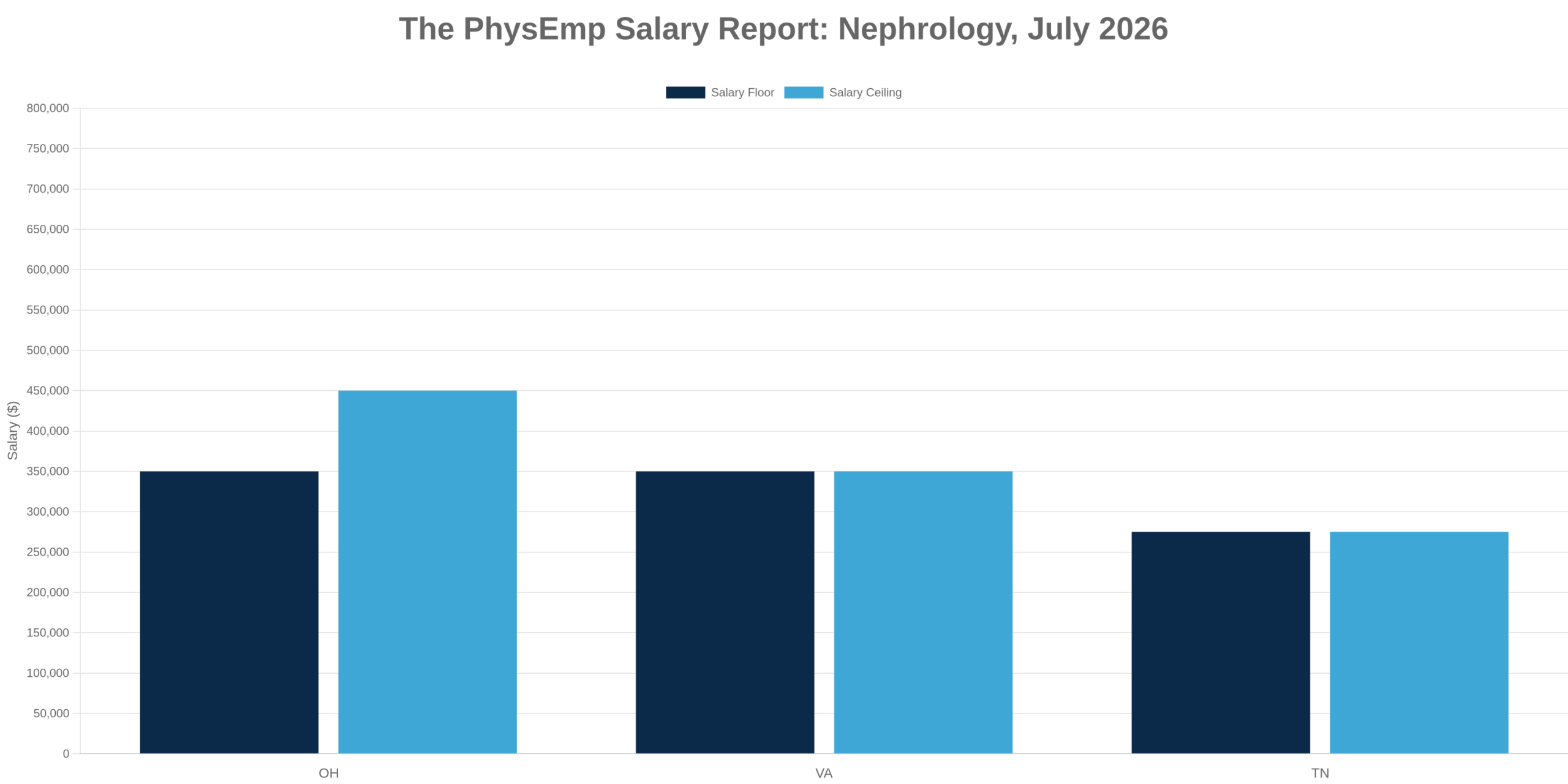
Fifty-three job listings. Three disclosed salaries. That is not a typo — that is the state of price discovery in American nephrology, a specialty that quite literally keeps people alive by filtering their blood. The market stretches from California to the U.S. Virgin Islands, with Georgia, Montana, and Tennessee anchoring the volume leaderboard and Ohio quietly running away with the top salary. The disclosed range spans $275,000 to $450,000, a $175,000 gap wide enough to drive a dialysis truck through. The thesis: nephrology is a high-demand, low-transparency market where the few employers willing to name a number are setting the entire narrative.
👉 Explore Nephrology job market insights and trends
The Nephrology Job Market at a Glance
Total listings: 53
Listings with salary data: 3
Full salary range: $275,000 – $450,000
Average salary range: $325,000 – $358,333
Three salaries. Twenty-three states and territories. The math here is uncomfortable for anyone trying to benchmark an offer, and it means a single Ohio posting is doing roughly 33% of the work in defining the national ceiling.
The spread is enormous relative to the sample. A $175,000 delta between the floor and the ceiling implies either dramatic regional variation, dramatic scope variation (transplant vs. general), or both. Given that the disclosed data includes a Transplant Nephrologist role, the answer is almost certainly “both.”
States represented: Texas, U.S. Virgin Islands, Indiana, Montana, Kentucky, Wisconsin, California, Nevada, Georgia, Virginia, Tennessee, Mississippi, Illinois, Arizona, Maryland, New Mexico, North Dakota, Ohio, Pennsylvania, Louisiana, Missouri, New Jersey, Florida.
👉 Browse Nephrology physician job opportunities
How States Stack Up
Overperformers: Ohio — Posts the widest and highest disclosed band at $350,000–$450,000, and also happens to be a high-volume state. A rare double.
Near-average: Virginia — Its lone disclosed listing at $350,000 sits right at the lower bound of the national average, making it the closest thing this dataset has to a “typical” number.
Underperformers: Tennessee — Discloses $275,000, a full $50,000 below the national average floor, in a state with four active listings. Not encouraging.
The remaining 20 states and territories — Texas, U.S. Virgin Islands, Indiana, Montana, Kentucky, Wisconsin, California, Nevada, Georgia, Mississippi, Illinois, Arizona, Maryland, New Mexico, North Dakota, Pennsylvania, Louisiana, Missouri, New Jersey, and Florida — disclosed nothing. Draw your own conclusions.
Volume leaders: Georgia (5), Montana (4), California (4), Tennessee (4), Indiana (3), Illinois (3), Maryland (3), Ohio (3). Of those eight, only Ohio and Tennessee bothered to post a salary — and one of them is the national floor.
👉 Compare Nephrology compensation and opportunities by region
What This Means If You’re a Physician
If your priority is maximum compensation: Look at Ohio. The highest-paying disclosed listing in the country tops out at $450,000 in Ohio, and it sits inside a state that also has three active postings. That is the only place in this dataset where volume and pay actually agree.
If your priority is maximum optionality: Georgia (5), Montana (4), California (4), and Tennessee (4) offer the most postings — but three of those four states told you nothing about pay. Optionality here means “willingness to negotiate blind.”
If your priority is balance: Ohio and Virginia. Ohio for upside, Virginia for a benchmark $350,000 number you can actually plan around. And scrutinize Tennessee carefully — four listings and a disclosed $275,000 in a state where cost of living does not remotely justify the discount.
👉 Search Nephrology jobs by location and compensation
What This Means If You’re a Recruiter
Salary transparency rate: 3 ÷ 53 = 5.7%.
That is not a market. That is a fog bank. Candidates evaluating nephrology roles in 2026 have almost no public price signal, which means the employers who do disclose — Ohio, Virginia, Tennessee — are the ones shaping every conversation.
The volume-pay misalignment is glaring. Georgia leads the country in postings and has disclosed zero salaries. Montana and California, tied for second, have done the same. If you are recruiting in those markets, compensation cannot be your lead — because candidates cannot see it, cannot compare it, and will assume the worst. Lead with scope, call schedule, partnership track, and dialysis-unit ownership economics instead. Then disclose the number early, before a competitor in Ohio does it for you.
👉 Post Nephrology positions on PhysEmp
What’s Driving the Numbers
Subspecialty scope commands a premium. The $450,000 Ohio ceiling and the $350,000 Virginia transplant role both point to the same conclusion: subspecialty-trained nephrologists (transplant, interventional) are pulling the top of the range upward. General nephrology likely clusters closer to the $275,000–$325,000 zone, though the data is too thin to prove it cleanly.
Transparency is the actual scarcity. With 5.7% of listings disclosing pay, the binding constraint on this market is not supply of physicians or supply of jobs — it is supply of information. Employers who disclose will win the pipeline. Employers who don’t will lose candidates to Ohio without ever knowing why.
Volume does not equal pay. Georgia has the most listings and zero disclosed dollars. Ohio has three listings and the national high. In nephrology, “lots of openings” often signals retention problems, dialysis-chain expansion, or underserved geography — not competitive compensation. The volume-pay relationship does not just fail here; it inverts.
Underserved markets are not pricing in scarcity. Montana (4 listings), North Dakota, New Mexico, and the U.S. Virgin Islands all have active demand and disclosed nothing. In a rational market, rural and remote nephrology should carry a scarcity premium. This dataset offers no evidence that it does — which either means the premium exists and is being hidden, or it doesn’t exist at all. Neither is good.
The Bottom Line
Nephrology in 2026 is a specialty defined by what employers refuse to say out loud. The disclosed data points to a real, negotiable range of roughly $275,000 to $450,000, with subspecialty scope and Ohio doing most of the heavy lifting on the top end. Volume leaders are silent. Rural markets are silent. The one Transplant Nephrologist listing in Western Virginia at $350,000 is, statistically speaking, the most useful public data point in the entire American nephrology market.
When 94% of employers won’t name a number, the 6% who do get to decide what nephrology is worth.
👉 Browse all Nephrology physician jobs
👉 Upload your CV to get matched with opportunities
👉 Set alerts for new Nephrology roles
Salary data based on 3 listings with disclosed compensation. Figures may reflect part-time or specialized roles. This report is informational and should not replace professional judgment or financial planning.