
This analysis synthesizes 11 sources published the week ending Jul 7, 2026. Editorial analysis by the PhysEmp Editorial Team.
The ambient AI documentation revolution has arrived with a paradox at its center: tools sold as physician time-savers are creating new legal exposure, consent failures, and editing workloads that employment contracts rarely mention. As health systems race to deploy AI-powered scribes across clinical settings, the implications for AI in Physician Employment & Clinical Practice go beyond efficiency metrics—touching compensation models, liability frameworks, and how we count physician productivity.
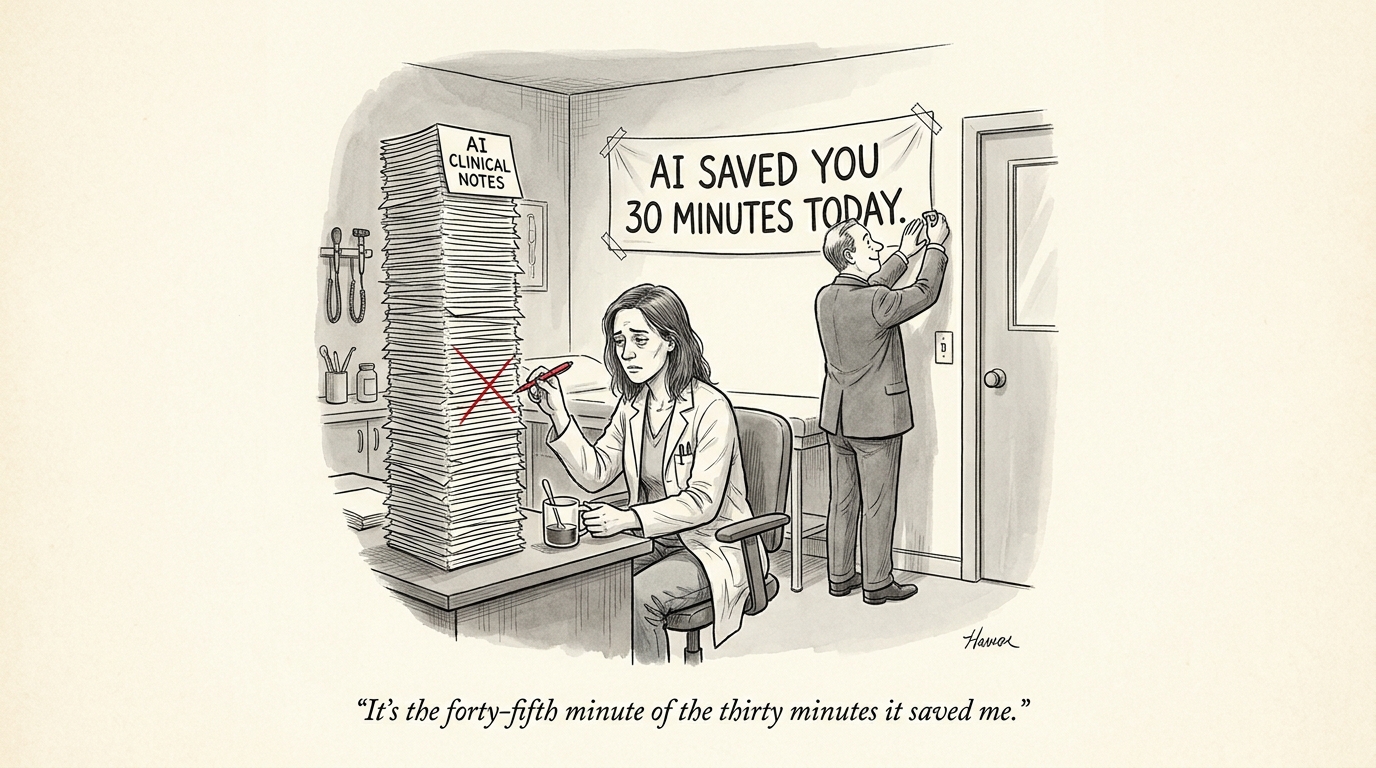
This week’s coverage shows a clear disconnect: institutions emphasize documentation-burden reduction, but studies and legal analysis suggest physicians are picking up new, uncompensated cognitive work. That mismatch matters for anyone evaluating a job at an AI-enabled organization and for executives designing compensation tied to these tools.
The productivity promise versus the editing reality
Several reports documented real time savings from ambient AI documentation. Washington University School of Medicine found physicians using their system cut documentation time substantially, and rural clinicians pointed to particular benefits where shortages make every minute count.
But other research paints a different picture. Studies of AI-generated patient message replies showed flawed outputs that increased physician editing time—sometimes taking longer to fix than writing the message from scratch. That undermines the simple productivity math many health systems use to justify these investments and to sell roles to candidates.
Physicians negotiating employment contracts should demand clarity on whether AI-assisted documentation time is measured by initial generation or by final verification. The difference determines whether productivity expectations reflect actual cognitive labor or institutional wishful thinking.
Mainstream coverage tends to call AI scribes net time-savers while downplaying the verification burden they create. When systems project higher patient volumes based on supposed documentation efficiency, they may be building targets on incomplete workload estimates. That leaves hired physicians accountable for volume goals that don’t include the time needed to check AI output.
Consent frameworks and liability exposure
Legal and ethical analyses flagged weak consent practices for AI scribes. One physician commentator argued that checkbox consent forms fail meaningful informed consent—patients clicking through intake forms rarely know an AI is listening or transcribing their visit.
Australia’s government warnings about privacy risks from AI scribes suggest regulators are paying attention, and other jurisdictions will follow. Legal experts also outlined liability pitfalls when AI-generated notes contain errors that make it into the medical record. The liability chain remains anchored to the signing clinician: regardless of AI involvement, the clinician bears responsibility for documentation accuracy.
The employment contract gap
Most physician employment agreements don’t spell out AI documentation liability. That creates asymmetric risk: health systems reap efficiency gains while physicians absorb the legal exposure from AI errors they’re expected to catch. As awareness grows, this imbalance will become a recruiting problem.
Patient advocates have pointed to documentation errors that escaped review, highlighting clinical and legal danger when AI notes are wrong. For physicians, that sharpens the need for mandatory verification workflows—and raises the question of whether compensation covers that time.
Structural implications for compensation models
AI documentation changes the math behind many compensation plans. If ambient AI truly cuts documentation time by 30–40% in some settings, productivity-based pay faces pressure to reset. Will RVU targets rise? Will base salaries shift? Will organizations expect higher patient volumes without adjusting pay?
Health systems that deploy AI documentation without transparent compensation adjustments risk losing physicians to competitors with clearer terms. The recruiting edge will go to organizations that explain how efficiency gains are shared rather than extracted.
Physicians should make AI documentation a standard contract question. Ask: What verification time is assumed in productivity expectations? How will compensation account for AI-related gains? What liability coverage exists for AI errors? If an organization can’t answer, they probably haven’t figured out the employment side of their technology purchase.
Rural and underserved settings: a different calculus
AI documentation carries particular weight in rural and underserved areas. Where shortages are severe and burnout drives departures, shaving chart time may help keep clinicians in place. In those settings, AI support can be a real quality-of-life improvement rather than pure productivity extraction.
Still, the same consent and liability problems apply, and rural sites often lack resources for strong AI governance and verification support. That can turn a potential retention tool into added risk if leaders don’t invest in oversight and training.
What executives and recruiters must address
Leaders implementing AI documentation face a choice: treat these systems as plug-and-play efficiency tools, or recognize their workforce impacts and address them up front. The evidence this week favors the latter.
Recruiting into AI-enabled environments now requires honest explanations of documentation workflows, verification expectations, liability coverage, and how compensation interacts with these tools. Organizations that write clear policies and contractual language will beat those that treat AI as a simple tech rollout.
The physician workforce is more aware of AI’s practical implications than many assume. Recruitment pitches that sing the efficiency tune but ignore verification and liability will meet skepticism. Groups that demonstrate governance and fair compensation may actually turn AI into an advantage.
Forward trajectory
Ambient scribes and AI-assisted charting are on track to become common features of clinical practice in the next few years. The relevant question is not whether clinicians will use these tools, but under what terms they will use them.
Treat AI documentation policies as material contract terms. Compensation models should explicitly state how AI-related productivity expectations are set. Liability frameworks deserve clear contractual language—most current agreements do not provide it. Organizations that take these steps now will avoid churn later; those that don’t will meet friction once promises meet day-to-day work.
There is a window for physicians and health systems to set fair rules before bad precedents harden. Or, to put it another way: while contracts are still negotiable, somebody somewhere will be proofing an AI note at 2 a.m., coffee gone cold, muttering the chief complaint back into the record because the scribe heard something else. That image feels minor until it happens to you.
Sources
How AI Medical Scribes Are Changing the Doctor’s Office – The New York Times
Evaluating the Impact of AI Scribes on Modern Clinical Practice – Medical Economics
Avoid These Legal Pitfalls When Using AI Scribes – Medscape
Your Ambient AI Scribe Consent Checkbox Is Not Consent – KevinMD
Study shows how flawed AI responses increase physician workloads – News-Medical.net
Please please proofread your AI notes – a patient’s plea highlights a growing documentation risk – MDLinx
AI tool reduces paperwork for WashU Medicine and BJC physicians – Washington University School of Medicine in St. Louis
Doctors using AI scribes risk patient privacy government warns – The Guardian
What healthcare leaders should know before implementing AI-powered documentation tools – MedCity News
Less Charting More Care: Ambient AI’s Promise for Rural Clinicians – Healthcare IT Today
AI-Generated Replies Increase Physician Editing Workload – Let’s Data Science