
This analysis synthesizes 7 sources published the week ending May 25, 2026. Editorial analysis by the PhysEmp Editorial Team.
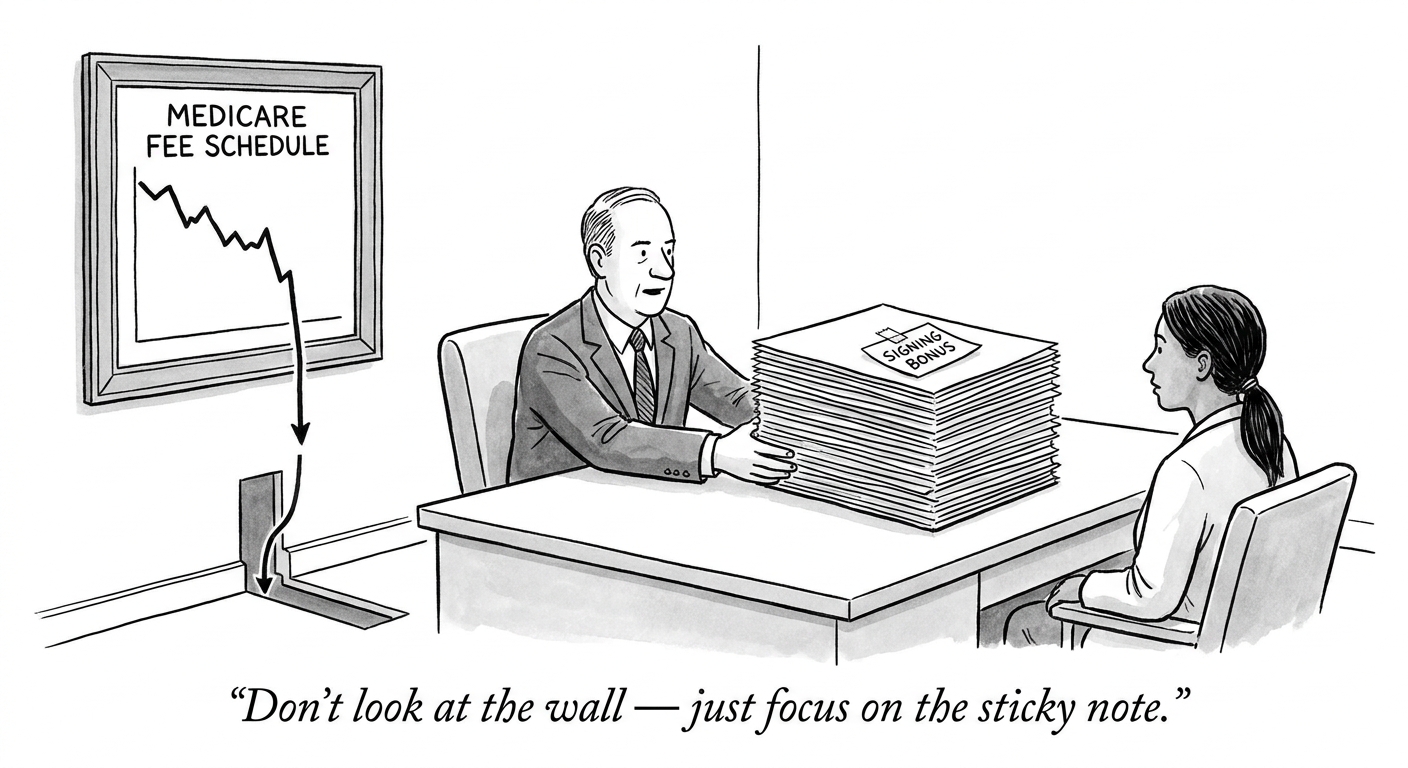
The 33% inflation-adjusted fall in Medicare physician reimbursement since 2001 has crossed a threshold that changes how specialties get recruited and forces health systems to pay more just to keep a functioning workforce. This steady squeeze—now getting renewed Congressional attention—does more than feed policy headlines; it shifts bargaining power, reshapes contract terms, and alters total compensation packages across the Physician Compensation & Demand spectrum.
Mainstream coverage treats Medicare reimbursement as a Washington story. The costs of that framing are local: hospitals and medical groups are absorbing and reallocating shrinking Medicare margins, and those moves show up in the offers physicians receive in 2026.
The compounding math of payment erosion
The 33% real-dollar decline since 2001 looks worse when you stack it against practice-cost inflation. Malpractice premiums, staff wages, new technology, and regulatory compliance have all risen faster than general inflation. The gap between what Medicare pays and what it takes to run a practice has widened.
Congressional testimony this week underscored a structural mechanic that makes the problem stick: the fee schedule’s budget neutrality rules trigger offsets whenever new codes or services are added, so cuts follow unless lawmakers change the rules. Proposals to cap annual cuts at 1% aim to limit harm, not to restore purchasing power—an important distinction for physicians projecting career earnings.
For physicians negotiating contracts in 2026, Medicare trends are an early warning. Health systems with shrinking Medicare margins have less room for base-salary increases. The result: more pay tied to productivity and RVU targets, shifting volume pressure to individual providers.
Specialty recruitment divergence accelerates
Recent recruitment data show uneven effects across specialties. Psychiatry, neurology, urology, and gastroenterology are among the hardest to staff—precisely the specialties with high Medicare exposure and limited ability to move patients to higher-paying commercial plans.
Primary care faces its own squeeze. The American Academy of Family Physicians has pushed this point in Congress: heavy Medicare and Medicaid exposure leaves primary care more exposed to federal payment policy. Primary care visits generate less revenue per encounter while overhead remains similar to higher-reimbursed specialties.
That math forces employers into a choice: offer guaranteed salaries to attract physicians who treat lots of Medicare patients, or push compensation toward productivity models that shift risk back to clinicians. Many systems are choosing guarantees and sweeteners—signing bonuses, recruitment incentives—because they need bodies now, even if those payouts strain margins.
Geographic variation intensifies
State-level politics and cost differences amplify the effect. California’s debate over a proposed ballot measure, for example, shows how local policy can tighten supply and raise compensation demands in places that already have high living costs and large Medicare populations.
For physicians weighing offers, geography matters. Areas with acute shortages in Medicare-heavy specialties often pay more overall, but those packages usually come with productivity expectations that can be hard to meet if patient mix or volumes change.
Hospital executives building 2026 recruitment plans face a tension: Medicare payment erosion squeezes operating margins while shortages push them toward bigger offers. The answer is often creative contract design—loan repayment, retention bonuses, equity participation—rather than sustained base-salary growth.
The four forces and compensation strategy
Medicare policy is one of four linked pressures reshaping physician pay—alongside administrative burden, consolidation, and the shift to value-based care. The effects feed into each other.
Administrative work reduces effective productivity without raising pay. Pair that with falling Medicare rates and you get a shrinking real hourly wage for many physicians, a figure that salary surveys don’t always capture but that affects retention.
Consolidation is, in part, a response. Small practices struggle to absorb payment volatility, so physicians move toward employed roles at larger systems that can cross-subsidize. Over time that concentration can weaken individual negotiating power as fewer employers control more jobs.
Legislative uncertainty and contract implications
Specialty coalitions—radiology among them—are lobbying for limits on cuts because budget-neutrality adjustments hit imaging hard. That kind of uncertainty complicates multi-year deals.
Physicians signing contracts in 2026 are increasingly asking for clauses that tie compensation to fee-schedule changes, that adjust productivity targets for payer mix shifts, or that allow exit paths when economics change. Recruiters report candidates and their attorneys are more aware of these levers than a few years ago.
Modest legislative relief might appear now and then. Structural reform of the fee schedule, though, looks unlikely for the foreseeable future. Plan for a slow grind with occasional partial fixes.
Positioning for continued pressure
The intersection of payment erosion, specialty shortages, and geography has made compensation strategy a competitive edge. Systems that treat pay as a simple market-rate exercise will lose to employers who tailor offers to the specific economic pressures physicians face.
For physicians, that means reading offers with a policy lens. Productivity models that worked in steadier times carry different risks when federal payment policy points toward continued erosion.
Think about the next contract you sign in terms of a decade, not a year. Picture the small clinic with a faded ‘‘Help Wanted’’ sign taped to the window, an empty chair in the break room, and a stack of unsigned offers on the admin’s desk. That image will feel familiar long after the headlines move on.
Sources
Medicare Physician Pay Has Fallen 33 Percent Since 2001 – KevinMD
Pallone Opening Remarks: Hearing on Medicare Physician Fee Schedule – House Energy and Commerce Committee Democrats
Radiology groups urge Congress to pass bill that would cap pay cuts to Medicare – Radiology Business
The Four Forces Reshaping Physician Compensation in 2026 – Medical Economics
The Most Difficult Physician Specialties to Recruit – Becker’s Hospital Review
Congress can improve health for less by focusing on primary care – American Academy of Family Physicians
CMA opposes dangerous ballot measure that could worsen California’s physician workforce shortage – California Medical Association