
The 2026 Internal Medicine Physician Salary Report
A Completely Serious Analysis of 1,439 Job Listings, Which Is a Lot of Listings, and Yet We Read All of Them So You Don’t Have To
Published by Physemp Research Division, a team of dedicated professionals who have now spent more time staring at salary spreadsheets than is generally recommended by occupational health guidelines.
We have analyzed 1,439 active Internal Medicine job listings across the United States using a rigorous methodology that involved looking at numbers, writing down what they said, and occasionally saying “huh” out loud in a quiet room.
Of those 1,439 listings, 461 had actual salary data — meaning 978 listings apparently believe that compensation is a surprise best revealed after you’ve already moved your family to a new state. We have thoughts about this. They are not positive thoughts. We will return to them later.
THE FINDINGS
1. Oklahoma has apparently never met a physician.
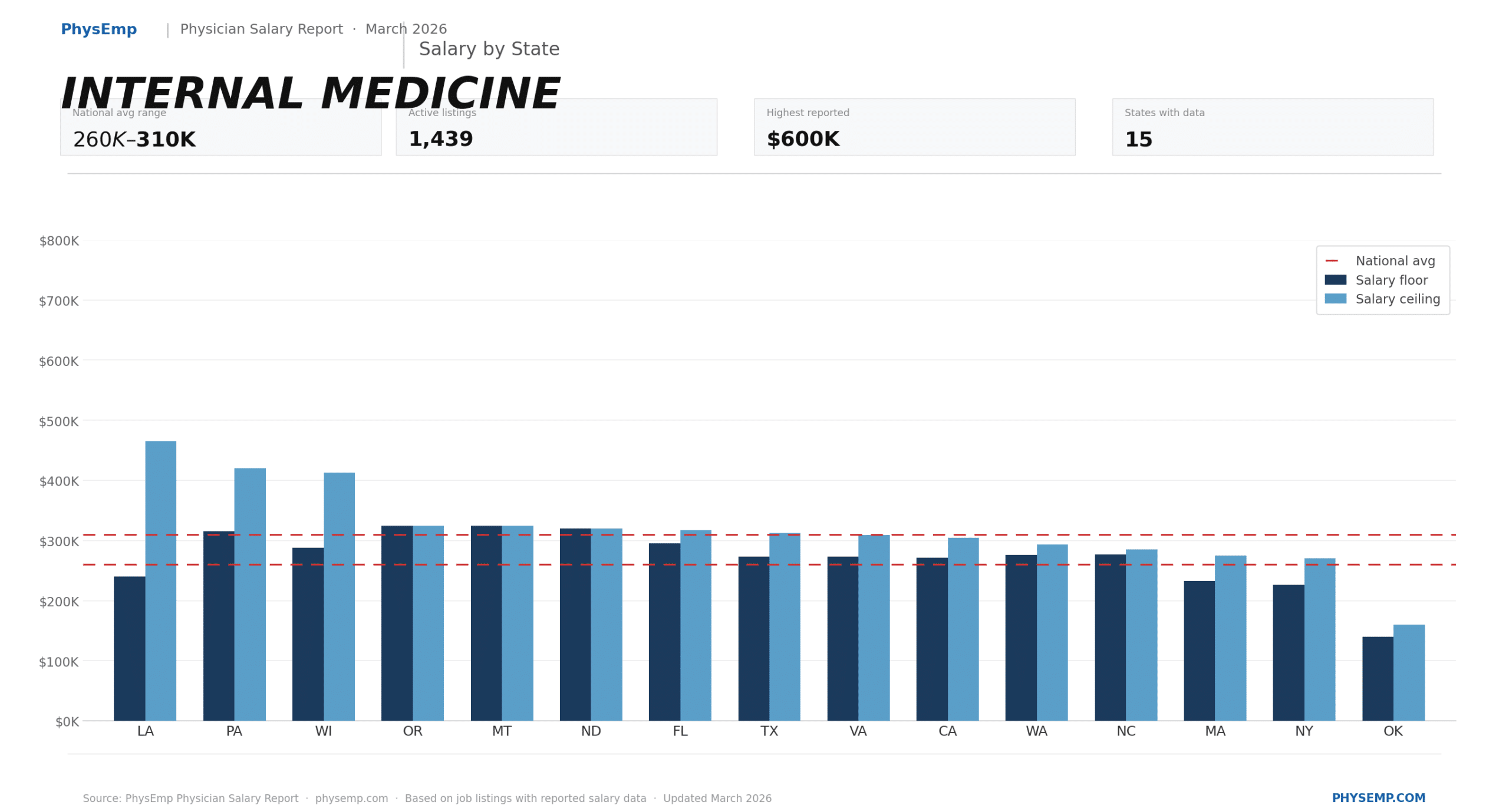
With an average salary of $140,000 to $160,000, Oklahoma is the only state in our dataset averaging below $200,000 — a distinction it holds completely alone, like someone who showed up to a potluck with a single cracker.
To put this in context: the national average for Internal Medicine runs roughly $260,000 to $350,000. Oklahoma’s offer is not in that neighborhood. Oklahoma’s offer is not in that zip code. Oklahoma’s offer is in a different state, metaphorically speaking, which is ironic because physically speaking we are discussing Oklahoma.
We wish Oklahoma’s physicians well.
2. North Dakota continues its strategy of simply paying more than anyone expects and not making a big deal about it.
$320,000. Flat. No range. No ambiguity. North Dakota looked at the question of physician compensation and said: “Three hundred and twenty thousand dollars. Next question.”
There are only 14 listings, because North Dakota has a population roughly equivalent to a mid-sized stadium, but the ones that exist are financially committed in a way that frankly puts larger states to shame. North Dakota is like that quiet person at the meeting who doesn’t say much but when they do speak, everyone stops and listens.
3. Oregon and Montana are also quietly wealthy and would like you to know about it in a low-key way.
Both states average $325,000 — higher than North Dakota, somehow less discussed, possibly because Oregon is busy talking about coffee and Montana is busy being enormous.
Montana has fewer people per square mile than almost anywhere in the continental United States. What it lacks in neighbors, it is attempting to compensate for in W-2s. This is a reasonable trade-off that more physicians should consider.
4. Pennsylvania and Wisconsin remain the chaos agents of American physician compensation.
We reported on this situation previously and nothing has changed:
- Pennsylvania: $315,000 to $420,000
- Wisconsin: $287,500 to $412,500
These ranges suggest that somewhere in Pennsylvania and Wisconsin there are Internal Medicine positions paying $400,000-plus, which is either the result of extraordinary market forces or, as we have previously theorized, a cheese-related data entry incident in Wisconsin’s case. Pennsylvania’s explanation remains unclear. Pennsylvania is like that.
We are not saying these numbers are wrong. We are saying they are surprising, and that if you are an Internal Medicine physician, you should probably look into Pennsylvania before Pennsylvania figures out what it’s doing and corrects course.
5. Louisiana: still unresolved, still $465,000 at the top end.
Louisiana’s salary range runs from $240,000 to $465,000, which is one of the broadest spreads in the country and raises the same questions it raised last quarter, namely:
What, specifically, is happening at the $465,000 end of that range?
Louisiana has not answered this question. Louisiana has excellent gumbo and a complicated relationship with full disclosure. We continue to recommend reading the entire job description before relocating, with particular attention to any sections describing the physical demands of the role or the local wildlife situation.
6. Florida has a plan and is executing it.
109 job listings. $295,000 to $317,000 average. Florida has achieved something that California, New York, and Massachusetts have collectively failed to manage: high job volume and competitive pay at the same time.
Florida’s pitch to Internal Medicine physicians is essentially: “Warm. No state income tax. Lots of jobs. Reasonable salaries.” This is a coherent pitch. Florida should be proud of having a coherent pitch. Several larger states do not have one.
7. California: still the biggest market, still charging $14 for a sandwich.
201 listings — more than any other state, more than some countries — with salaries averaging $270,000 to $303,000, which falls at or slightly below the national midpoint.
California has identified a recruitment strategy that consists of saying “but it’s California” and waiting to see if that’s enough. For many physicians, it is enough, which is why California has 201 listings and somehow still has a physician shortage. California contains multitudes. California also contains tolls, parking fees, and a housing market that will make a $290,000 salary feel surprisingly modest in ways that will dawn on you gradually over your first eighteen months.
8. New York and Massachusetts: prestige markets with salaries that reflect their feelings about prestige markets.
- New York: 112 listings, $226,000–$270,000 average
- Massachusetts: 85 listings, $233,000–$274,000 average
These are, objectively, fine salaries. They are also, objectively, lower than what you’d earn in Montana, Wisconsin, North Dakota, Oregon, Florida, Texas, Pennsylvania, or Louisiana — which together represent most of the country.
What New York and Massachusetts offer instead is proximity to things, including world-class hospitals, academic medical centers, excellent restaurants, and apartments the size of a physician’s office, by which I mean a small physician’s office, not one with a waiting room.
You can absolutely rent a one-bedroom in Manhattan on $260,000. You just won’t be doing much else.
THE BIG PICTURE
(Refined from 1,439 listings down to three sentences, for efficiency)
The Internal Medicine market is extremely active across nearly every region of the country. Physicians who want the best combination of jobs and pay should look seriously at Florida, Texas, and Pennsylvania. Physicians who want maximum earnings and are willing to move somewhere with a more “rugged character” — a phrase that here means “fewer Whole Foods locations” — should investigate North Dakota, Oregon, Montana, and Pennsylvania, all of which are paying above-average salaries with apparent sincerity.
Physemp has been navigating the physician job market since 1994, back when “salary transparency” meant a recruiter who’d give you a range on the third call. We’ve come a long way. Mostly.
[Share freely. Forward to a resident. Leave on the desk of anyone who thinks Oklahoma’s numbers are competitive.]