
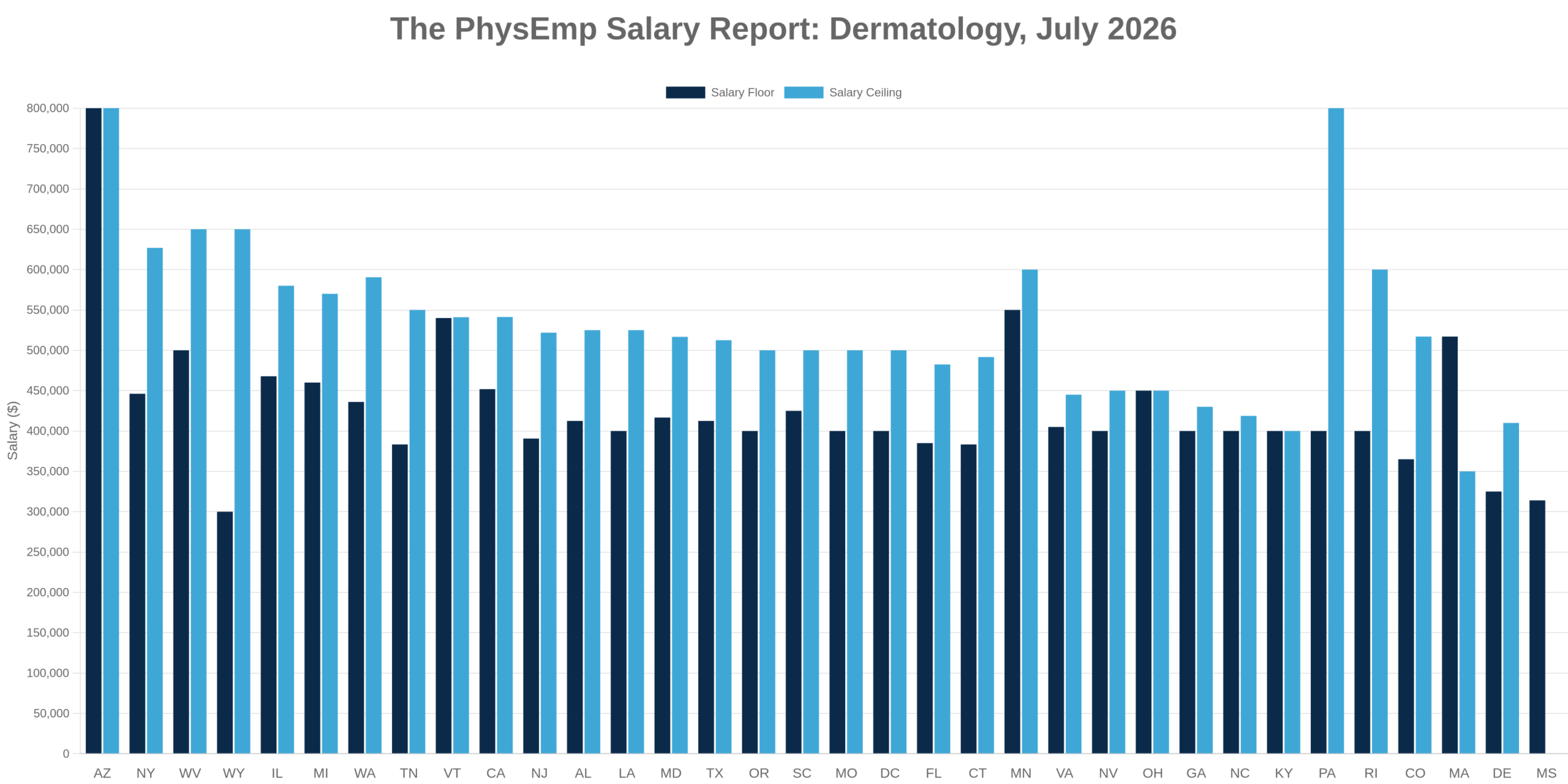
Somewhere near Paradise Valley, Arizona, a single Dermatology listing is offering up to $1,000,000 a year to look at skin. That is not a typo. That is the ceiling of the current national market, and it is being set by exactly one job in a state with seven total openings.
Across the country, PhysEmp is currently tracking 348 active Dermatology listings spanning more than 40 states, with disclosed compensation on 122 of them. The floor sits at $120,000. The ceiling sits at seven figures. Almost everyone lands somewhere in the middle, but the middle is wider than most specialties would dare admit.
Dermatology remains one of the most consistently lucrative and geographically flexible physician markets in the country — provided you know where to look, and where not to.
👉 Explore Dermatology job market insights and trends
The Dermatology Job Market at a Glance
Total listings: 348
Listings with salary data: 122
Full national salary range: $120,000 to $1,000,000
National average salary range: $421,156 to $528,607
Practical compensation cluster: $350,000 to $600,000
The spread here is doing a lot of talking. A $120,000 floor and a $1,000,000 ceiling in the same specialty is not a market — it is a mood ring. Part-time roles, fellowship-track positions, and Mohs-heavy or leadership-tier listings are all being averaged into the same bucket, which is why the practical cluster ($350,000 to $600,000) is the number most working dermatologists should actually care about.
The average low of $421,156 is the more honest anchor. The high end is skewed upward by the Arizona outlier and a handful of scope-loaded roles.
States represented with listings: California, New York, Florida, Illinois, Texas, North Carolina, Massachusetts, New Jersey, Pennsylvania, Connecticut, Tennessee, Michigan, Georgia, Alabama, Virginia, Missouri, Arizona, Washington, Minnesota, Ohio, New Hampshire, Oregon, Colorado, Delaware, Mississippi, Wisconsin, Rhode Island, Idaho, Maryland, Nevada, Kentucky, Louisiana, South Carolina, South Dakota, Iowa, North Dakota, Vermont, Maine, West Virginia, Wyoming, Montana, Alaska, Oklahoma, Indiana, Hawaii, Nebraska, and Washington, D.C.
👉 Browse Dermatology physician job opportunities
How States Stack Up
Overperformers
- Arizona: Average range of $800,000 to $1,000,000, based entirely on one listing near Paradise Valley (asterisk permanently attached).
- West Virginia: $500,000 to $650,000 across two salary-reported listings — a small market punching genuinely hard.
- Minnesota: $550,000 to $600,000, quietly one of the strongest averages in the country.
- Vermont: $540,000 to $541,000, narrow but elite.
- Massachusetts: A flat $517,000 average that says exactly what it means.
- New York: $446,154 to $626,923, and it comes with volume — the rare combination that actually matters.
- Illinois: $467,857 to $580,000, comfortably above the cluster.
- Michigan: $460,000 to $570,000, an underrated Midwest pocket.
Near-Average
- Georgia: $400,000 to $430,000 — a steady benchmark.
- Virginia: $405,000 to $445,000, textbook midpoint.
- Texas: $412,500 to $512,500, predictable and broad.
- North Carolina: $400,000 to $418,750, tight and reliable.
- Missouri: $400,000 to $500,000, unremarkable in the best way.
- Oregon: $400,000 to $500,000, one salary-reported listing but on-cluster.
- California: $451,875 to $541,250 — solid, not exceptional, considering it leads the country in volume.
- Washington: $436,000 to $590,500, quietly competitive.
- Maryland: $416,667 to $516,667, a clean national mirror.
- New Jersey: $390,625 to $521,875, wide but average.
- Alabama: $412,500 to $525,000, better than most expect.
- Ohio: A flat $450,000 across two listings.
- Nevada, D.C., Kentucky, Louisiana, South Carolina, Rhode Island, Pennsylvania, Colorado: All hovering around the $400,000 low-end anchor with varying ceilings.
Underperformers
- Delaware: $325,000 to $350,000 — well below the cluster and not subtle about it.
- Mississippi: $314,000 to $410,000, the lowest reported average in the country.
- Wyoming: $300,000 to $650,000 (single listing, wide enough to drive a truck through).
- Connecticut: $383,333 to $491,667, dragged down by lower-end postings.
- Tennessee: $383,333 to $550,000, softer than its volume suggests.
- Florida: $385,000 to $482,500, below the national midpoint despite ranking third in volume.
Volume leaders: California (32), New York (29), Florida (25), Illinois (18), Texas (15). Of these, only New York and Illinois pair volume with above-average pay. Florida underperforms on compensation despite its listing count.
👉 Compare Dermatology compensation and opportunities by region
What This Means If You’re a Physician
If your priority is maximum compensation: Look at the myDermRecruiter Dermatologist role near Paradise Valley, Arizona, listed at $800,000 to $1,000,000 per year. It is the single highest-paying Dermatology listing in the national dataset. West Virginia ($500,000 to $650,000) and Minnesota ($550,000 to $600,000) offer the next-strongest averages without requiring a lottery ticket.
If your priority is maximum optionality: California (32 listings), New York (29), and Florida (25) give you the widest selection. California and New York justify the cost of living with above-average pay. Florida does not.
If your priority is balance: New York and Illinois are the only large-volume states where compensation clears the national midpoint. Michigan and Washington deserve a serious look for physicians willing to trade volume for pay.
Watch the cost-of-living mismatch in Florida and Connecticut, where compensation runs below average in markets that are not cheap.
👉 Search Dermatology jobs by location and compensation
What This Means If You’re a Recruiter
Salary transparency rate: 122 of 348 listings, or 35.1%. Roughly two out of three Dermatology postings are still going to market with no disclosed compensation. In a specialty where candidates have this much leverage, that is a pipeline problem, not a strategy.
The volume-pay misalignment is loudest in California and Florida. California has 32 listings and pays on-cluster; Florida has 25 and pays below it. Recruiters in both markets cannot lead with money. They will need to lead with lifestyle, patient mix, partnership track, cosmetic revenue share, or scope autonomy.
New York is the outlier that proves the rule: high volume, above-average pay, and still competitive. That is what a healthy market looks like.
👉 Post Dermatology positions on PhysEmp
What’s Driving the Numbers
Scope and leadership command a real premium. The seven-figure Arizona listing, the Minnesota range, and the Michigan cluster are not entry-level general derm roles. Mohs surgeons, cosmetic-heavy practices, and medical directorships are pulling the ceiling up. The base market is $400,000 to $500,000. Everything above that is being paid for something specific.
Part-time and fellowship roles are distorting the floor. A $120,000 national low in Dermatology is not a full-time attending salary. It is almost certainly part-time, academic, or a fellowship-adjacent posting. The practical floor for a full-time general dermatologist sits closer to $350,000, as seen in Naples and Branford.
Underserved markets are pricing in scarcity. West Virginia ($500,000 to $650,000 on two listings) and Minnesota ($550,000 to $600,000) are not paying premium wages by accident. Rural and semi-rural markets with few dermatologists are writing bigger checks to close the geographic gap. Small volume, big offers.
The volume-pay relationship mostly breaks. Only New York holds both. California is solid but not exceptional given its cost basis. Florida is actively underperforming. High listing counts signal demand, not generosity — a distinction Dermatology candidates should internalize before signing anything.
The Bottom Line
Dermatology in 2026 is a market of wide bands, thin transparency, and geographic arbitrage. The floor is soft, the ceiling is theatrical, and the middle — where most working dermatologists actually live — is a durable $400,000 to $600,000 range that rewards subspecialty scope, rural willingness, and negotiating patience. The volume states are not the pay states, with one clean exception in New York.
Dermatology is one of the few specialties where the smart money moves toward the smaller map.
👉 Browse all Dermatology physician jobs
👉 Upload your CV to get matched with opportunities
👉 Set alerts for new Dermatology roles
Salary data based on 122 listings with disclosed compensation. Figures may reflect part-time or specialized roles. This report is informational and should not replace professional judgment or financial planning.