
Somewhere in Attleboro, Massachusetts, a hospital briefly advertised an Anesthesia role paying $8,400 a year (roughly what a board-certified anesthesiologist bills before their second coffee). It was almost certainly a data entry error. Almost. Everywhere else in the country, the numbers behave like Anesthesia numbers are supposed to behave: large, confident, and occasionally staggering. As of July 1, 2026, PhysEmp is tracking 385 active Anesthesia listings across 41 states, with disclosed salaries running from $250,000 to a flat $1,000,000. The thesis is simple: Anesthesia remains one of the most lucrative and geographically forgiving specialties in American medicine, provided you can read a salary field.
👉 Explore Anesthesia job market insights and trends
The Anesthesia Job Market at a Glance
Total listings: 385
Listings with salary data: 66
Full salary range: $250,000 – $1,000,000
National average range: $488,242 – $562,872
Most listings cluster: $400,000 – $600,000
The spread is wide enough to drive an OR through. A $750,000 delta between the floor and the ceiling is not a rounding error — it is a career decision. Most of the market sits in a tight, boring, and quite comfortable band between $400,000 and $600,000, which is what a healthy specialty looks like when demand outstrips supply for the better part of a decade.
The tail, however, is where the interesting money lives. A handful of markets are quietly clearing $600,000 as a baseline, not a ceiling.
States represented: CA, NY, IL, VA, PA, TX, FL, IN, GA, MA, NE, NJ, OR, AZ, IA, AL, NH, CT, MD, MO, HI, CO, WI, OH, MI, KY, ME, OK, WA, MN, DE, VT, NM, AK, WV, SD, LA, ND, TN, SC, and one lonely posting apiece in a few of them.
👉 Browse Anesthesia physician job opportunities
How States Stack Up
Overperformers
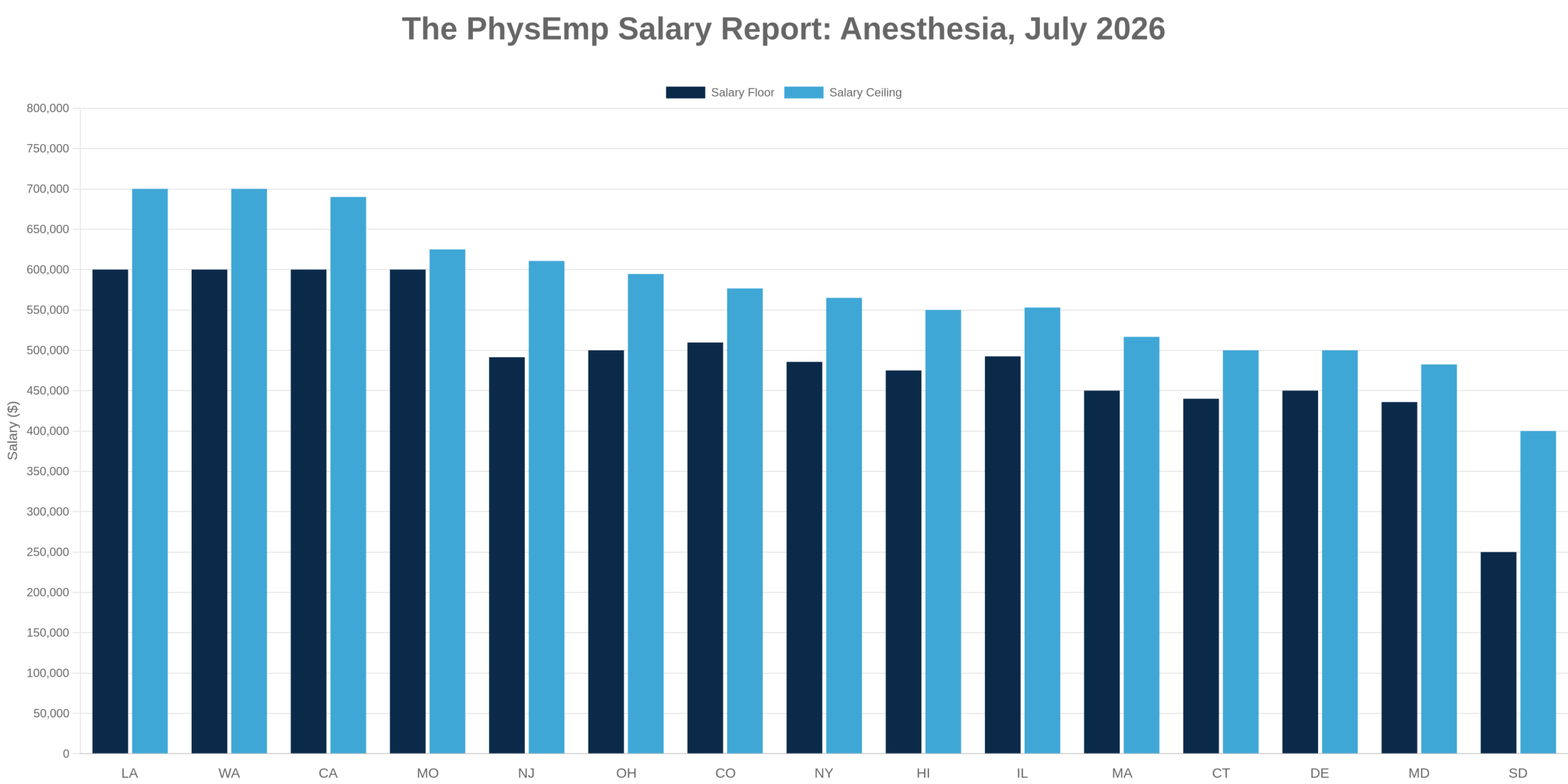
- California ($600,000 – $690,000): High volume and high pay, which is not supposed to happen but does. (32 listings.)
- Louisiana ($600,000 – $700,000): One salary-disclosing listing, punching several weight classes above its size.
- Washington ($600,000 – $700,000): Also a sample size of one, but a compelling one.
- Missouri ($600,000 – $625,000): Quietly outbidding the coasts.
- Colorado ($509,667 – $576,667): A legitimate premium market with actual listing volume.
Near-average
- New York ($485,667 – $565,000): The benchmark, with 15 salary listings backing it up.
- New Jersey ($491,429 – $610,714): Solidly middle, with a top end that flirts with premium.
- Illinois ($492,500 – $553,000): The most predictable data point in the country.
- Ohio ($500,000 – $594,557): One listing, but comfortably at the mean.
- Hawaii ($475,000 – $550,000): Paradise at market rate.
- Massachusetts ($450,000 – $516,667): Slightly under, which will surprise Bostonians.
- Delaware ($450,000 – $500,000): Small, tidy, and on target.
Underperformers
- Connecticut ($440,000 – $500,000): Seven listings all agreeing the state pays less than its neighbors.
- Maryland ($435,833 – $482,500): Six data points, none flattering.
- South Dakota ($250,000 – $400,000): The national floor. (One listing. Please assume context.)
Volume leaders: New York (33), California (32), Virginia (22), Illinois (22), Pennsylvania (21), Texas (20). Of that list, Virginia, Pennsylvania, and Texas disclosed exactly zero salaries. That is not a coincidence.
👉 Compare Anesthesia compensation and opportunities by region
What This Means If You’re a Physician
If your priority is maximum compensation: Head to California, Louisiana, Washington, or Missouri. The nationally cited ceiling is a Rochester, NY listing at $750,000 per year — the highest specifically identified figure in the dataset. (The broader national high touches $1,000,000, if you can find the door it lives behind.)
If your priority is maximum optionality: New York and California together account for 65 listings — roughly 17% of the national market — and both pay at or above average. Illinois and Virginia offer volume without the pricing signal.
If your priority is balance: Illinois, New Jersey, and Colorado deliver median-to-strong pay with real job counts and no obvious cost-of-living traps. Maryland’s discount, given its proximity to DC, deserves scrutiny before signing.
👉 Search Anesthesia jobs by location and compensation
What This Means If You’re a Recruiter
Salary transparency rate: 66 of 385 listings, or 17.1%. That is not a market. That is a shrug.
The pipeline implication is direct: candidates now cross-reference every posting against public data, and a listing without a number is a listing that gets skipped. Texas (20 listings, zero disclosed), Virginia (22, zero), and Pennsylvania (21, zero) are effectively invisible to any physician doing a salary-first search. If your compensation is competitive, say so. If it is not, recruiters will need to lead with case mix, call structure, partnership track, or geography — because the candidate has already assumed the worst.
👉 Post Anesthesia positions on PhysEmp
What’s Driving the Numbers
Scope and leadership command a real premium. The gap between the $488,242 national floor-average and the $600,000+ ranges in CA, MO, LA, and WA is not random. Those are the listings attaching medical direction, chief roles, or supervisory scope — and the market is paying an unmistakable $100,000+ premium for it.
Part-time and anomalous postings distort the floor. The Attleboro, MA listing at $8,400 – $12,600 is almost certainly a display error or a per-diem fragment. Excluding it, the true low-end benchmark is a Westminster, MD role at $325,000 – $350,000, which reframes the entire lower quartile.
Underserved markets price in scarcity. Louisiana, Missouri, and Washington are not high-volume states, yet each posts salary ranges rivaling California. When a hospital in a low-density market discloses $700,000, it is doing so because it has to, not because it wants to.
The volume-pay relationship mostly breaks. California is the exception that proves the rule. Everywhere else, high listing counts correlate with either silence (TX, VA, PA) or average pay (NY, IL). Scarcity, not saturation, is what moves the number.
The Bottom Line
Anesthesia in mid-2026 is a market where the median is strong, the ceiling is absurd, the floor is either a data error or a rural outlier, and roughly 83% of employers still refuse to tell you what they will pay. Physicians hold the leverage. Recruiters who disclose will win the funnel. Everyone else is competing on vibes.
If you make people not feel things for a living, someone in America is prepared to pay you a million dollars a year to keep doing it — they just may not put it in the ad.
👉 Browse all Anesthesia physician jobs
👉 Upload your CV to get matched with opportunities
👉 Set alerts for new Anesthesia roles
Salary data based on 66 listings with disclosed compensation. Figures may reflect part-time or specialized roles. This report is informational and should not replace professional judgment or financial planning.