
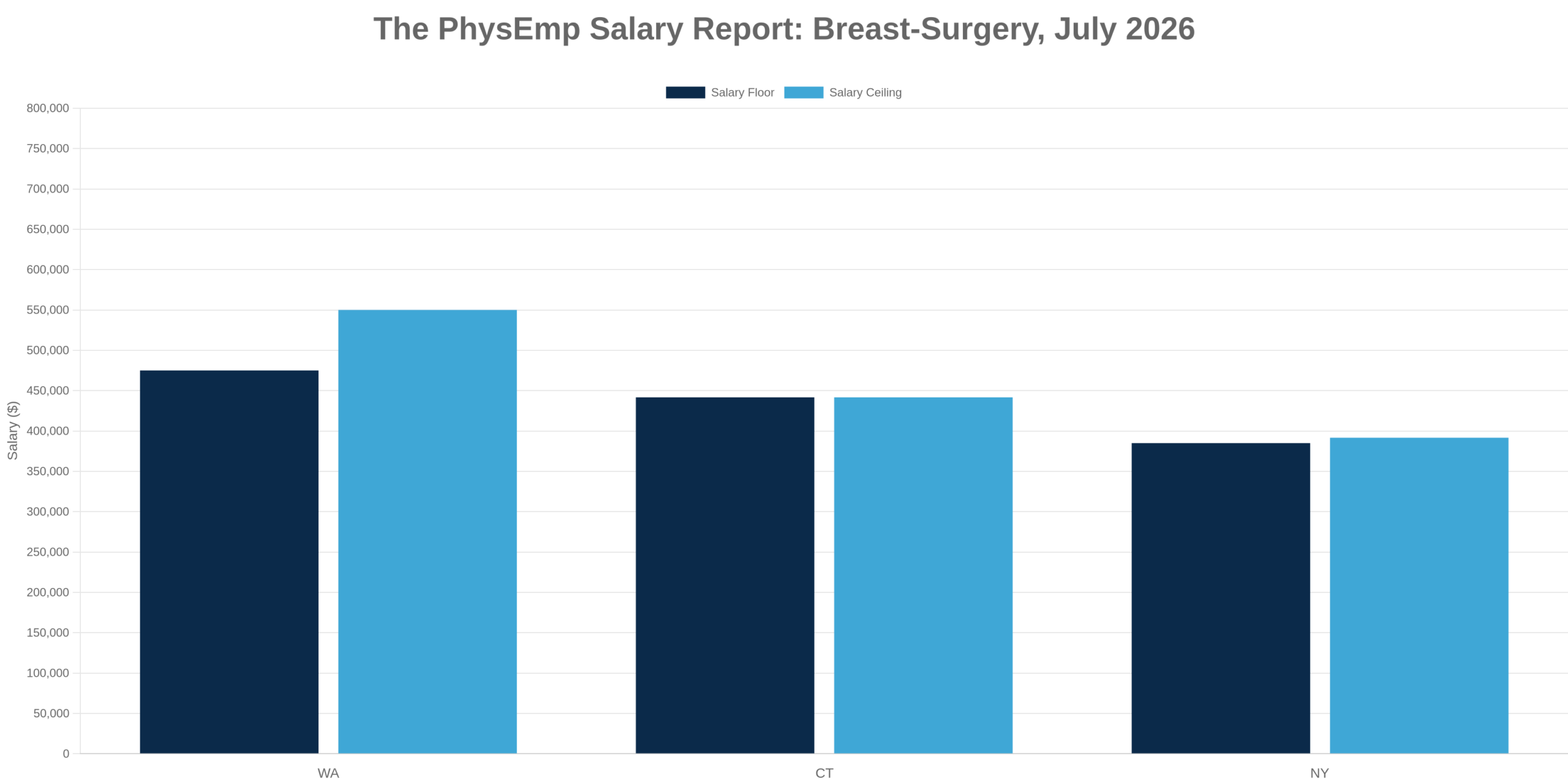
Spokane, Washington — population roughly 230,000, famous mostly for being not-Seattle — is currently home to the highest-paying Breast Surgery listing in the country. It tops out at $550,000 per year. Meanwhile, three listings sit in the New York metro region, historically not known for its affordability, offering as little as $375,000. That is the Breast Surgery market in one sentence: 21 listings, 13 states, and a $175,000 spread between the top and bottom of the disclosed range. Demand is real. Transparency is not.
👉 Explore Breast Surgery job market insights and trends
The Breast Surgery Job Market at a Glance
Total listings: 21
Listings with disclosed salary: 5
Full national salary range: $375,000 to $550,000
National average salary range: $414,338 to $433,338
Five disclosures out of 21 is a 24% transparency rate, which is another way of saying 76% of the market is asking physicians to apply first and ask questions later. The disclosed range spans $175,000 from floor to ceiling, which in a subspecialty this narrow is a substantial gap (and one entirely explained by geography rather than scope).
States represented: New York, Washington, Indiana, Tennessee, Kentucky, Arizona, Louisiana, Florida, Connecticut, Maine, South Carolina, New Jersey, and New Hampshire.
Thirteen states, three volume leaders, one clear high-water mark, and a whole lot of blank compensation fields.
👉 Browse Breast Surgery physician job opportunities
How States Stack Up
Overperformers:
- Washington — Spokane leads the national dataset at $475,000 to $550,000, proving that the highest-paying breast surgery job in America is not in a coastal megacity.
- Connecticut — A single NYC Metro-adjacent listing at $441,688 lands squarely near the national average and functions as the market’s cleanest benchmark.
Near-average: Connecticut again serves as the midpoint reference. There is no one else in the middle. The middle, in this dataset, is a party of one.
Underperformers:
- New York — Three disclosed listings averaging $385,000 to $391,667, all sitting below the national average low. High cost of living, low disclosed pay, high volume. A rough combination.
Silent (no disclosed salary): Indiana, Tennessee, Kentucky, Arizona, Louisiana, Florida, Maine, South Carolina, New Jersey, New Hampshire.
Volume leaders: New York, Indiana, and Florida tie at three listings each. Two of the three disclose nothing. The one that does discloses the lowest numbers in the country.
👉 Compare Breast Surgery compensation and opportunities by region
What This Means If You’re a Physician
If your priority is maximum compensation: Book a flight to Spokane. The CompHealth listing in Spokane, WA at $475,000 to $550,000 is the single highest-paying Breast Surgery opportunity in the dataset — and it is in a market with a cost of living that makes the top-line number feel considerably larger than it would in, say, Middletown.
If your priority is maximum optionality: New York, Indiana, and Florida each offer three listings. Six of those nine roles disclose no salary at all, so optionality here means being willing to negotiate blind.
If your priority is balance: Connecticut’s $441,688 listing hits the national average and sits in the NYC Metro Area. Reasonable pay, dense clinical infrastructure, no need to relearn a new state’s licensing quirks.
The gap worth scrutinizing: New York pays the least while costing the most. That is not a rounding error.
👉 Search Breast Surgery jobs by location and compensation
What This Means If You’re a Recruiter
Salary transparency rate: 5 of 21 listings, or 23.8%.
That means roughly three out of four Breast Surgery postings are asking candidates to invest time in a conversation before learning the number. In a subspecialty this small, with this few active roles, that friction costs pipeline. Surgeons talk. When Spokane is publicly at $550,000 and your Florida or Indiana listing shows a blank field, candidates assume the worst and self-select out.
The volume-pay misalignment is glaring: the three highest-volume states (New York, Indiana, Florida) include the lowest-paying disclosed market and two black boxes. Recruiters in those states will need to lead with case mix, program prestige, call structure, or lifestyle — because the compensation story, where it exists, is not doing the selling.
👉 Post Breast Surgery positions on PhysEmp
What’s Driving the Numbers
Geography is doing more work than scope. The top listing is in Spokane. The bottom three are in New York. Nothing in the disclosed data suggests that academic rank, program leadership, or fellowship scope is driving the spread — it is zip codes, plain and simple.
Transparency is inversely correlated with volume. The three highest-volume states account for nine of 21 listings and only three disclosed salaries — all from New York, all below average. Indiana and Florida, combined, disclose nothing. Silence at scale is a market signal.
Low-volume states are pricing in scarcity. Washington has two listings and one of them is the national high. Connecticut has two listings and one of them is the national benchmark. When a state posts less, it seems to post better.
The volume-pay relationship is broken here. Ordinarily more listings suggest a competitive market bidding pay upward. In Breast Surgery, the opposite is happening: the states with the most openings are either underpaying or refusing to say.
The Bottom Line
Breast Surgery in 2026 is a small, quiet, geographically scattered market where 21 listings tell only a partial story and five of them do the actual talking. Washington is the outlier on the high end. New York is the outlier on the low end. The middle is Connecticut, alone. And the states with the most jobs are, almost without exception, the states least interested in telling you what those jobs pay.
If you want to know what a Breast Surgeon is worth in America, you have to move to Spokane to find out.
👉 Browse all Breast Surgery physician jobs
👉 Upload your CV to get matched with opportunities
👉 Set alerts for new Breast Surgery roles
Salary data based on 5 listings with disclosed compensation. Figures may reflect part-time or specialized roles. This report is informational and should not replace professional judgment or financial planning.