
This analysis synthesizes 12 sources published the week ending Aug 26, 2026. Editorial analysis by the PhysEmp Editorial Team.
A coordinated wave of state investments totaling more than $200 million is changing how rural America confronts its chronic physician shortage. States are focusing on building training infrastructure where physicians are needed, rather than relying on recruitment bonuses. This shift reflects a fundamental rethinking of Healthcare Workforce & Labor Market dynamics: the recognition that geographic training exposure, not recruitment incentives, determines where physicians practice.
The Residency Proximity Effect
Research published this month in JAMA Network Open quantifies what rural advocates have long suspected: where physicians complete residency training matters far more than where they attend medical school. Rural graduate medical education alone accounts for a 42% increase in subsequent rural practice, while the site of medical school contributes just 1%. Rural upbringing adds another 27% increase, and even physicians raised in cities who complete rural residencies show much higher rates of rural practice.
This helps explain why sign-on bonuses, loan repayment, and salary premiums have not closed the rural physician gap. Only 9% to 11% of actively practicing physicians work in rural areas despite 15% to 20% of the population living there, so the supply deficit keeps widening. Idaho makes the mismatch obvious: the state needs about 1,400 more physicians to reach the national average, yet its residency programs graduate only seven physicians a year.
The states investing most heavily in rural training infrastructure are trying to build a workforce pipeline that competing states cannot easily copy. Recruitment bonuses can be matched; embedded training relationships cannot.
Alabama’s Comprehensive Workforce Strategy
Alabama’s $144 million first-round allocation shows how much it takes to create sustainable rural physician pipelines. The grants cover five initiatives: Rural Health, Rural Workforce, Mental Health, Rural Health Practice, and Collaborative Electronic Health Record systems. The University of Alabama at Birmingham received $7 million to expand rural primary care training across 35 counties, and Auburn University got $5 million for a multidisciplinary Rural Workforce Academy serving 12 counties.
The program recognizes that physician training needs supporting systems. Grants also fund non-emergency medical transportation, telehealth infrastructure, cybersecurity upgrades, and behavioral health integration. Cullman Regional Medical Center received $3.8 million to establish a family medicine residency program with a focused obstetrics track—directly addressing the specialty gap that forces rural women to travel hours for maternity care.
For physicians weighing career options, Alabama’s approach signals a long-term commitment. Hospitals that receive these grants will have better technology, transportation networks, and specialist backup than facilities that depend only on recruitment incentives.
Tribal Medical Education Breaks New Ground
The University of Arizona’s partnership with Gila River Health Care to create the nation’s first MD-granting medical school branch on tribal land is a rare structural move. Starting July 2027, the branch will admit 10 students annually to a three-year Primary Care Accelerated Program; Gila River Health Care will provide full-tuition scholarships and has committed more than $25 million through 2034.
That model attacks a specific labor-market failure: tribal and rural communities have the greatest unmet primary care needs, yet physicians rarely train in those settings. Arizona ranks 42nd nationally for primary care access, and AAMC projections estimate a national shortage of up to 86,000 physicians by 2036. The Gila River program embeds students in community-based clinical training for 18 months and could retain graduates through locally developed residency programs.
Full-tuition scholarships remove the debt pressure that pushes many new physicians toward higher-paying urban specialties. Debt-free graduates can choose practice settings based on preference rather than financial necessity.
Why Some Hospitals Are Declining Federal Funds
One underreported tension is that hospitals most in need sometimes cannot take part in transformation funding. The $50 billion Rural Health Transformation Program, run by CMS through states, requires a lengthy application process plus ongoing performance reporting and outcomes documentation that many small hospitals lack the capacity to manage.
A provider network estimated the cost of handling grant applications and compliance at roughly $1 million—a prohibitive sum for facilities operating on thin margins. Hospitals must not only implement projects but prove their impact over time, which needs analytics, informatics, and reporting systems many rural facilities do not have. The accountability requirements create a paradox: the hospitals that need transformation funding most may be the least able to access it.
That administrative gap affects workforce outcomes. Hospitals that navigate RHTP funding can invest in technology, workforce development, and care delivery changes. Those that cannot will lag further, and closures will proceed. For physicians considering rural practice, the divide between better-resourced and under-resourced facilities will grow.
Mental Health Infrastructure Emerges as Workforce Priority
Mississippi is directing Rural Health Transformation dollars toward Emergency Psychiatric Assessment and Treatment and Healing (EmPATH) units—crisis stabilization spaces near emergency departments but focused on psychiatric care. These units offer calming environments, immediate psychiatric evaluation, and up to 23-hour stabilization; Tennessee facilities report 75% same-day discharge rates.
For rural hospitals that struggle to recruit emergency physicians, reducing psychiatric boarding makes the ED less chaotic and more sustainable to staff. Alabama’s grants also emphasize behavioral health: school-based mental health networks, tele-psychiatry, and transitions to Certified Community Behavioral Health Clinics. Illinois earmarked $14 million for disease prevention and chronic disease work, recognizing that recruitment depends partly on whether local practices face manageable patient panels.
The Unresolved Training Capacity Constraint
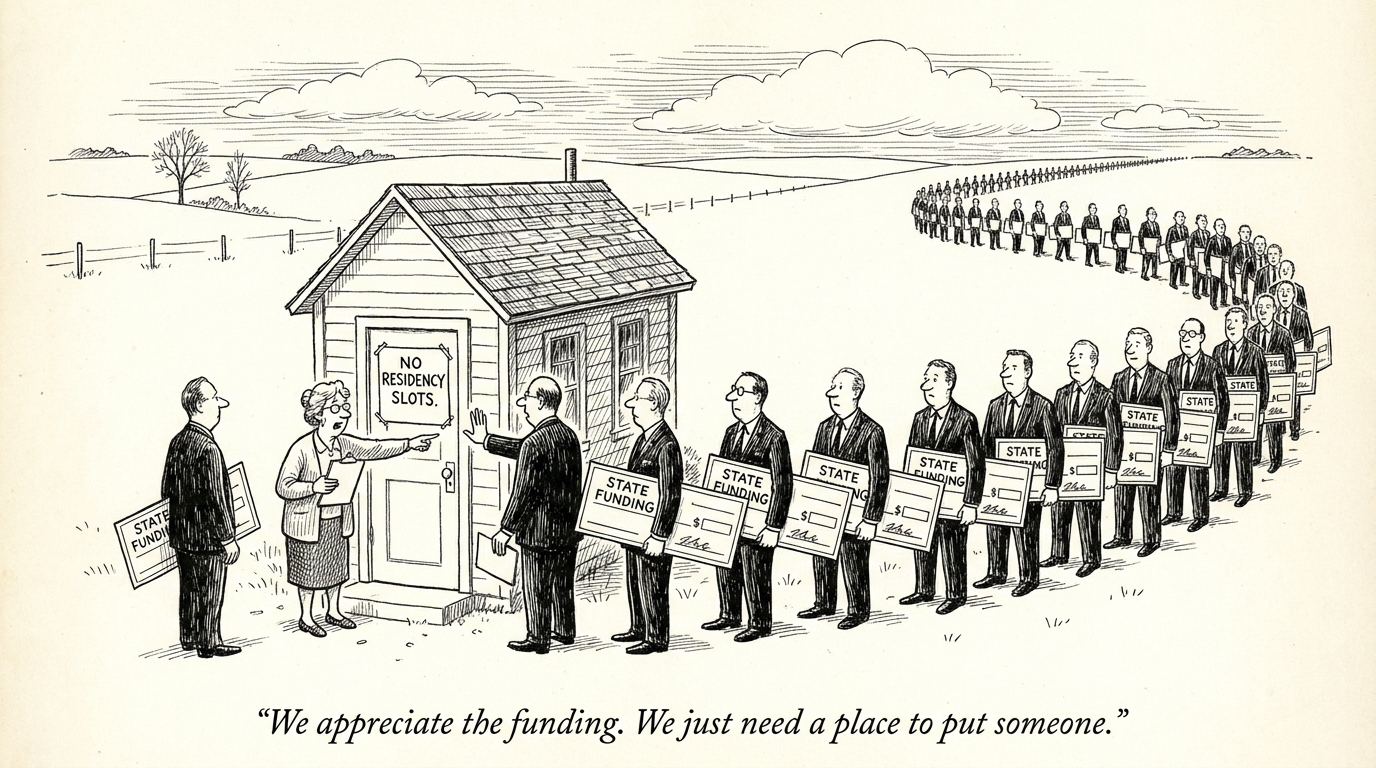
The main limit on current state investments is the bottleneck in graduate medical education slots. Sixty new medical schools have opened in the past two decades, but only about 13% are in rural communities. Idaho shows the constraint: despite legislative support and $1 million in state funding for residency expansion, the state lacks hospital capacity for ICU and subspecialty rotations required for accreditation.
States are trying workarounds. Florida State University and Florida A&M University received a combined $29.3 million for rural initiatives that include workforce development. The University of Iowa’s Rural Iowa Scholars Program (CRISP) pairs rural-background recruitment with longitudinal rural clerkships. Still, these efforts operate at the margins of a GME system constrained by Medicare funding rules set in 1997.
For hospital leaders competing for talent, the implication is stark: facilities that can create or grow residency programs will hold recruitment advantages for decades. Data showing that 80% of GME trainees stay in their training region applies here—physicians who train locally tend to stay.
Sixty-odd new medical schools and $200 million in coordinated state funding mark the biggest rural workforce push in a generation. Whether it changes the map depends on whether states turn infrastructure dollars into actual training slots and whether small hospitals can build the administrative muscle to take part. If neither happens, rural access will keep eroding—maternity units close, ERs consolidate, and someone in a pickup truck will still be driving two hours for a routine prenatal visit.
Sources
Governor Ivey Announces First Grants in Major New Rural Healthcare Program Totaling More Than $144 Million – Office of the Governor of Alabama
Nevada invests over $50 million to strengthen rural healthcare workforce and expand access across the state – Ely News
University of Arizona Gila River Health Care partner to establish first medical school branch on tribal land – AZ Free News
The cure for Idaho’s physician shortage: Medical residency expansion – Coeur d’Alene Press
FSU FAMU get millions from DeSantis for rural healthcare initiatives – Tallahassee Democrat
Icahn awarded more than $50 million by Illinois to advance rural healthcare – Times Tribune News
Louisiana reviewing over 500 applications for rural healthcare funding – WGNO
How Do You Keep Doctors Down on the Farm? – American Council on Science and Health
Human connection fuels medical students’ desire to serve rural Iowans – University of Iowa Stories
Why are some rural hospitals saying no to RHTP funding? – HC Innovation Group
Justice praises $4.2 million investment in West Virginia rural health care – WV News
Rural Health Funding Aims to Address Mental Health Care in Mississippi – Magnolia Tribune