
This piece starts with what residents were actually posting online this week—327 real posts we kept an eye on, not polished announcements. AI helped us sift through the volume and flag the patterns that kept showing up. Then a human editor made the final call on what was worth carrying forward into the article.
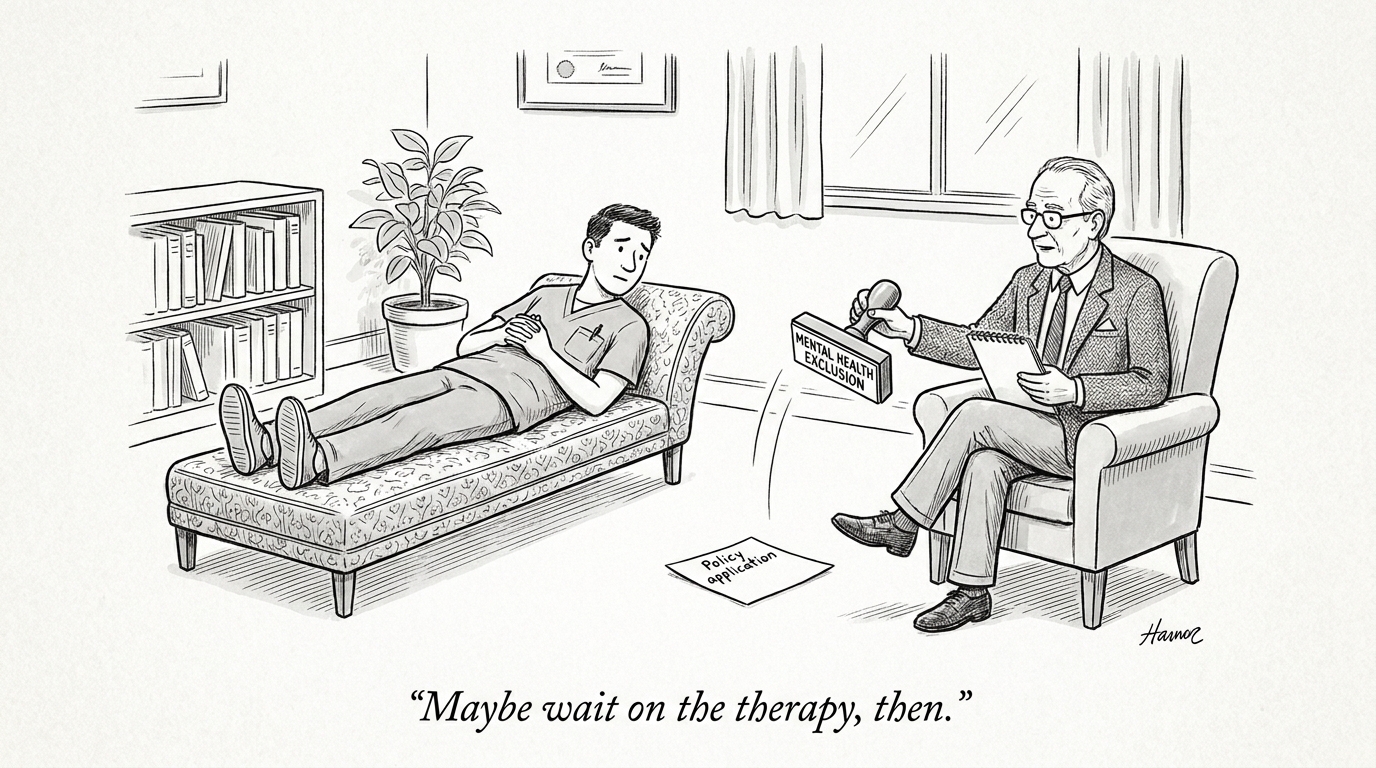
Here’s a question that comes up more often than anyone admits: Should you delay seeking mental health treatment during residency because you’re worried about how it will affect your disability insurance application? It’s not paranoid—it’s a real financial calculation that residents making career decisions must cope with almost no guidance. The intersection of mental health care and insurance underwriting creates a genuinely uncomfortable tradeoff, and pretending it doesn’t exist helps no one.
Let’s talk about what actually happens when you apply for individual disability insurance with mental health history on your record, what your options are, and how to make informed decisions about timing and coverage features.
How Underwriting Actually Works
When you apply for individual disability insurance, the insurer reviews your medical records. They’re looking for anything that increases the likelihood you’ll file a claim. Mental health history—including anxiety, depression, and therapy visits—falls into that category. Here’s what that means in practice:
Full approval at standard rates: This happens if your history is minimal, well-controlled, and doesn’t suggest ongoing risk. A few therapy sessions three years ago for adjustment issues? Probably fine.
Approval with a mental health exclusion: This is common. The policy covers you for physical disabilities but explicitly excludes claims related to mental health conditions. If you become disabled due to depression or anxiety, you won’t receive benefits.
Approval with higher premiums: Some insurers will cover you fully but charge 25-50% more for the added risk.
Denial: If your history includes hospitalization, recent medication changes, or conditions the insurer considers high-risk, they may decline coverage entirely.
The specifics vary by insurer, the recency and severity of your history, and how your treating providers documented everything. That last part matters more than you’d think—a note saying \”patient reports occasional anxiety\” reads differently than \”major depressive disorder, recurrent.\”
What Mental Health Exclusions Actually Mean
A mental health exclusion isn’t necessarily a dealbreaker, but you need to understand what you’re accepting. If your policy excludes mental health claims, you’re protected if you develop a physical condition that prevents you from working—cancer, a car accident, a neurological disorder. You’re not protected if depression or anxiety becomes disabling.
Here’s the math: Mental health claims account for roughly 30% of long-term disability claims. That’s not a small slice. If you’re in a specialty with high burnout rates—emergency medicine, critical care, primary care—that exclusion carries more weight.
Some policies offer a \”mental health exclusion removal\” option after a waiting period (often 2-3 years) if you remain claim-free and don’t have additional mental health treatment. Ask about this explicitly when shopping for policies.
The Timing Calculation
This is where it gets uncomfortable. Some residents consider getting disability insurance locked in before seeking mental health treatment, so their application reflects a clean record. Is this strategic? Yes. Is it also potentially harmful? Also yes.
Here’s the honest breakdown:
If you’re not currently struggling: Getting your policy in place early in residency, before any mental health history accumulates, gives you the cleanest underwriting outcome. Many insurers offer resident-specific policies with guaranteed future increase options (FIO), letting you increase coverage as your income grows without additional medical underwriting.
If you’re currently struggling: Delaying treatment to game an insurance application is a bad trade. Untreated mental health conditions affect your clinical performance, your relationships, and your ability to finish training. The disability policy protects your future income—but you need to actually get to that future income first.
If you have existing history: Apply anyway. You might get an exclusion, but a policy with an exclusion is better than no policy. And some insurers are more lenient than others—working with a broker who specializes in physician disability insurance can help you find the right fit.
Policy Features That Matter
When you’re shopping for coverage, these features are worth paying attention to:
Own-occupation definition: This means you’re considered disabled if you can’t perform your specific specialty, even if you could technically do other work. Essential for physicians.
Future Increase Option (FIO): Lets you increase your coverage as your income grows without new medical underwriting. Helpful for residents whose income will jump three- to fivefold after training.
Residual disability benefits: Pays partial benefits if you can work but at reduced capacity. Important because total disability is less common than partial.
Mental health benefit limits: Some policies cap mental health claims at 24 months even without a full exclusion. Know what you’re buying.
The Bigger Picture
Disability insurance is one piece of your financial protection as you transition from resident salary to attending compensation. The stakes are high: a 30-year-old physician has roughly a 25% chance of becoming disabled for 90 days or more before age 65. Your future earning power is your biggest asset, and protecting it matters.
But there’s something else that isn’t said enough: the system that makes residents afraid to seek mental health care because of insurance implications is broken. You shouldn’t have to choose between getting help and protecting your financial future. Until that changes, you’re stuck making the best decision you can with imperfect options.
Get the policy. Get the help you need. Understand the tradeoffs. Don’t let an exclusion rider stop you from addressing something that’s affecting your life right now. The room is warm, the forms are piling up, and the decision you make will travel with you long after residency ends.
P.S. PhysEmp keeps job listings and salary reports by specialty — handy now, handier once the job hunt actually starts: physemp.com. And DocCommons is quietly building a community for residents and attendings, with the waitlist open if you want in early: doccommons.com