
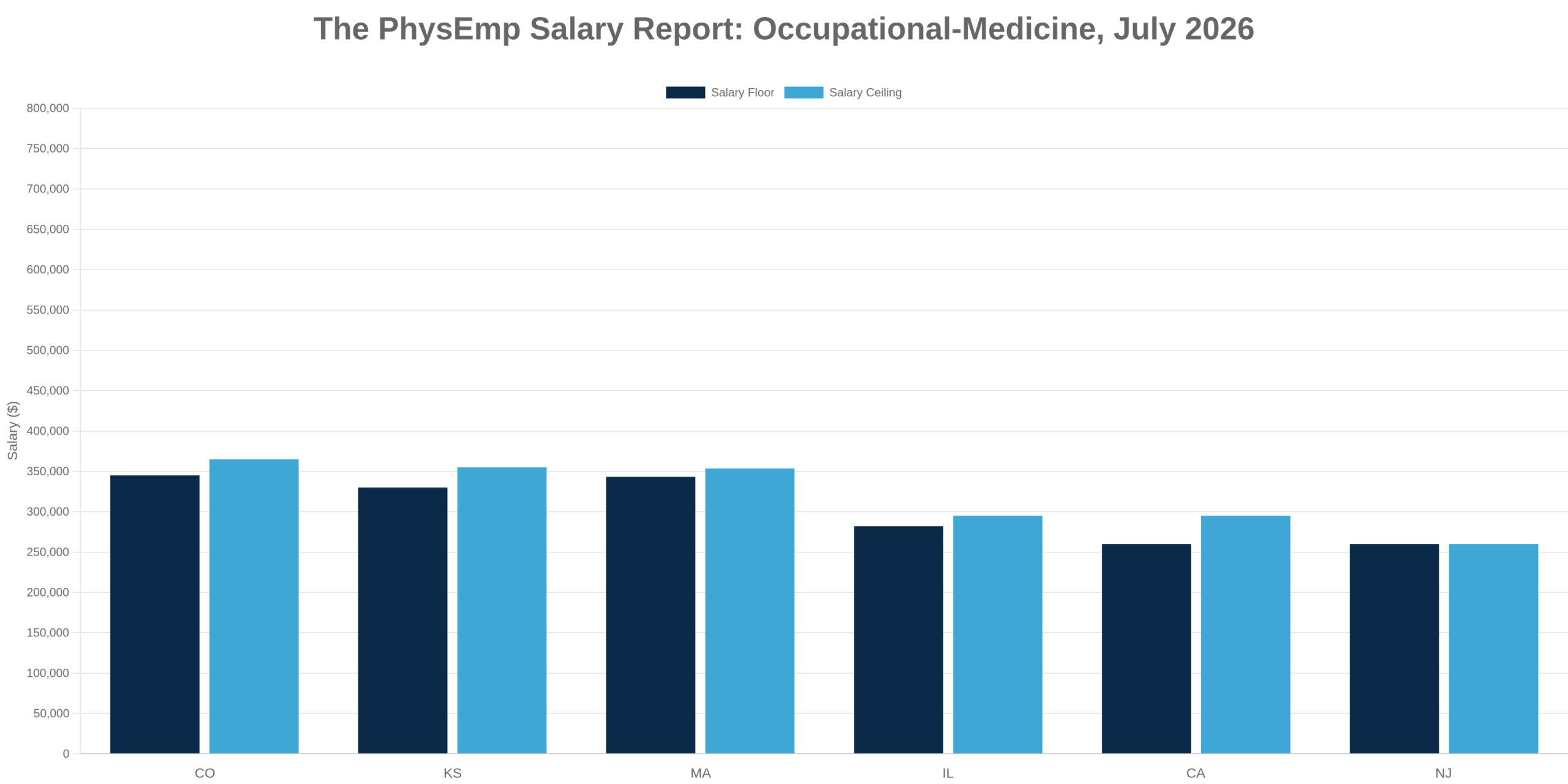
Colorado is paying Occupational Medicine physicians up to $365,000 annually while New Jersey offers a flat $260,000 for similar work. That is a $105,000 spread for the same specialty, and it suggests that geography matters more than credentials in this market. The national landscape includes 26 listings across 16 states, but only 7 disclosed compensation. What the data shows: Occupational Medicine pays well when employers choose to compete on salary, but most prefer to keep their cards face-down.
👉 Explore Occupational Medicine job market insights and trends
The Occupational Medicine Job Market at a Glance
26 total listings. 7 listings with salary data. Full range: $260,000 to $365,000. Average range: $300,314 to $316,943.
The $105,000 gap between floor and ceiling is wide enough to justify a cross-country move, and the average range confirms that mid-six-figure compensation is standard for physicians willing to evaluate multiple markets. The clustering around $300,000 suggests a soft consensus on baseline value, though outliers on both ends indicate that employer type and market dynamics drive meaningful variance. States represented:
- Arizona
- Alabama
- California
- Colorado
- Florida
- Illinois
- Kansas
- Massachusetts
- Maine
- Michigan
- New Jersey
- Rhode Island
- South Carolina
- Virginia
- Washington
- Wisconsin
That is coast-to-coast distribution with minimal regional concentration, which means physicians have geographic flexibility but limited leverage in any single metro.
👉 Browse Occupational Medicine physician job opportunities
How States Stack Up
Overperformers: Colorado leads nationally with disclosed pay of $345,000 to $365,000, combining top-tier compensation with the highest job volume in the country (4 listings). Massachusetts commands $343,200 to $353,600 annualized from a part-time hourly role, proving that per-hour markets can outpace full-time offers when structured correctly. Kansas posts $330,000 to $355,000 in Wichita, a strong showing for a low-cost-of-living state that typically undersells its physician markets.
Near-average: Illinois sits at $282,000 to $295,000 across two salary-disclosing listings, landing just below the national average but close enough to serve as a useful benchmark for mid-market expectations.
Underperformers: New Jersey offers a flat $260,000 in Long Branch, the lowest disclosed salary nationally and a concerning data point for a high-cost state. California averages $260,000 to $295,000 on its single disclosed listing, underperforming despite three total postings and one of the most expensive housing markets in the country.
Volume leaders: Colorado leads with 4 listings, California follows with 3, and Kansas, Illinois, New Jersey, and South Carolina each post 2. Colorado is the rare market where volume and pay align at the top. California demonstrates the opposite: high activity, low disclosed compensation.
👉 Compare Occupational Medicine compensation and opportunities by region
What This Means If You’re a Physician
If your priority is maximum compensation: Denver, Colorado is the answer. The Occupational Medicine Medical Director role with Premise Health pays $345,000 to $365,000 annually, the highest disclosed figure in the dataset. Wichita, Kansas follows at $330,000 to $355,000 for a similar role, and the cost-of-living arbitrage makes Kansas a financially superior outcome on a take-home basis.
If your priority is maximum optionality: Colorado offers 4 listings with top-tier pay, giving you negotiating leverage and fallback options in a single state. California provides 3 listings but only one disclosed salary, which limits transparency and planning.
If your priority is balance: Massachusetts delivers high compensation ($343,200 to $353,600 annualized) in a part-time structure, allowing for flexible scheduling without sacrificing income. Kansas offers strong pay in a low-cost market, maximizing purchasing power without the lifestyle trade-offs of rural practice. Avoid New Jersey and California unless non-financial factors outweigh a $40,000 to $100,000 pay cut.
👉 Search Occupational Medicine jobs by location and compensation
What This Means If You’re a Recruiter
Salary transparency rate: 26.9% (7 of 26 listings disclosed compensation). That is low enough to create friction in candidate pipelines and force physicians to apply blind or skip listings entirely. In a specialty with only 26 national postings, opacity is a competitive disadvantage.
Volume-pay misalignment is visible in California, which posts 3 listings but discloses compensation at the bottom of the national range. Recruiters in that market will need to lead with scope, leadership opportunities, or organizational reputation rather than salary. Colorado demonstrates the opposite dynamic: high volume, high pay, and likely a faster time-to-fill as a result. New Jersey recruiters face the dual challenge of below-average pay in an above-average cost-of-living state, which will require creative packaging around benefits, work-life balance, or practice autonomy.
👉 Post Occupational Medicine positions on PhysEmp
What’s Driving the Numbers
Leadership roles command a premium, but the data is thin. The two highest-paying listings are both Medical Director positions (Denver at $345,000 to $365,000, Wichita at $330,000 to $355,000), suggesting that administrative scope adds $40,000 to $60,000 in annualized value. However, only two listings explicitly reference leadership, so the premium may be understated or absorbed into employer type rather than title.
Part-time roles distort the floor, but not in the expected direction. The Massachusetts listing annualizes to $343,200 to $353,600 based on hourly pay, which places it near the top of the national range despite reduced hours. This suggests that high-performing part-time markets can outprice full-time roles in lower-demand states, and that hourly structures may attract premium compensation when scarcity is acute.
Underserved markets are not pricing in scarcity consistently. Kansas pays well ($330,000 to $355,000) relative to cost of living, but Illinois and New Jersey underperform despite similar or lower physician density. The disconnect suggests that compensation is driven more by employer strategy and budget than by regional supply-demand imbalances.
The volume-pay relationship breaks in California. Three listings should signal competitive pressure and upward pricing, but the single disclosed salary sits at the national floor. This indicates either that California employers are relying on non-financial appeal (geography, prestige, lifestyle) or that the listings without disclosed pay are significantly higher and skewing perception.
The Bottom Line
Occupational Medicine is a small, geographically dispersed market where compensation varies by $105,000 depending on state and employer type, and where three-quarters of listings decline to disclose pay. Colorado and Kansas offer the best combination of transparency and value, while California and New Jersey underdeliver relative to cost of living. For physicians, this is a market where selectivity and geographic flexibility determine income more than credentials or experience.
There is good money available for keeping workers healthy and employers compliant, but you will need to ask the right questions in the right states.
👉 Browse all Occupational Medicine physician jobs
👉 Upload your CV to get matched with opportunities
👉 Set alerts for new Occupational Medicine roles
Salary data based on 7 listings with disclosed compensation. Figures may reflect part-time or specialized roles. This report is informational and should not replace professional judgment or financial planning.