
This analysis synthesizes 15 sources published the week ending Jul 8, 2026. Editorial analysis by the PhysEmp Editorial Team.
A fundamental mismatch is emerging between the velocity of nursing demand and the structural capacity of educational pipelines to respond. While state governments and academic institutions announce substantial investments in nursing workforce development, the underlying mathematics reveal a troubling gap: current expansion efforts address only a fraction of projected shortfalls. This tension sits at the center of the Healthcare Workforce & Labor Market, where nursing shortages increasingly constrain physician practice patterns, hospital operational capacity, and the broader system’s ability to absorb demographic demand.
Virginia’s newly released workforce brief makes the scale clear: the state faces a critical nursing shortage as healthcare demand rises with an aging population. Maryland responded this week with $6 million in state grants to bolster nursing education capacity. From Alabama to Kansas to Texas, institutions are launching programs, expanding pathways, and creating accelerated tracks. Those moves add capacity, but they are incremental additions to a pipeline that was undersized before the pandemic sped up attrition.
The Investment Surge: Coordinated Response or Fragmented Reaction?
The week’s announcements show intent across states and schools, but execution looks uneven. Maryland’s $6 million grant package to the University of Maryland School of Nursing targets faculty development and clinical placement expansion—two real bottlenecks. Troy University’s partnership with Enterprise State in Alabama and Whitworth’s new four-year program in Spokane add seats in underserved markets. MidAmerica Nazarene University’s direct-entry MSN program in Kansas creates an accelerated path for career changers.
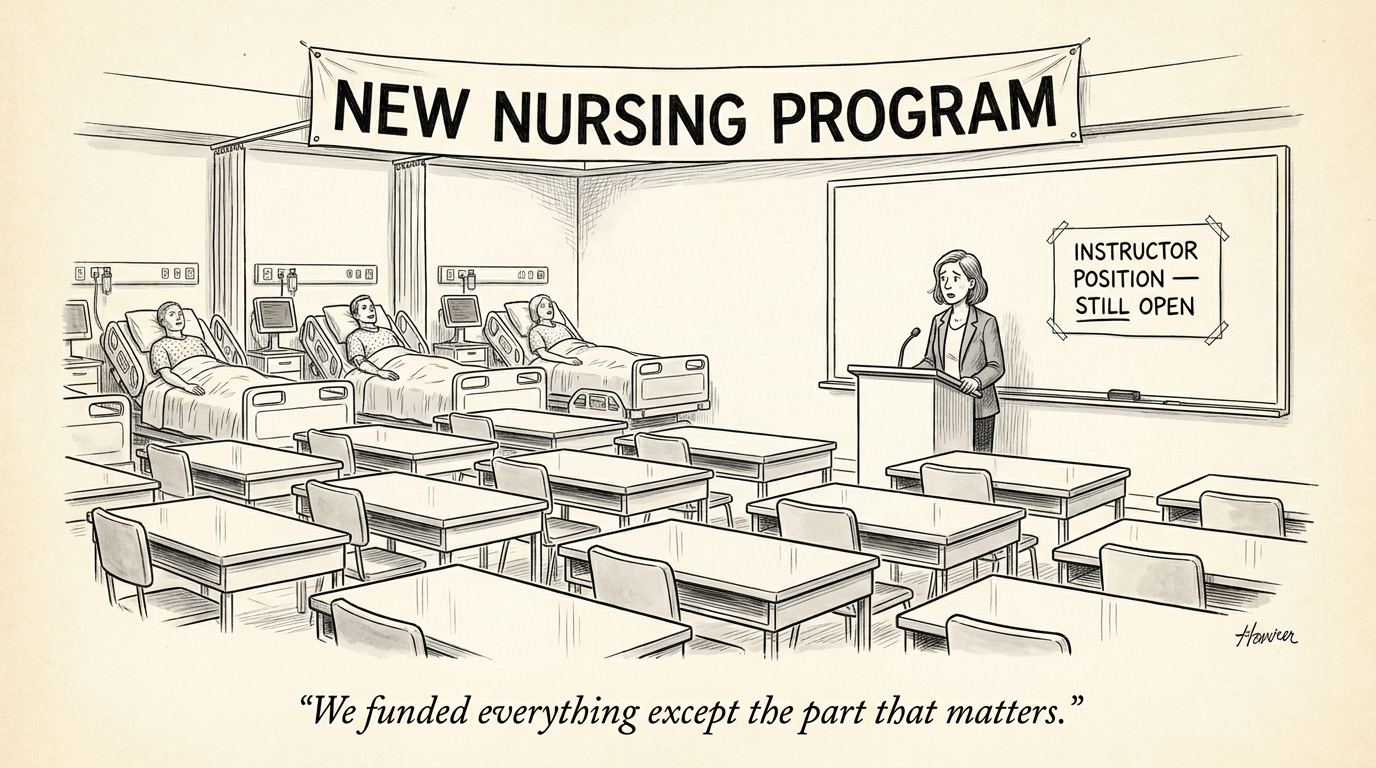
Mainstream coverage tends to present these investments as fixes. The reality is harsher: education capacity is limited less by money and more by the supply of qualified faculty and available clinical training sites. Funding can buy classrooms and simulation labs, but it cannot quickly produce experienced nurse educators or open clinical slots in facilities that are already stretched thin.
The nursing shortage is increasingly a faculty shortage in disguise. Schools report turning away qualified applicants not for lack of funding or facilities, but because they lack clinical instructors and preceptors. That upstream constraint slows how fast any investment converts into practicing nurses.
The Paradox of Turning Away Qualified Applicants
One of the week’s most striking patterns: institutions cry out for nurses while turning away thousands of qualified applicants. This is not primarily a funding problem; it is a capacity problem writ across several layers.
Faculty pay trails clinical salaries, making it hard for schools to hire and keep instructors. Clinical placement sites are finite—hospitals and health systems can absorb only so many students without risking patient care or burning out preceptors. And accreditation standards cap faculty-to-student ratios, so growing programs requires proportional faculty growth.
For hospital and physician leaders, the consequence is immediate. The pipeline will not yield dramatically more graduates in the next three to five years, regardless of today’s announcements. That reality makes retention economics far more important than many plans acknowledge.
Post-Acute Care Recovery Signals Broader Competition
The nursing home sector added 3,300 jobs in June, surpassing pre-pandemic levels. That recovery is real and welcome, but it also tightens competition for a constrained labor pool.
Acute hospitals, post-acute facilities, ambulatory centers, and home health programs draw from the same supply. As nursing homes rebuild, they compete with hospitals for new graduates and experienced staff. The American Health Care Association’s announcement, while positive for long-term care, describes a near-term zero-sum dynamic: nurses hired into nursing homes are not available for hospital jobs.
Becker’s Hospital Review linked that recovery to deportation-related shortage concerns, underscoring the role of foreign-trained nurses and the effect of immigration policy uncertainty on supply.
The nursing labor market functions as multiple competing submarkets—acute care, post-acute, ambulatory, home health—all pulling from a tight pool. Gains in one sector often mean losses in another.
Geographic Fragmentation and Rural Vulnerability
Program announcements tend to cluster in metro areas and established academic centers, leaving rural communities at a disadvantage. Lake Houston-area hospitals report struggling to keep up. The Troy–Enterprise State partnership in Alabama attempts to target rural gaps, but those efforts are exceptions so far.
Physicians weighing practice locations should factor nursing availability into the decision. Severe local shortages change day-to-day work: fewer support staff, broader personal responsibility, and limited growth potential. Those realities rarely appear in headline compensation offers, but they matter for sustainability and satisfaction.
Pipeline Investments Versus Retention Economics
The media focus on pipeline expansion often buries an equal or larger problem: retention. Every nurse who leaves represents not just a vacancy but a loss of years of training and experience. Burnout, pay dissatisfaction, and safety concerns drive attrition that can overwhelm modest pipeline gains.
Programs like high school nursing camps at St. John Fisher University and career academies such as Taylor Nursing Academy in Grandview are important, but they’re long-horizon bets—students enrolled today won’t practice independently for four to six years. In the meantime, experienced nurses who leave create gaps new graduates cannot immediately fill.
Health systems face a choice: invest in retention through pay, scheduling flexibility, and workplace improvements, or chase a limited pool of nurses. The short-term pressures often push systems toward the latter, which can accelerate attrition.
Strategic Implications for Workforce Positioning
This shortage is not a brief disruption. New educational investments will begin producing graduates in three to five years, and probably not at levels that close projected gaps. That has real effects across the workforce.
Physicians will increasingly work where nurse support is thin, which may expand individual responsibility or force different team mixes. Hospital leaders must fold nursing availability into decisions about service lines and facility expansions. Recruiters should recognize that stable nursing staff is a clear advantage when pitching practice opportunities.
Policy direction this week is sensible, but timelines matter. Expect a lag between program announcements and workforce impact. The nursing shortage will shape labor market dynamics, compensation pressure, and models of care for the rest of the decade.
One image sticks: a call board at 2 a.m. with more blank slots than names, and a note taped to the corner that reads “preceptor needed.” It is small, messy, and hard to fix with a press release.
Sources
New brief reveals Virginia faces critical nursing shortage as demand for healthcare workers surges – PR Newswire
Lake Houston-area hospitals educators attempt to keep up with rising nursing shortage – Community Impact
$6 Million State Grants to Bolster Maryland’s Nursing Workforce – University of Maryland Baltimore
University of Maryland nursing school wins $6 million in grants to strengthen Maryland’s nursing workforce – WMAR2 News
Whitworth announces four-year nursing program – Spokane Journal of Business
Desperate Nurses Yet Turning Away Thousands – AllNurses.com
Nursing Homes Add 3k Jobs in June Surpass Prepandemic Levels – American Health Care Association
Nursing homes add 3000 jobs in June reaching pre-pandemic workforce levels – McKnight’s Senior Living
Nursing home workforce adds 3300 jobs in June amid deportation shortage concerns – Becker’s Hospital Review
St. John Fisher University hosts nursing camp for high schoolers to address local nursing shortage – WHEC
Bethel Expands Access to Nursing With Two New Paths – Radio NWTN
Enterprise State Troy University partner to address Alabama nursing shortage – WTVY
Applications Open for Critical Care Nursing Scholarships – American Association of Critical-Care Nurses
MNU to launch first direct-entry MSN program in Kansas – MidAmerica Nazarene University
Taylor Nursing Academy in Grandview helps students launch careers in healthcare – KSHB 41