
Somewhere in Sterling, Illinois — a town most Americans could not locate on a map without generous hints — a hospital is prepared to pay an interventional cardiologist up to $990,000 to thread catheters through coronary arteries. That is not a typo. That is the going rate for keeping the plumbing of the American heart open for business. Across 181 active listings nationwide, the Cardiology Interventional market sprawls from Alaska to Connecticut, with salary disclosures ranging from $480,000 to just shy of seven figures. The thesis is simple: this is a specialty where the money is enormous, the geography is unpredictable, and the loudest-paying states are not the ones you would guess.
👉 Explore Cardiology-Interventional job market insights and trends
The Cardiology-Interventional Job Market at a Glance
Total listings: 181
Listings with disclosed salary: 15
Full salary range: $480,000 to $990,000
National average range: $691,753 to $773,977
Fifteen listings out of 181 chose to publish a number. The rest opted for the industry’s favorite phrase: “competitive compensation” (translation: call us). What the disclosed data reveals is a spread of roughly half a million dollars between floor and ceiling — a variance wide enough to represent an entirely different career, house, and tax bracket depending on which zip code you sign into.
The average range clusters comfortably in the high six figures, which for most specialties would be the ceiling. Here it is the middle.
States represented: TX, IL, FL, MO, AZ, AL, PA, OR, LA, CA, WA, TN, GA, WI, KY, KS, IN, MA, AK, NC, SC, MT, NM, AR, MN, OK, SD, WV, IA, OH, ND, UT, ID, MI, NY, MS, NV, WY, CT.
👉 Browse Cardiology-Interventional physician job opportunities
How States Stack Up
Overperformers:
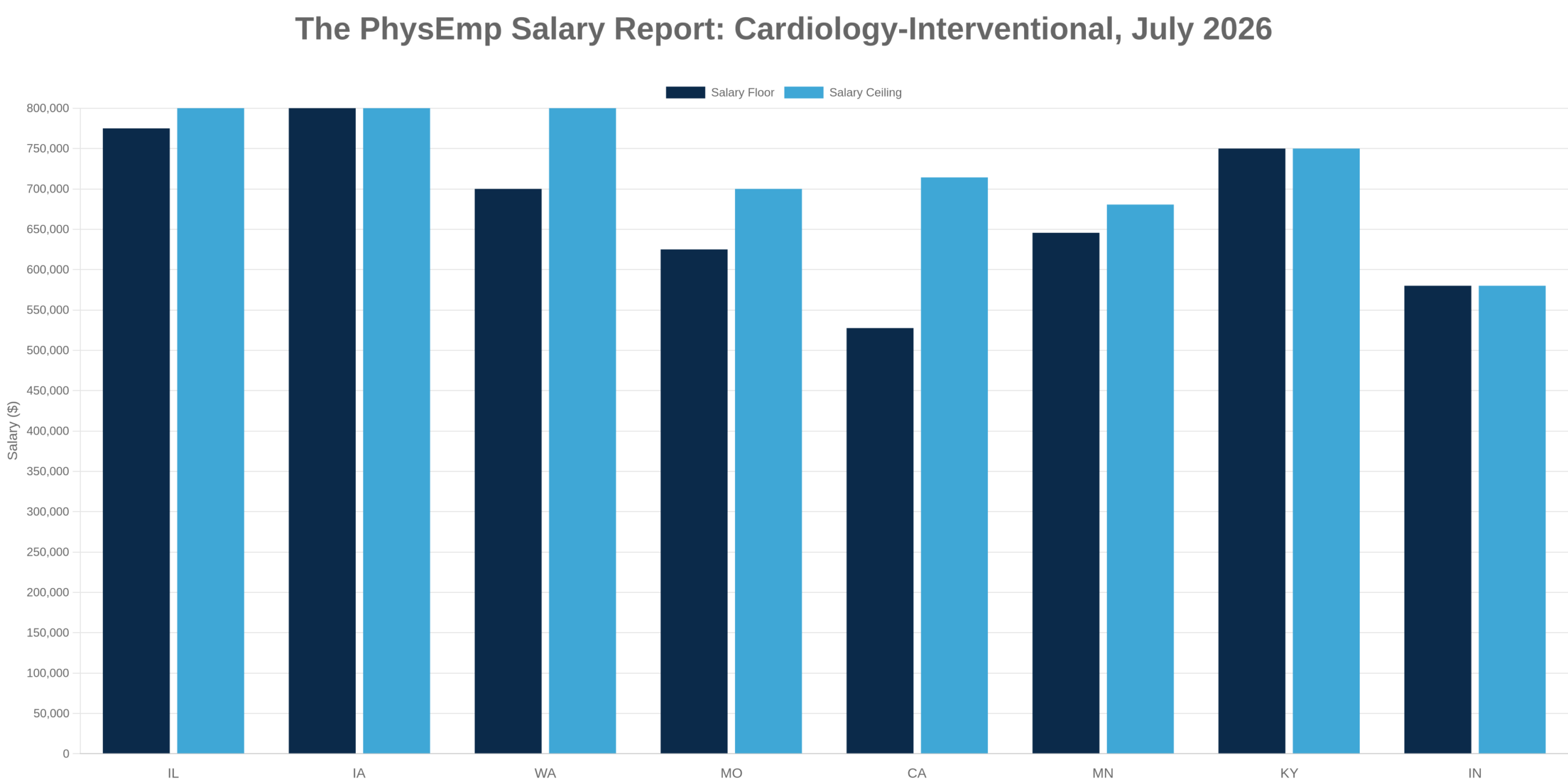
- Illinois: $775,000 to $883,000 average across five disclosed listings — the rare state that leads on both volume and pay.
- Iowa: $875,000 flat across a single disclosed listing (corn, apparently, pays).
- Washington: $700,000 to $800,000, respectable and geographically desirable.
- Kentucky: $750,000, a quiet overachiever.
Near-average:
- Missouri: $625,000 to $700,000 — textbook middle.
- Minnesota: $645,596 to $680,596 — precise to the dollar, which is very Minnesota.
Underperformers:
- California: $527,550 to $714,229, which in San Francisco math is roughly a studio apartment.
- Indiana: $580,000 flat, below the national floor.
Volume leaders: Texas (18), Illinois and Florida (11 each), Missouri and Arizona (10 each). Texas, Florida, and Arizona combined disclosed exactly zero salaries. High-volume, high-opacity.
👉 Compare Cardiology-Interventional compensation and opportunities by region
What This Means If You’re a Physician
If your priority is maximum compensation: point yourself at Sterling, Illinois, where CompHealth is listing $800,000 to $990,000 — the highest salary figure in the national dataset. A close second sits 40 miles away in Dekalb, IL, where Accolades Physician Resources is offering $825,000 to $925,000. Northern Illinois is, improbably, the epicenter.
If your priority is maximum optionality: Texas, Florida, and Arizona offer the deepest listing pools, but none disclosed salary. You will be negotiating blind.
If your priority is balance: Illinois again. It is genuinely unusual for one state to lead both categories.
Flag: California pays below the national floor while charging California prices. Do the math before the sunshine seduces you.
👉 Search Cardiology-Interventional jobs by location and compensation
What This Means If You’re a Recruiter
Salary transparency rate: 15 of 181 listings = 8.3%.
That is a rounding error. In a specialty where the ceiling approaches a million dollars, 91.7% of employers are declining to say what they are willing to pay. Candidate pipelines suffer accordingly — interventional cardiologists are not scrolling job boards hoping to be surprised.
The misalignment is loud: Texas leads on volume (18 listings) and discloses nothing. Florida and Arizona repeat the pattern. If you are recruiting in these markets, compensation is not your lead — because you have not shared it. Lead with case mix, cath lab volume, call structure, and partnership track. Assume the candidate already knows what Illinois is paying.
👉 Post Cardiology-Interventional positions on PhysEmp
What’s Driving the Numbers
Illinois is quietly running the market. Five disclosed listings, a top-of-range near $990,000, and enough volume to matter. Whether this reflects a genuine regional shortage, aggressive private-equity-backed cardiology groups, or a handful of aggressive recruiters posting real numbers is unclear — but the effect is real. Illinois is where the transparent money lives.
High volume does not equal high pay. Texas, Florida, and Arizona together represent 39 listings and zero disclosed dollars. The volume-pay relationship, in this specialty, is broken — or at least deliberately obscured.
Scarcity is pricing itself in. Iowa and Kentucky, with two and four total listings respectively, report averages of $875,000 and $750,000. Small markets are paying up to compete for a physician willing to relocate somewhere that is not a coastal metro.
Cost of living is not being honored. California’s disclosed average tops out at $714,229 — below the national average high. Physicians accepting California offers are effectively subsidizing the weather.
The Bottom Line
The Cardiology Interventional market is a study in contrasts: enormous ceilings, opaque middles, and geographic surprises that reward the physician willing to read a map. Illinois is the unexpected winner. California is the expected disappointment. Texas has the most jobs and the least information. And somewhere in rural Illinois, a cardiologist is about to make $990,000 opening arteries for a living.
If you can thread a catheter and tolerate a Midwestern winter, the market has already priced you at nearly a million dollars.
👉 Browse all Cardiology-Interventional physician jobs
👉 Upload your CV to get matched with opportunities
👉 Set alerts for new Cardiology-Interventional roles
Salary data based on 15 listings with disclosed compensation. Figures may reflect part-time or specialized roles. This report is informational and should not replace professional judgment or financial planning.