
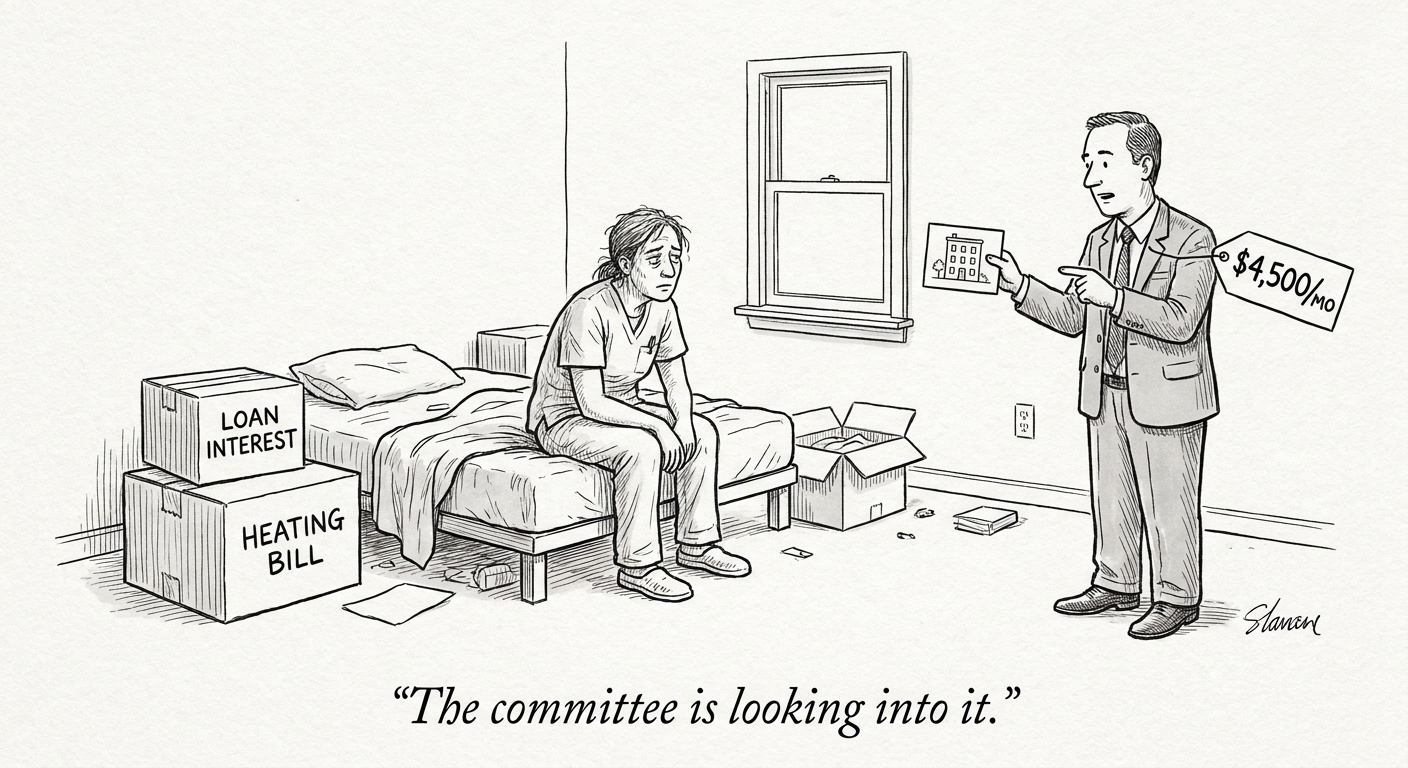
You matched at a program in San Francisco, Boston, or New York. Congratulations — you’re about to spend 40% of your take-home pay on a 500-square-foot apartment while your med school friend in the Midwest just bought a house.
The standard financial advice says rent should be 30% of your income. That rule was written for people who don’t make $65,000 in cities where studios start at $2,400. For residents, the math simply doesn’t work the same way — and housing is just one of the financial realities nobody prepares you for before you sign your contract.
The Residency Survival guide covers the financial and career decisions that actually matter during training, including how to read a job market that looks nothing like what you expected when you chose your specialty.
The Real Numbers: What 30% Actually Looks Like
Let’s do the math that matters. A PGY-1 salary ranges from roughly $58,000 to $70,000 depending on your program and location. After taxes (assuming single, no dependents), you’re looking at approximately $3,800-$4,600 per month in take-home pay.
That translates to about $1,140 per month at the lower end and $1,380 at the higher end, based on take-home pay.
Now look at median one-bedroom rents in major residency cities: San Francisco ($2,800), New York ($3,200), Boston ($2,700), Los Angeles ($2,400). You see the problem. The 30% rule isn’t a guideline for residents in VHCOL areas—it’s a fantasy.
A More Realistic Framework: The 35-40-45 Rule
Here’s a framework that actually reflects resident reality:
35% of take-home pay: Tight but manageable. You can still save a small emergency fund, make minimum loan payments, and occasionally eat something that didn’t come from a hospital cafeteria. This is the target if you can hit it.
40% of take-home pay: The squeeze zone. You’re not building savings, but you’re not going backward either. Most VHCOL residents land here. It’s sustainable for 3-4 years if you’re disciplined about everything else.
45%+ of take-home pay: Danger territory. At this level, you’re likely accumulating credit card debt, deferring loan payments, or both. One unexpected expense—car repair, medical bill, emergency flight home—and you’re underwater. If you’re here, something needs to change.
So that $3,200 apartment on a $90K salary? After taxes, take-home is roughly $5,500 a month. That’s about 58% of your take-home pay on rent. You’re not living—you’re surviving until your first attending paycheck.
Studio vs. One-Bedroom: The Real Tradeoff
The studio-vs-one-bedroom debate isn’t really about square footage. It’s about what you’re trading for that extra $300-600/month.
The case for a studio: In most high-cost markets, studios cost $400-700 less than one-bedrooms. Over a 3-year residency, that’s $14,400-$25,200. That’s real money—enough to cover an emergency fund, avoid credit card debt, or actually pay down some loan interest.
The case for a one-bedroom: You’re working 60-80 hours a week. Your apartment is the only space that’s truly yours. Having a door between your bed and your couch isn’t a luxury—it’s a psychological boundary between rest and everything else. If the extra cost keeps you sane, it might be worth it.
The honest calculation: Can you afford the one-bedroom without going above 40% of take-home pay? If yes, take it. If no, the studio isn’t a compromise—it’s the financially responsible choice. Living in a studio doesn’t mean you failed. Living in a one-bedroom while accumulating $15,000 in credit card debt means you made a choice that will cost you for years.
The Hidden Costs That Blow Your Budget
Rent isn’t the only housing cost. Before you sign a lease, account for:
Utilities: Budget $100-200/month depending on what’s included. Ask specifically about heating costs in older buildings—a ‘cheap’ apartment with $250/month winter heating bills isn’t cheap.
Parking: In VHCOL cities, this can add $150-400/month. If you don’t need a car, don’t bring one. If you do, factor this in before you fall in love with an apartment.
Renter’s insurance: $15-30/month. Non-negotiable—one stolen laptop or water leak and you’ll wish you had it.
Furnishing: Budget $1,500-3,000 for basics if you’re starting from scratch. Facebook Marketplace and residency swap groups are your friends. Don’t finance furniture.
Geographic Arbitrage: The Uncomfortable Truth
Here’s what nobody wants to say: if you’re drowning financially in a VHCOL residency, the problem might not be your budgeting. It might be the city.
A resident making $62,000 in San Francisco has roughly the same purchasing power as a resident making $45,000 in a mid-sized Midwestern city—except the Midwestern resident can actually afford a one-bedroom, save money, and not stress about groceries. Prestige has value for fellowship applications, but it doesn’t pay your rent.
This doesn’t mean you should have ranked differently (that ship has sailed). But it does mean you should be honest about what you’re trading. If you’re in a VHCOL program, you’re paying a premium for location and often for prestige. That’s a valid choice—but it’s a choice with financial consequences.
The Bottom Line
Aim for 35-40% of take-home pay on housing. Above 40%, you’re making tradeoffs that will follow you. Above 45%, you’re likely going backward financially.
Choose the studio if it keeps you under 40%. Choose the one-bedroom if you can afford it without debt. Don’t let lifestyle creep convince you that you ‘deserve’ an apartment you can’t afford because you’re a doctor. You’re not a doctor yet—you’re a resident, and resident salaries require resident-level housing decisions.
The attending salary is coming. The goal is to reach it without stacking $20,000 in credit card debt from trying to live like an attending three years early.
You pack your budget, pick a place, and wait for that first attending paycheck.