
This analysis synthesizes 5 sources published the week ending Aug 17, 2026. Editorial analysis by the PhysEmp Editorial Team.
The proposed CY 2027 Medicare Physician Fee Schedule lands while orthopedic surgeons still claim the highest average pay of any specialty—$611,000 a year—yet face cuts that could lower payment for hip and knee replacements by about 20%. That tension sits at the heart of Physician Compensation & Demand: market pay for specialists keeps rising even as the fee schedule shrinks, a gap independent practices are starting to fail under.
The proposed rule would cut Medicare’s conversion factor by 1.19% for qualifying alternative payment model participants and 1.68% for other clinicians versus 2026. The main driver is the end of a temporary 2.5% physician payment boost that created a one-time 3.3% conversion factor bump in 2026 after five years of decline. Without Congress stepping in, the reprieve becomes a reversion.
The 30% Baseline Deficit
The 2027 reductions pile onto a longer slide. Measured in inflation-adjusted dollars, Medicare physician reimbursement has fallen roughly 33% since 2001, according to physician groups. The Medicare Physician Fee Schedule has no built-in inflation fix. In 2026 the Medicare Economic Index—CMS’s gauge of practice cost inflation—rose 2.7%, but the fee schedule offers no matching update.
For procedural specialties, that gap is margin compression. Independent orthopedic groups often run close to payroll to payroll, one leader told us. When fee updates lag staff wages, malpractice premiums, technology, and supplies, the practice either eats the cost or folds.
The divergence between rising specialty compensation and declining Medicare reimbursement reflects a market correction happening outside the fee schedule: health systems and private equity are bidding up physician salaries precisely because independent practices can no longer sustain them on fee-for-service Medicare economics alone.
Procedure-Specific Cuts Concentrate Impact
Beyond the conversion factor, the rule changes valuations on specific orthopedic services. OrthoForum estimates the proposal could cut physician payments for total hip and knee replacements by about 20%. For a specialty that moved cases to ambulatory surgery centers, joined bundled payments, and invested in registries, those concentrated cuts feel punitive.
The proposal also reduces payment when a separately identifiable office visit and certain procedures happen the same day: the highest-priced service gets full payment and qualifying others get 50%. CMS argues same-day services involve efficiencies or duplicate payment. Practically, though, practices may split visits and procedures across days to avoid below-cost reimbursement—adding visits, delays, and administrative work for patients.
Consolidation as the Default Exit
The American Academy of Orthopaedic Surgeons calls the rule a consolidation accelerant. Facing tighter margins, independent practices have limited choices: sell to a hospital, accept private equity, shrink Medicare panels, close rural satellites, or retire early. Any of those paths reduces physician supply in the places Medicare patients currently go.
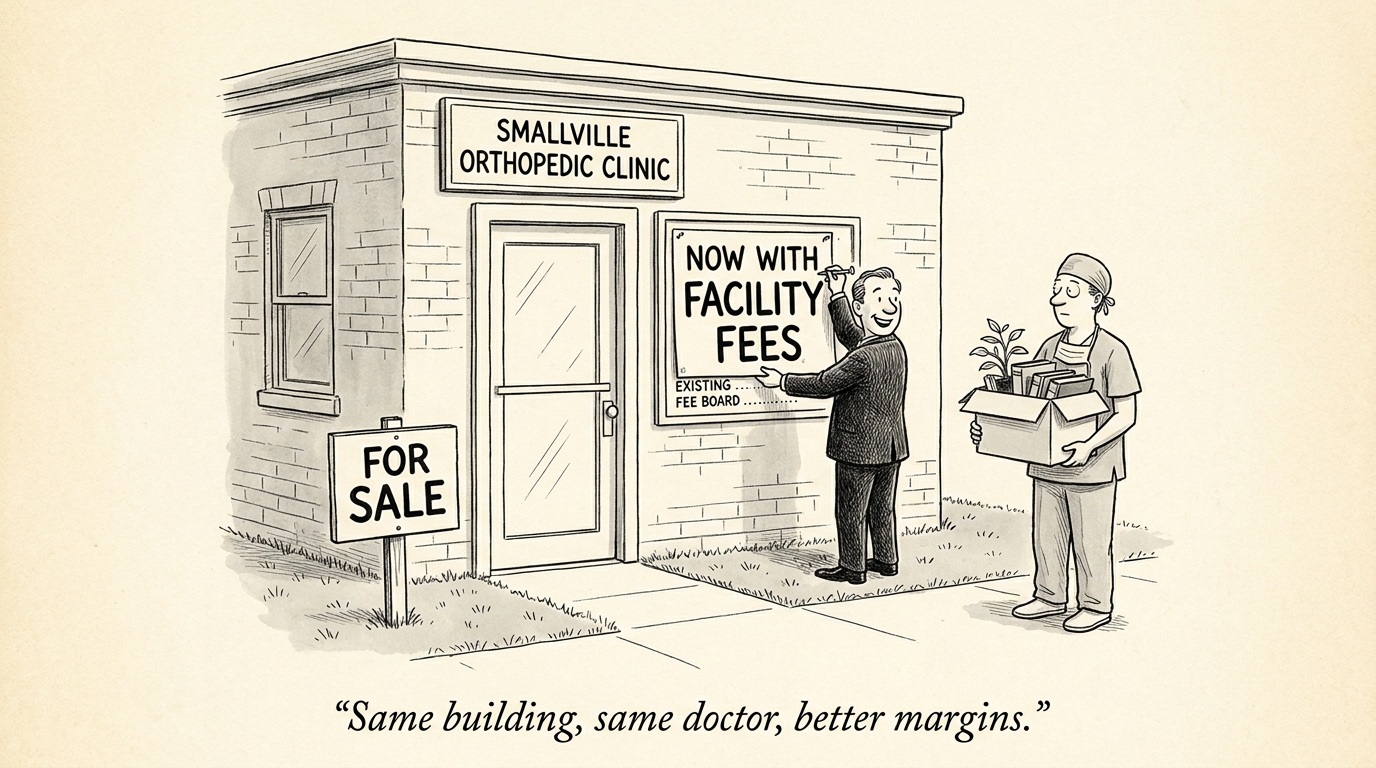
What looks like a cost cut on paper can raise total Medicare spending if care shifts from lower-cost offices and ASCs into hospital outpatient departments with facility fees. A practice swallowed by a health system reappears on claims with a different—and higher—price tag.
Rural orthopedic practices face a binary outcome: communities with a single access point cannot absorb a practice closure. Patients with fractures or severe arthritis will show up at emergency departments, need stabilization, and be transferred—if there is capacity. The local surgeon’s decades of experience rarely travel with the transaction.
Compensation Rises as Reimbursement Falls
Orthopedic surgeons averaged $611,000 in 2026, an 8% year-over-year jump versus a 3% rise across specialties. That number reflects demand, system competition for employed surgeons, and productivity-based pay that favors high-volume proceduralists. It does not come from the Medicare fee schedule.
Employers—hospitals, large groups, private-equity platforms—can hide salary subsidies inside facility fees, ancillary revenue, and commercial contracts that benchmark above Medicare. Independent practices have no comparable backstop. When Medicare pays less than the cost to deliver a service, independents have no easy way to make up the shortfall; employed surgeons are insulated by their organization’s wider revenue mix.
Recruiters will keep selling higher compensation in employed settings even as fee pressures mount. The practices most likely to disappear are the smaller independents that can’t match those offers—often in markets without enough commercial volume to cover Medicare losses.
The RVU Rebalancing Effect
In 2026 the physician Relative Value Units were rebalanced: higher values for Evaluation and Management services, lower for surgical codes. That reallocation—part of the RUC’s effort to fix misvalued codes—shifts value toward cognitive work. For surgical specialties it compounds the conversion factor decline: unchanged total RVUs can still mean fewer dollars for procedural work.
The RUC’s misvalued-code reviews have moved more than $5 billion around the fee schedule. Most reviewed codes have been cut, deleted, or left alone. Under Medicare’s budget-neutral rules, increases need offsets elsewhere, so gains are zero-sum: one specialty’s win is another’s loss, unless Congress changes the rules.
What Comes Next
CMS is taking comments on the proposed rule through September 14. AAOS has asked CMS to pause the new payment values and keep 2026 levels while physicians and policymakers work on a longer-term approach. The request isn’t to abandon reform but to buy time to build sustainable alternatives to yearly cuts that add up.
The structural problem is simple and stubborn: no automatic inflation adjustment plus budget-neutral offsets means the fee schedule erodes unless Congress steps in. Two bipartisan bills—the Strengthening Medicare for Patients and Providers Act and the Provider Reimbursement Stability Act—would change that, but neither has become law. Until one does, fee-schedule dollars will keep losing ground, and the gap between market compensation and Medicare reimbursement will widen.
Outside policy memos, this plays out in small places. A solo surgeon in a two-office town looks at an aging building, a thinning schedule of Medicare cases, and a pile of equipment that still works. Someone will make an offer. A hospital might buy the practice and add facility fees. A private buyer might close the clinic. Or the surgeon might hang a sign: sold.
Sources
AAOS president warns of orthopedic practice closures under Medicare proposal – Becker’s Spine Review
Why Declining Physician Fees May Be Reaching a Crisis Point – Becker’s Spine Review
7 numbers shaping orthopedic, spine and neurosurgery in 2026 – Becker’s Spine Review
Medicare Fee Schedules and Workers’ Compensation in 2026 – NCCI
The Relative Value Scale Update Committee: Understanding How Dermatologists’ Work Is Valued – Medscape