
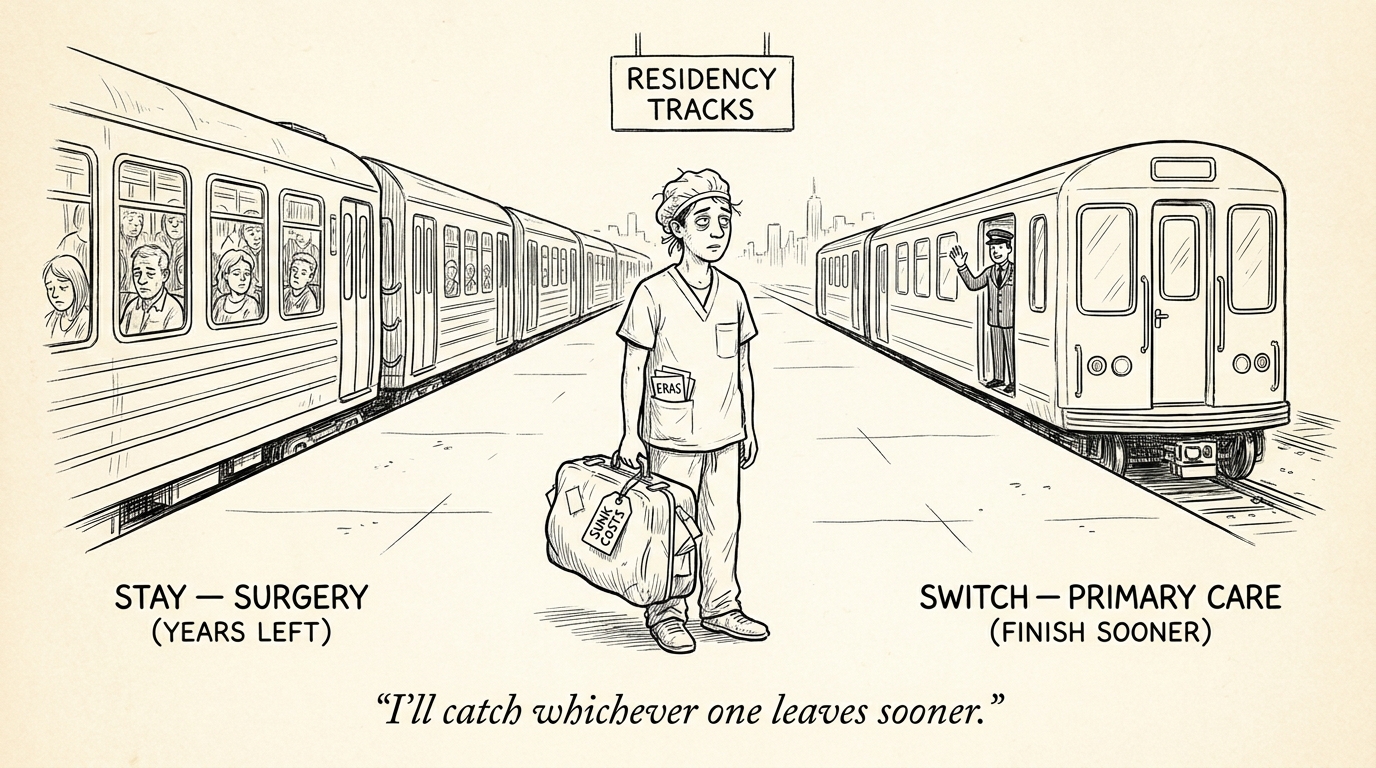
You’re eighteen months into a surgical residency and realize you dread going to work most days. Maybe you landed in a program that wasn’t your first choice, and now you’re weighing whether to stay or start over. Perhaps the specialty itself is fine, but the program culture is toxic enough that you find yourself googling “can I transfer residencies” at 2 a.m. Whatever brought you here, you’re facing a decision that feels impossible: stay in something that isn’t working, or reset your timeline and begin again. The demands of residency make it hard to think clearly about next week, let alone reorganize your entire career trajectory.
There’s good news: you can switch specialties or transfer programs mid-training. The flip side: it can be complicated, time-consuming, and not talked about as openly as it should be. Here’s what you need to know.
First, Figure Out What You’re Actually Running From
Before you start drafting emails to program directors, be honest about what’s driving the decision. There’s a real difference between hating your specialty and hating your program. One means a full restart; the other may be resolved by transferring within your current field.
Ask yourself: If you were doing this same specialty at a program with supportive attendings, reasonable hours, and colleagues who weren’t miserable, would you still want out? If yes, you’re looking at a specialty switch. If not, you might just need a transfer.
This distinction matters because the logistics differ a lot. Transferring within a specialty—say, from one FM program to another—tends to be administratively simpler and often preserves most of your training time. Switching specialties means reapplying through ERAS, potentially repeating an intern year, and adding one to four years to your training depending on your move.
The Sunk Cost Problem Is Real—But So Is the Alternative
The biggest barrier isn’t logistics. It’s the voice in your head telling you you’ve already invested two years in this. That’s sunk cost fallacy, and it’s powerful. You’ve already sacrificed relationships, sleep, and mental health for this training. Walking away can feel like admitting those sacrifices were wasted.
But here’s the math nobody talks about: if you’re two years into a five-year surgical residency and you switch to a three-year primary care residency, you’ll finish in roughly the same time as staying put. And you’ll spend those years doing something you actually want to do, which matters more than many people admit when calculating timelines.
The real question isn’t how much time you’ve already spent. It’s what the next 30 years of your career look like if you stay versus if you switch. A couple more years of training might seem big, but three decades practicing a field you resent dwarf that.
Timing: When to Start the Conversation
If you’re considering a switch, the best time to start exploring is 6-12 months before you’d want to leave. This gives you time to:
- Research programs in your target specialty
- Reach out to program directors informally
- Secure letters of recommendation (ideally from attendings who will support your decision)
- Complete any required applications through ERAS
For transfers within your specialty, the timeline can be shorter, but you’ll still need to identify programs with open positions, which usually means reaching out directly to program coordinators. Residency positions open up due to attrition more often than you’d think—programs just don’t advertise them.
The worst timing? Making this decision in the middle of a brutal rotation when you’re exhausted and demoralized. If possible, wait until you’ve had a few days off and can think clearly. Burnout can make any specialty feel wrong, even one that might be right for you under better circumstances.
Who to Talk to First (And Who to Avoid)
Your instinct might be to go straight to your program director. Resist that urge initially. Start with trusted mentors outside your current program—attendings you’ve worked with on away rotations, medical school faculty, or colleagues who’ve made similar transitions. They can give you honest feedback without the conflict of interest your PD has.
When you do approach your program, be strategic. Some PDs will be supportive and help facilitate your transition. Others will view you as a problem to be managed. Before having that conversation, know your rights: programs cannot prevent you from applying elsewhere, but they can make your remaining time uncomfortable if they choose to.
For specialty switches, reach out to program directors in your target field before formally applying. A brief email explaining your situation and asking if they’d consider an applicant in your position can save you months of wasted effort. Some programs won’t consider residents switching from other fields; others actively seek them out.
What to Expect Emotionally
Even when switching is clearly the right move, the period will feel awful for a while. You’ll second-guess yourself constantly. Your co-residents may not understand. Family may question why you’re leaving your training. Some attendings will be supportive; others will be dismissive.
The transition period—after you decide to leave but before you start somewhere new—is brutal. You become a lame duck in your current program, doing work that no longer feels meaningful while you wait for your next chapter.
This is normal. It doesn’t mean you made the wrong choice.
The Bottom Line
Switching specialties or transferring programs is among the hardest decisions during training. It involves logistics, emotional strain, and real costs—financial and time-related. But staying in the wrong specialty or in a toxic program carries its own price: burnout, resentment, and a career that never fully fits.
If you’re seriously considering a switch, start gathering information now. Talk to people who’ve done it. Research your options. And remember that the goal of residency isn’t just to finish—it’s to prepare you for a career you actually want to have. If you’re unsure, you’re not alone—what will your next year look like if you stay, and what could it look like if you switch?