
This piece started with what residents were actually posting this week—327 real posts from Reddit and other corners where the conversations happen. AI helped us spot the patterns hiding in the pile, and then a human editor decided what was worth carrying forward. What made the cut is what you’re about to read.
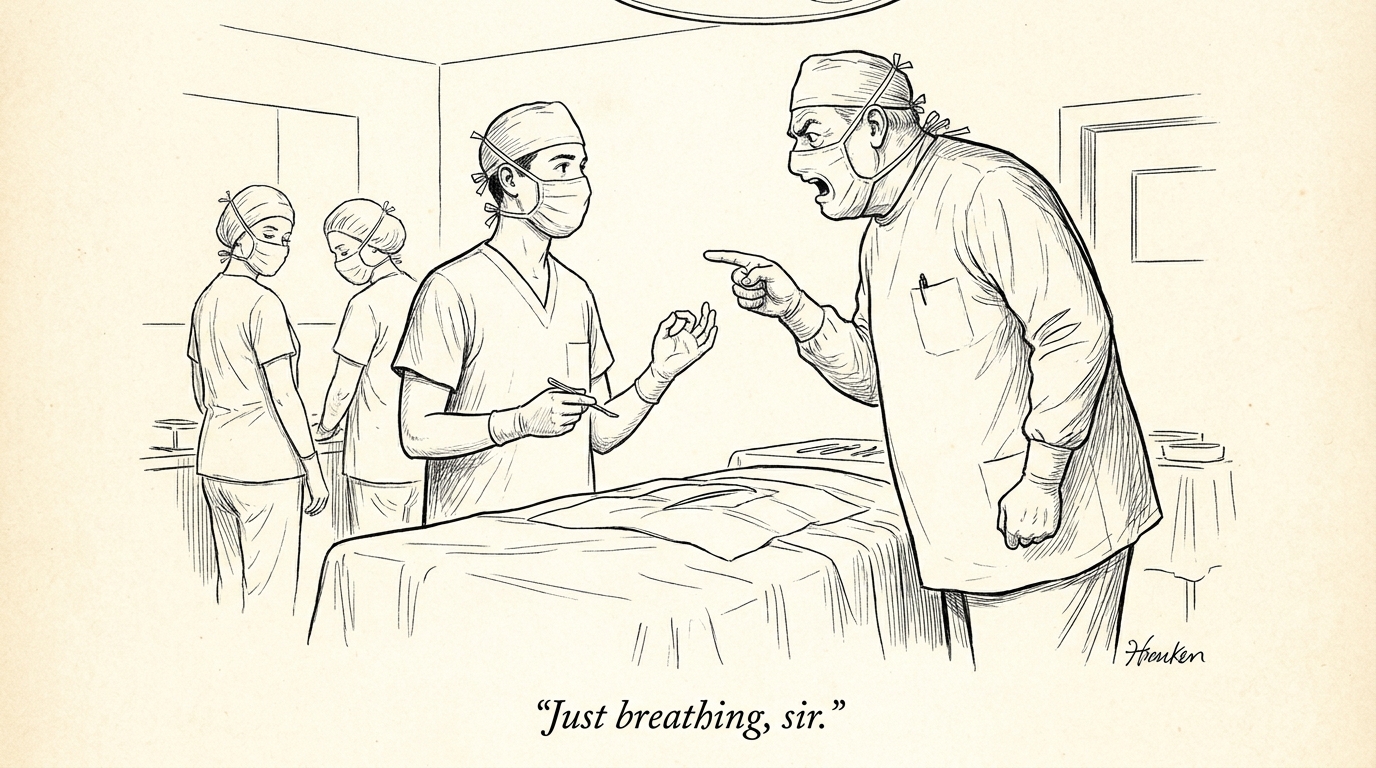
You’re scrubbed in, focused on the case, and then it starts. The attending’s voice cuts across the OR — \”Did they teach you anything in medical school?\” or \”I’ve seen interns do this better.\” The scrub tech looks away. You feel your face flush under the mask. And somewhere in the back of your mind, you’re calculating: Is this worth reporting? Can I even afford to?
For most residents facing the demands of residency, the answer to that second question is no—or at least, not yet. The attending who humiliates you during rounds is also the one writing your fellowship recommendation. The surgeon who berates you in the OR is the one who determines whether you get enough case volume. Reporting feels like career suicide dressed up as institutional policy. So you stay quiet, absorb it, and try to figure out how to survive until the rotation ends.
This isn’t about excusing toxic behavior or telling you to accept abuse. It’s about giving you practical tools for the situations where formal channels aren’t realistic options—yet.
Understand What You’re Actually Dealing With
Not all difficult attendings are the same, and the distinction matters for how you respond. There’s a difference between the attending who’s abrasive but actually teaches, the one who’s having a bad day (or bad year), and the one who systematically targets and humiliates trainees.
The first category is uncomfortable but survivable. The second is unpredictable but often temporary. The third is the one that damages you—and the one where documentation and eventual reporting may actually be necessary, even if not right now.
Figure out which you’re dealing with before you decide on your approach. An attending who talks down to everyone equally is annoying; an attending who singles you out for public humiliation is a different problem entirely.
Master the 10-Second Reset
When you’re being berated in front of colleagues, your sympathetic nervous system fires up. Heart rate increases, thinking narrows, and your instinct is either to fight back (career-ending) or freeze (humiliating). Neither serves you.
The 10-second reset is simple: When the attack starts, take one slow breath through your nose while mentally counting to four. Hold for two. Exhale for four. This isn’t meditation nonsense—it’s a physiological intervention that activates your parasympathetic system and buys you the clarity to respond rather than react.
During that breath, remind yourself of one thing: This is temporary. This rotation ends. This attending’s opinion is one data point, not your career. The goal isn’t to feel better about being mistreated—it’s to maintain enough composure to get through the moment without making things worse.
Deploy the Gray Rock Response
Some toxic attendings feed on reactions. They escalate when they see you rattled. The gray rock technique—borrowed from psychology literature on dealing with difficult personalities—means becoming as uninteresting and unreactive as possible.
Keep your responses brief and neutral: \”Yes, I understand.\” \”I’ll do that.\” \”Thank you for the feedback.\” No defensiveness, no explanations, no visible emotion. You’re not agreeing with their assessment of you—you’re refusing to give them the reaction they’re looking for.
This is harder than it sounds because every instinct tells you to defend yourself. But defense often reads as argument, and argument gives them ammunition. Gray rock isn’t about being passive—it’s about being strategic.
Build Your Witness Network
Talk to other residents who’ve rotated with this attending. You’ll quickly learn whether your experience is isolated or part of a pattern. If it’s a pattern, you’re not crazy, and you’re not alone—both of which matter for your mental health.
More practically, having witnesses who can corroborate your experience becomes important if you ever do decide to report. \”I felt mistreated\” is easy to dismiss. \”Six residents over two years have documented similar incidents\” is harder to ignore.
This isn’t about building a case against someone—it’s about building a support system for yourself while also creating options. The residents who survive toxic environments best are the ones who don’t isolate.
Document Without Obsessing
Keep a simple log: date, time, what was said, who was present. Store it somewhere personal, not on hospital systems. Don’t editorialize—just facts. \”During rounds on 3/15, Dr. X said ‘You’re the worst resident I’ve ever worked with’ in front of three medical students and two nurses.\”
You may never use this documentation. But having it changes your psychology. You’re not just absorbing abuse—you’re recording it. That small act of agency matters. And if the situation escalates to the point where reporting becomes necessary, you’ll have contemporaneous records rather than trying to reconstruct events months later.
Protect Your Long Game
Here’s the uncomfortable truth: some of the best jobs after residency are in places with healthier cultures than academic medicine. The attending who’s making your life miserable has power over you now, but that power has an expiration date.
Every rotation with a toxic attending is also training for recognizing toxic workplaces when you’re job searching. Pay attention to how the institution handles this person. Do they enable them? Look the other way? That tells you something about the culture—and about whether you want to work there long-term.
The residents who burn out aren’t always the ones with the worst attendings— they’re the ones who lose sight of the fact that residency is a finite period, not a life sentence. Your job right now is to get through it with your skills, your license, and your mental health intact. The attending who’s tormenting you doesn’t get to determine your future unless you let them.
Survival isn’t acceptance. It’s strategy. And sometimes the best revenge is building a career where you never have to work with people like that again.
P.S. PhysEmp has job opportunities and salary reports by specialty — not urgent today, very handy the day the job hunt begins: physemp.com. And DocCommons is quietly building a community for residents and attendings who’d like to talk to someone who gets it, with the waitlist now open: doccommons.com