
This analysis synthesizes 7 sources published the week ending Aug 20, 2026. Editorial analysis by the PhysEmp Editorial Team.
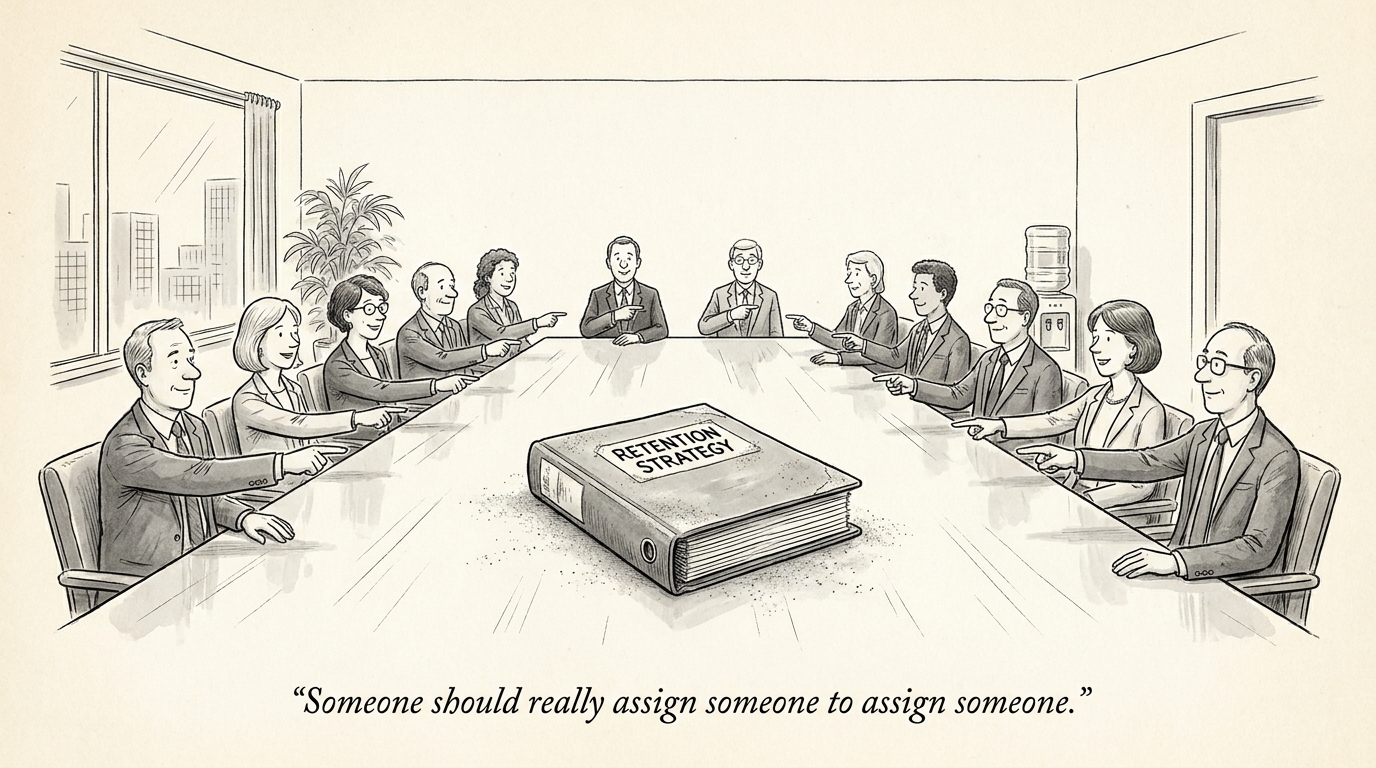
Only 39% of healthcare organizations have a formal, documented strategy for retaining physicians. The remaining 61% either operate informally or lack any retention structure—a structural gap that creates measurable workforce risk at the exact moment new data links excessive work hours and burnout directly to quit intentions. This disconnect between what organizations say about retention and what they actually execute belongs squarely within Physician Recruiting & Staffing Insights, where the line between recruiting success and retention failure determines long-term staffing economics.
The Accountability Vacuum
The Association for Advancing Physician and Provider Recruitment’s 2026 retention strategy report surfaces a revealing finding: organizations that claim to prioritize retention frequently cannot identify who owns the strategy. As AAPPR CEO Carey Goryl put it, “You can’t have a strategy if nobody owns it.” That absence of designated accountability means retention activities happen without measurement, feedback loops, or documented outcomes.
The implications for recruiting teams are immediate. When retention lacks an owner, recruiters keep backfilling the same positions instead of advancing harder-to-fill specialty searches. The cycle compounds: constant turnover consumes recruiting bandwidth, delays time-to-fill on strategic hires, strains remaining staff, and accelerates further departures. In organizations with 200 or fewer physicians—where one leader often handles both recruitment and retention—compensation quickly becomes the default retention lever, even though pay alone rarely prevents departures.
Excessive Hours as a Measurable Turnover Predictor
A European Federation of Salaried Doctors survey of over 8,000 physicians provides hard data linking work hours to quit intentions. Among respondents, 33.8% exceeded the 48-hour weekly cap established by the European Working Time Directive, and as weekly hours increased, so did reported intentions to leave both jobs and the profession entirely. Night shift frequency tracked with steady declines in emotional and physical health.
The survey’s most actionable finding for staffing strategy: physicians who could take vacation flexibly were significantly less likely to report resignation intent. Only 51% had that flexibility. FEMS President Alessandra Spedicato noted that flexible leave access “may be because the ability to take holidays flexibly is, in itself, an indicator of adequate organization and staffing levels.” Schedule flexibility often signals adequate staffing; its absence signals the opposite.
Mainstream coverage of physician burnout usually treats it as an individual wellness issue. The FEMS data reframes it as a staffing operations problem: work organization—not resilience training—predicts whether physicians stay or leave.
Belonging as Retention Infrastructure
A JAMA Network Open study published this month found that physicians reporting a strong sense of organizational belonging were far less likely to experience burnout, reduce clinical hours, or consider leaving. Four out of five physicians with strong belonging felt their teammates “have their back.”
The inverse finding matters for recruiting strategy: nearly 40% of surveyed physicians did not feel a strong sense of belonging. Specific groups—women physicians, surgeons, and those practicing more than five years—were less likely to report belonging. For in-house recruiters, this highlights which physician segments face higher attrition risk and where retention investments may pay off fastest.
Baptist Health offers a practical model: listening campaigns that put physicians in direct conversation with the CMO, wellness champions at each location, and feedback loops that reach frontline staff. These function as retention infrastructure that create conditions where physicians choose to stay.
When the average age of physicians leaving clinical practice has dropped from 57 to 48 since 2008, belonging stops being a soft metric and starts to look like a leading indicator of mid-career attrition that compounds specialty-level shortages.
The Strategy-Practice Gap
AAPPR’s data shows a troubling gap between what organizations list in retention strategies and what they actually deliver. While 92% of respondents said their strategies included work-life balance measures, only 81% had actual programs. Peer support appeared in 71% of strategies but only 61% of practice. Compensation and benefits appeared in 82% of strategies—but only 53% of organizations reported actual offerings in that category.
This strategy-practice gap is why physicians evaluating offers should ask pointed questions during interviews: Is there a documented retention strategy? Who owns it? How is usage tracked? What data drives decisions? Vague answers usually mean the organization has activities rather than accountability—and that the physician could become a future recruiting requisition.
For hospital executives and recruiting leaders, the gap suggests value is leaking at implementation. A strategy on paper without ownership, measurement, or consistent delivery doesn’t reduce turnover; it creates the appearance of effort.
Presenteeism and the Myth of Constant Readiness
One source traced physician presenteeism—working while sick, exhausted, or impaired—to cultural expectations absorbed during training. The message, learned quietly and early: real professionals don’t stop. Stories of physicians rounding with IVs or returning to procedures after vomiting get passed down “like folklore, cautionary tales stripped of their caution.”
That cultural norm undermines retention by normalizing the conditions that drive burnout. When hypervigilance becomes baseline, physicians run in sustained sympathetic activation that degrades cognitive flexibility, working memory, and emotional connection. The system rewards constant availability, so it rarely flags illness or exhaustion. The result: clinicians who look retained but are actually eroding—present in body, shrinking in capacity, and increasingly likely to leave abruptly.
What Retention Ownership Actually Requires
The sources converge on a structural prescription: retention needs a named champion who coordinates stakeholders, tracks metrics, and reports progress. Cross-functional involvement—HR, clinical leadership, executive leadership—improves outcomes, but diffused responsibility without clear ownership produces the 61% of organizations operating informally or without strategy.
Smaller practices with 200 or fewer physicians must move beyond compensation as the default. Career development, mentoring, flexible scheduling, conflict resolution, and values-aligned culture all emerged as drivers—but only when someone is accountable for implementation and measurement.
Organizations that designate retention ownership and measure outcomes should lose fewer physicians to competitors that do not. Recruiters can shift budget from backfill to growth, and time-to-fill for strategic specialties shortens when positions stop cycling.
Those still treating retention as a diffuse responsibility—or as a compensation problem solved with bigger signing bonuses—will keep converting retention failures into recruiting costs. Whether that conversion stays invisible depends on whether anyone is assigned to measure it.
Sources
Someone needs to own the retention strategy: Keeping physicians on the job — or not – Medical Economics
Physicians Working Excessive Hours More Likely to Quit – Medscape
How Measuring Physician Burnout Could Improve Retention – KevinMD
Stronger belonging may help ease physician burnout – American Medical Association
How to Tell When Physician Retention Gets More Lip Service – American Medical Association
Physician Presenteeism Starts With a Dangerous Myth – KevinMD
Why Your Culture Trumps Your Recruitment Strategy – Medical Economics