
This analysis synthesizes sources published the week ending August 17, 2026. Editorial analysis by the PhysEmp Editorial Team.
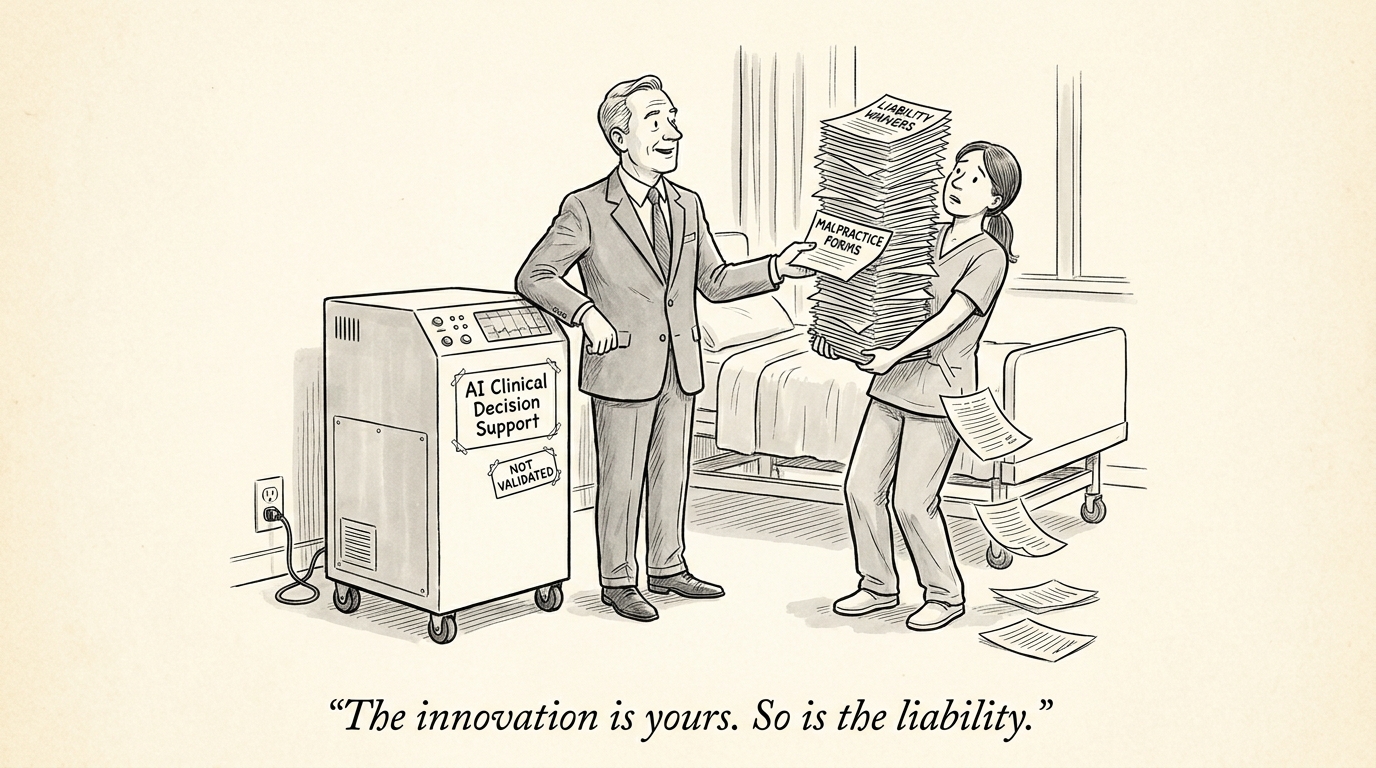
Health systems are deploying AI clinical decision-support tools at a pace that has outstripped the evidence validating their safety and efficacy—and the liability exposure is landing squarely on individual physicians. This asymmetry is reshaping the risk calculus for employed physicians and changing power dynamics in contract negotiations. For those tracking Physician Compensation & Demand, the real question is who bears the cost when these tools fail.
The core tension: regulatory clearance is not clinical validation. The FDA’s 510(k) pathway—used for most AI diagnostic tools—requires only that a device demonstrate substantial equivalence to a predicate, not that it improves patient outcomes in real-world deployment. Yet health systems are integrating these tools into clinical workflows as if they carry the same evidentiary weight as peer-reviewed interventions.
The Clearance-Validation Gap
Multiple analyses this week documented the same structural problem from different angles. AI decision-support tools are being marketed and deployed based on regulatory clearance, but clearance thresholds do not require prospective validation in the clinical environments where these tools will actually operate. A Dartmouth study found that while AI could help physicians communicate more empathetically, the same systems demonstrated patterns of overdiagnosis and overtreatment when applied to clinical decision-making.
Human clinicians outperformed AI stethoscope tools in direct comparisons, yet the AI tools remain on the market and in use. The evidence base is not keeping pace with deployment—and the gap is widening as health systems face pressure to demonstrate AI adoption to boards and investors.
When a tool is cleared but not validated, the physician who follows its recommendation becomes the de facto testing ground; this shifts liability onto clinicians while the system calls it innovation.
Accountability Falls to the Clinician
Expert consensus across multiple sources converged on a single point: physicians remain accountable for clinical decisions regardless of whether an AI tool contributed to that decision. This creates a structural imbalance. Health systems capture the efficiency gains and marketing value of AI deployment while individual physicians absorb the malpractice exposure when tools underperform.
The legal framework has not evolved to address this asymmetry. Malpractice insurance policies were not designed for scenarios where a physician follows an institutionally mandated AI recommendation that later proves harmful. Plaintiffs’ attorneys are already developing theories of liability that target both the physician who relied on the tool and the system that deployed it without adequate validation—but the physician remains the most exposed party in the chain.
For employed physicians, this creates a new dimension of contract risk. Standard employment agreements rarely address AI-related liability explicitly. Physicians may find themselves bound to use institutionally approved tools without corresponding indemnification for AI-related adverse outcomes. The absence of contract language on this point is itself a form of risk transfer—one that favors the employer.
Contract Implications and Negotiating Leverage
The AI validation gap is becoming a compensation and contract issue, not merely a clinical one. Physicians negotiating new employment agreements should be examining several previously overlooked provisions: indemnification clauses that explicitly address AI-assisted decision-making, malpractice tail coverage that accounts for emerging AI liability theories, and documentation requirements that preserve the physician’s clinical reasoning independent of AI recommendations.
Recruiters and health system executives face a corresponding challenge. Compensation packages that do not account for increased liability exposure may prove insufficient to attract physicians to roles with heavy AI integration. Early adopter systems that deploy unvalidated tools may find themselves at a recruiting disadvantage as physicians become more sophisticated about these risks.
The market has not yet priced AI liability into physician compensation. Systems that move first to address this gap—through explicit indemnification, enhanced malpractice coverage, or risk-adjusted pay—may gain a recruiting edge before the broader market recalibrates.
Documentation as Risk Mitigation
One emerging best practice deserves attention: physicians are increasingly documenting their independent clinical reasoning separately from AI recommendations. This creates a paper trail that distinguishes physician judgment from algorithmic output—a distinction that may prove critical in future litigation. Health systems that discourage or complicate this documentation practice are effectively asking physicians to merge their clinical judgment with unvalidated tools, further concentrating liability on the individual clinician.
The Validation Timeline Problem
Rigorous post-deployment validation takes years. Prospective studies, outcome tracking, and comparative effectiveness research cannot be rushed without compromising their value. Yet health systems are deploying AI tools on timelines measured in months. This temporal mismatch means that physicians practicing today are being asked to use tools whose real-world performance will not be understood until after those physicians have already integrated them into thousands of patient encounters.
Ethicists and clinical researchers published analyses this week arguing that AI tools must be evaluated within actual clinical workflows—not in controlled research environments that do not reflect real-world complexity. That evaluation framework does not yet exist at scale, and the physicians using these tools cannot wait for it to materialize.
For physician compensation, this creates a slow-moving structural shift. As liability exposure becomes better understood, expect to see differentiated pay for roles with heavy AI integration, specialized malpractice products for AI-adjacent practice, and contract language that explicitly allocates AI-related risk. Systems that anticipate this shift will be better positioned to recruit; those that ignore it may find their AI investments creating recruiting liabilities rather than efficiencies.
The validation gap will close eventually—but not before a generation of physicians faces it without adequate contractual protection. Whether compensation structures adapt before the first wave of AI-related malpractice claims reshapes the market remains to be seen.
Picture a hospitalist late at night explaining to a family that an AI flag led to an extra test and an unexpected operation. She shows her notes, the AI report, and a contract that said nothing about who would pay if the tool was wrong. That image hangs there, unresolved.
Sources
AI clinical decision support is everywhere — the evidence base is not – Clinical Trial Vanguard
AI Tools in Health Care Are Cleared, Not Proven to Work – KevinMD
The Most Important Thing AI Cannot Do in Medicine – Time
AI in healthcare: Doctors must stay accountable, experts say – NDTV
Human clinicians outperform AI stethoscope – Phys.org