
This piece started with what residents were actually posting online this week—166 real threads and questions from the places they talk when no one’s polishing the message. We used AI to spot the patterns that kept repeating across all that noise. Then a human editor made the judgment call on what was truly worth your time, and that became the article you’re about to read.
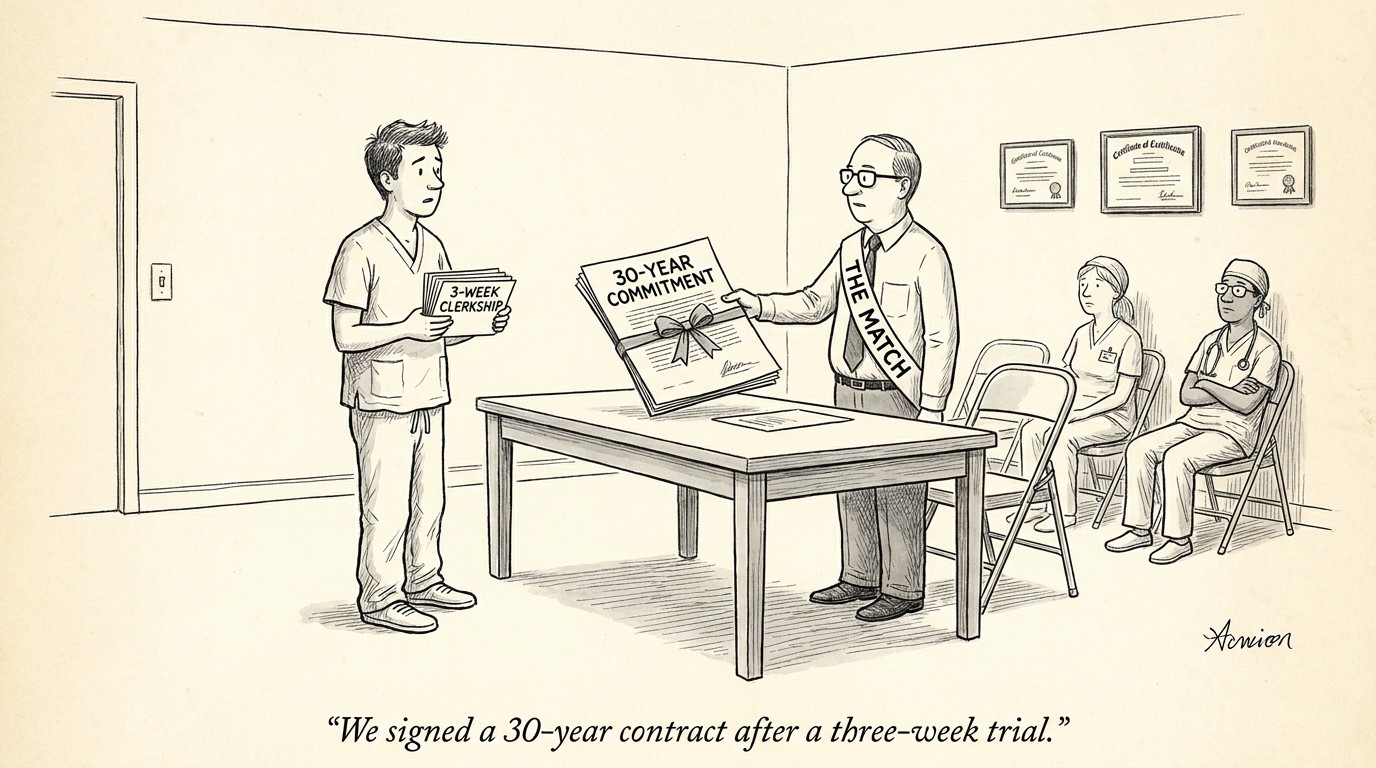
You can stay in family medicine and spend the next two years wondering if psychiatry was the right move—or you can actually see what switching would look like. For residents weighing a specialty change, the choice isn’t between commitment and quitting. It comes down to three paths, each with its own feasibility, costs, and timelines. The Match system forces early commitment before most medical students have enough clinical exposure to make fully informed decisions. That isn’t a character flaw—it’s a structural problem. Here’s how to approach it if you’ve realized your current specialty isn’t right.
Scenario One: You SOAPed Into the Wrong Specialty
If you matched through SOAP into a specialty you never wanted, you’re in a favorable position for switching—but only if you act quickly. Programs understand that SOAP placements are often mismatches. You have one year to apply again through the regular Match while finishing your intern year.
The mechanics: Start networking in your target specialty immediately. Reach out to program directors in your desired field by October of your intern year. Be direct about your situation—most PDs have seen this before. Complete your ERAS application for the next cycle while maintaining good standing in your current program. Your intern year counts toward your training timeline in many specialties, which means you’re not starting from zero.
What residents underestimate: You need letters from your target specialty, which means rotating there during your limited elective time. If you’re doing FM and want psychiatry, you need psych rotations and psych letters—not just your FM attendings saying you’d be great at psych. This requires coordination with your current program, which may or may not be supportive.
Scenario Two: Transferring Mid-Training
The FM PGY-2 who discovers they love EM after a rotation, or the anesthesia resident eyeing interventional radiology—this is the hardest path. Mid-training transfers happen, but they require finding a program with an open spot at your exact PGY level, convincing them you’re worth the disruption, and following ACGME transfer policies.
Realistic feasibility depends heavily on specialty. Switching from FM to EM is more common because emergency medicine programs occasionally have openings and value the primary care foundation. Switching from anesthesia to IR is harder because IR is competitive and most programs fill their spots through the Match. Switching into surgery from a non-surgical field mid-training is extremely rare—most surgical programs want residents who’ve been on the surgical track from day one.
How to approach program directors: Don’t lead with burnout or dissatisfaction with your current program. Lead with genuine interest in the new specialty, backed by evidence—rotations you’ve done, research interests, specific aspects of the field that fit your skills. PDs are evaluating whether you’ll be a reliable resident who finishes training, not whether you have a compelling personal narrative about self-discovery.
Credentialing implications matter here. If you leave a program mid-year, you may not get credit for that partial year. Some programs will let you transfer credit for completed rotations; others won’t. Get this in writing before you commit to anything.
Scenario Three: Leaving and Re-Entering
This is the nuclear option: resigning from your current residency and applying fresh to a different specialty. It’s also more common than people admit, particularly among residents in toxic programs or those who’ve realized—honestly—that they chose wrong.
The timeline cost is real. If you’re a PGY-3 in surgery and you leave to apply for psychiatry, you’re starting over as a PGY-1. That’s three years of training time gone, plus the gap year while you reapply. For a 28-year-old, that might mean finishing residency at 33 instead of 30. For someone with a family or significant debt, those three years carry real financial weight.
What you gain: A career you actually want to practice for 30 years. The math on this is straightforward—three extra years of training is a small fraction of a career, but spending that career in the wrong specialty compounds daily.
Finding off-cycle positions requires persistence. Academic programs occasionally have openings when residents leave unexpectedly. Community programs are often more flexible. The FREIDA database and direct outreach to program coordinators are your best tools. Don’t limit yourself geographically if you’re serious about making this work.
The Sunk-Cost Trap
The hardest part of switching isn’t logistics—it’s the guilt. You matched into this program. People congratulated you. You told your family. Now you’re considering walking away, and it feels like failure.
Here’s the reframe: The Match asked you to commit to a 30-year career based on a few weeks of clinical exposure during third year. That’s an absurd amount of certainty to expect from anyone. Recognizing a mismatch isn’t failure—it’s information. The question is what you do with that information.
Burnout complicates this calculation. If you hate your specialty because you’re exhausted, burned out, and working in a toxic environment, switching specialties might not fix the problem. But if you consistently feel energized by a different type of medicine—if your best days are the days you rotate off-service—that’s a signal worth following.
Making the Decision
Before you commit to switching, answer three questions honestly. First: Is this about the specialty or the program? A toxic surgery program doesn’t mean surgery is wrong for you—it might mean you need a different program. Second: Have you actually experienced your target specialty, or are you romanticizing it from a distance? Rotate there before you blow up your training. Third: Can you afford the timeline hit? If you’re carrying $300K in loans and switching adds two years to your training, that’s $100K+ in lost attending salary. That might still be worth it, but know the number.
The residents who switch successfully share one trait: they treat it as a logistics problem to solve, not a moral failing to justify. They research the mechanics, build relationships in their target specialty, and execute a plan. The ones who stay stuck treat the decision as a referendum on their character, which keeps them paralyzed.
Switching specialties during residency is possible. It’s also expensive, complicated, and not guaranteed to work. But staying in a specialty you know is wrong has costs too—they’re just harder to measure until you’re an attending who dreads going to work.
P.S. PhysEmp has job opportunities and salary reports by specialty — worth a look now, worth a lot more when the job hunt actually starts: physemp.com. And DocCommons is building a community for residents and attendings who’d rather not figure all this out in isolation — waitlist’s open: doccommons.com