
This analysis synthesizes sources published the week ending August 3, 2026. Editorial analysis by the PhysEmp Editorial Team.
Health systems are deploying clinical AI faster than they are resolving who controls it—and that governance vacuum is quietly reshaping physician compensation. As algorithms increasingly handle triage, documentation, and care pathway decisions, the question of whether physicians lead or follow AI implementation directly affects their negotiating position in contract talks, their claim to productivity-based pay, and their long-term demand profile. This structural shift sits at the center of Physician Compensation & Demand, where the rules governing clinical autonomy and workflow ownership translate directly into bargaining power.
The Compensation Mechanism at Stake
A new report covered by Medical Economics asks the question health systems have been avoiding: who pays for clinical AI, and how does that cost flow through reimbursement? The answer matters for physician compensation. If AI tools are billed separately or bundled into facility fees, physicians may find their RVU-generating activities algorithmically pre-filtered—patients triaged, notes drafted, care plans suggested—without corresponding credit or control. Kaiser’s use of algorithmic triage for mental health patients, now under union scrutiny in California, illustrates the pattern: clinical decisions that once required physician judgment are being automated upstream, compressing the scope of billable physician work.
For productivity-based compensation models, this creates a structural squeeze. Physicians paid on RVUs or collections depend on volume and complexity. When AI handles intake, documentation, or routine decision trees, the remaining physician work may be higher-acuity but lower-volume—the kind of shift productivity formulas rarely accommodate. Employers gain efficiency; physicians take on the compensation risk.
Physicians negotiating contracts in 2026 should scrutinize how AI-assisted workflows affect RVU attribution. If algorithms handle triage or documentation, the productivity metrics embedded in your contract may no longer reflect your actual clinical contribution.
Who Decides Where AI Stops and Physicians Start
The governance question is tangible. New York City nurses report AI systems are replacing some roles outright, while multiple physician commentators warn that trainees are learning to defer to AI before they develop independent clinical reasoning. The American Medical Association’s physician leadership roundtable pushed the same point: clinicians need to lead AI integration—if the institution actually gives them the authority to do so.
Physicians with governance roles—department chairs, medical directors, CMOs—are the ones who shape how AI tools interface with workflows. Those without such roles face a different calculus: their compensation depends on productivity metrics designed before AI existed, applied to workflows increasingly designed around AI. That gap is fast becoming a compensation stratifier.
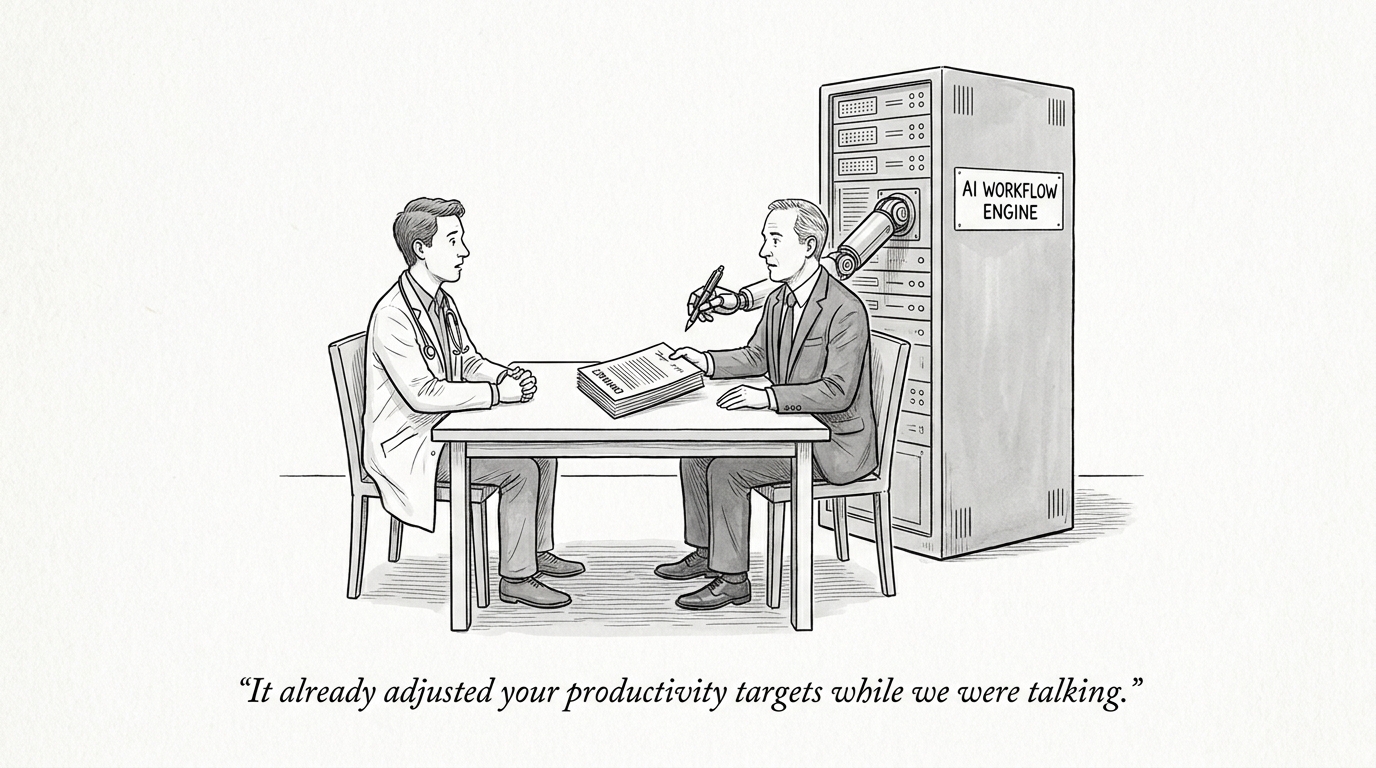
We’re already seeing the difference in contract offers. Leadership positions come with signing bonuses and compensation that explicitly include AI oversight. Employed physicians in high-volume clinics may see productivity targets adjusted to assume AI-assisted efficiency gains—raising the bar without raising pay.
Documentation and the RVU Squeeze
AI scribes are the most immediate pressure point. STAT’s reporting on AI scribes in medical education flagged cognitive risks for trainees, but the compensation implications extend to practicing physicians. When AI drafts notes, the time savings are real—but so is the question of who captures the value.
Health systems deploying AI scribes can argue physicians should see more patients per session, since documentation no longer consumes clinic time. That logic translates directly into higher productivity expectations. Physicians on fixed salaries may absorb increased volume without extra pay; those on RVU-based models may find per-patient reimbursement unchanged while expected throughput rises.
The efficiency gains from AI documentation are real, and they tend to accrue to whoever controls the productivity formula. Physicians should negotiate explicit language on how AI-assisted efficiency affects volume expectations and compensation benchmarks.
The Triage Upstream Problem
Kaiser’s algorithmic mental health triage, challenged by unions as a violation of state law, points to a broader pattern. When AI handles intake and acuity assessment, it decides which patients physicians see and in what order. That upstream control alters case mix, complexity weighting, and ultimately compensation for physicians paid on productivity or quality metrics.
Physicians in accountable care arrangements face particular exposure. Medical Economics reports that AI-driven care pathway selection could erode the clinical judgment that accountable care models claim to reward. If algorithms steer which patients receive intensive intervention and which receive lower-touch management, physicians lose control over the quality metrics that determine bonuses.
Demand Implications: Substitution Versus Augmentation
The nursing displacement reported in New York City raises the substitution question for physicians. Current evidence still points to augmentation rather than wholesale replacement of physician work, but augmentation changes demand dynamics. If AI extends physician capacity, marginal demand for additional physicians may soften. Recruiters in high-demand specialties should watch for signs that AI deployment is changing employer assumptions about headcount.
Substitution risk is higher in specialties with standardizable workflows. Radiology, pathology, and parts of primary care have long been flagged as vulnerable. Compensation data hasn’t shown sharp declines yet, but the governance decisions made now—who controls AI implementation, who sets productivity benchmarks, who captures efficiency gains—will determine whether AI becomes a tool for physicians or a way to manage fewer of them.
For physicians entering contract negotiations, governance participation is now a compensation issue. Those who shape AI implementation retain control over workflow, productivity attribution, and clinical scope. Those who cede governance to administrators and vendors may find compensation increasingly determined by algorithmic assumptions they had no role in designing. Contracts signed in 2026 will help decide which physicians lead integration and which are managed by it.
I keep coming back to an image: a CMO at a whiteboard sketching new patient flows, a junior clinician hovering with a stethoscope, and a contract on the table that already assumes a higher throughput. Whoever’s in that room when signatures go down will carry a lot of the consequences. Good luck to the rest of us.
Sources
Artificial Intelligence in Healthcare: Physicians Must Lead the Conversation – South Florida Hospital News
What AI in Medicine Still Can’t Replace – KevinMD
Moral Agency in Medicine Is Quietly Disappearing – KevinMD
When AI Picks Winners: How Technology Could Undermine Accountable Care – Medical Economics
AI Scribes in Medical Education: Learning Tool or Cognitive Crutch? – STAT
Learning Medicine With AI Before Learning to Think – KevinMD
New York City Nurses Say AI Is Replacing Them – Prism Reports
Union complains that Kaiser uses algorithm, not clinicians, to triage mental health patients, violating state law – San Jose Inside
3 Habits That Guard Against Automation Bias in Medicine – KevinMD
5 physician leaders on what comes next for health care – American Medical Association
Rethinking the Physician Response to Patient AI Use, With Robert Shpiner, MD – Patient Care Online
How should health care pay for clinical AI? New report raises tough questions – Medical Economics