
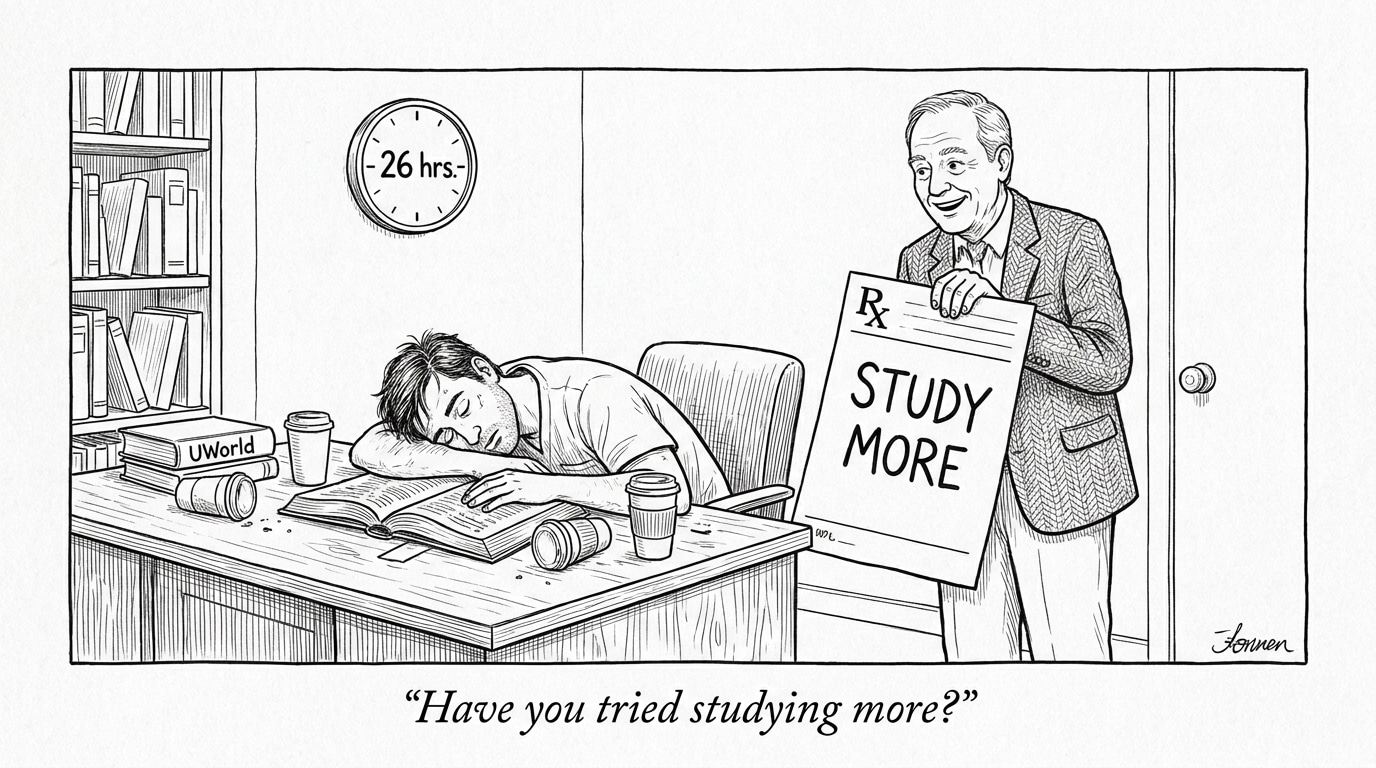
You’re post-call, you’ve been awake for 26 hours, and you know you should study for boards. You open UWorld, read the same question three times, and realize you’ve absorbed nothing. You close your laptop, feel guilty, and go to bed. The next day, you get vague feedback about “knowledge gaps.” Now you’re exhausted and demoralized. This is the reality of residency training that no one talks about honestly: the system that demands you learn at an elite level is the same system that makes learning nearly impossible.
Here’s what nobody tells you: you can’t study your way out of burnout. And the attempt to do so often makes everything worse.
The Cycle Nobody Names
The exhaustion-learning cycle goes like this: you’re working 70-80 hour weeks. Sleep deprivation impairs memory consolidation — this isn’t weakness, it’s neuroscience. The hippocampus literally cannot form new memories when you’re running on 4 hours of sleep. So you study, but retention drops. Your rounds or in-service performance suffers. You get critical feedback. That criticism spikes stress, which further harms cognitive function. Now you’re exhausted, anxious, and your brain is less able to learn.
The kicker: most programs respond by telling you to study more. Which is like telling someone with a broken leg to run faster.
Many residents describe the same pattern: feeling dumber from exhaustion, getting negative feedback that feels impossible to act on, and guilt about not studying while being too tired to retain information. This isn’t a series of individual failures. It’s a systemic problem being treated as a personal flaw.
Why “Just Study Harder” Isn’t Enough
The advice to study more assumes your brain is a machine that outputs learning in proportion to time spent. But cognitive science says otherwise. After about 16-18 hours awake, your cognitive performance is like being legally drunk. After 24 hours, it’s worse. You wouldn’t expect someone to ace a test after four beers, but we expect residents to learn complex medicine after call shifts that would make a trucker lose their license.
More importantly, stress and shame hinder learning. When you’re in a cortisol-flooded state because you were just criticized for missing something on rounds, your prefrontal cortex—the part responsible for complex reasoning and memory formation—goes offline. Your brain shifts to survival mode. Great if you’re fleeing a predator; terrible if you’re trying to remember carvedilol’s mechanism of action.
So when you sit down to study after harsh feedback, you’re studying with a compromised brain. The information doesn’t stick. You feel worse about yourself. The cycle continues.
What Actually Helps
Breaking this cycle means facing a hard truth: you can’t outperform your physiology with willpower. Here’s what actually helps:
- Protect sleep ruthlessly on non-call days. This isn’t laziness—it’s strategic. One hour of studying on a rested brain is worth three hours on an exhausted one. If you have to choose between staying up late to study or sleeping, sleep wins almost every time.
- Recognize vague feedback for what it is. “You need to read more” or “your fund of knowledge needs work” isn’t actionable feedback—it’s a reflection of a system that doesn’t know how to teach burnt-out learners. Push back (professionally) by asking for specifics: “Can you tell me exactly what I missed and suggest a resource that covers it?” This shifts the burden from “be better” to “here’s how to be better.”
- Separate performance from identity. Missing a question on rounds after a post-call doesn’t mean you’re a bad doctor. It means you’re a human operating under conditions that would impair anyone. The guilt spiral is real, but it’s not useful.
- Document the pattern. If your program’s feedback consistently shows underperformance that correlates with brutal rotations, that’s data. Programs should know their scheduling is contributing to the problem they criticize you for.
Advocating for Yourself Without Getting Labeled
Residency culture often punishes residents who name the problem. Saying “I can’t learn because I’m too exhausted” can be heard as “I’m not committed enough.” This is unfair, but it’s real.
Frame it differently. Instead of “I’m burnt out and can’t study,” try: “I’ve noticed my retention improves when I study after post-call sleep. I’d like to adjust my study schedule to maximize learning.” Same reality, different framing. You’re not complaining—you’re optimizing.
If your program has a wellness committee or ombudsperson, use them. These resources exist because enough residents have hit this wall that institutions had to respond. Using them isn’t weakness; it’s using the system as designed.
The Bigger Picture
The exhaustion-learning cycle isn’t just a residency problem — it has career implications. Residents who burn out during training often carry that into their job search, taking positions out of desperation instead of fit. They are more likely to take jobs with brutal schedules because burnout becomes the norm. And the cognitive habits formed during burnout—the constant self-criticism, the guilt, the sense of never being enough—don’t disappear when you become an attending.
Breaking this cycle now isn’t just about surviving residency. It’s about not carrying these patterns into a career where you have real choices about how you work and live. The job market for physicians is strong, and you’ll have options. But you need enough cognitive and emotional reserves to evaluate them clearly—not just grab the first offer because you’re too exhausted to think.
You can’t study your way out of burnout. But you can recognize the cycle, stop blaming yourself for a systemic problem, and start making strategic decisions that protect your brain’s ability to actually learn. That’s not giving up. That’s being smart about a system that wasn’t designed with your wellbeing in mind.