
This analysis synthesizes 11 sources published the week ending Jul 13, 2026. Editorial analysis by the PhysEmp Editorial Team.
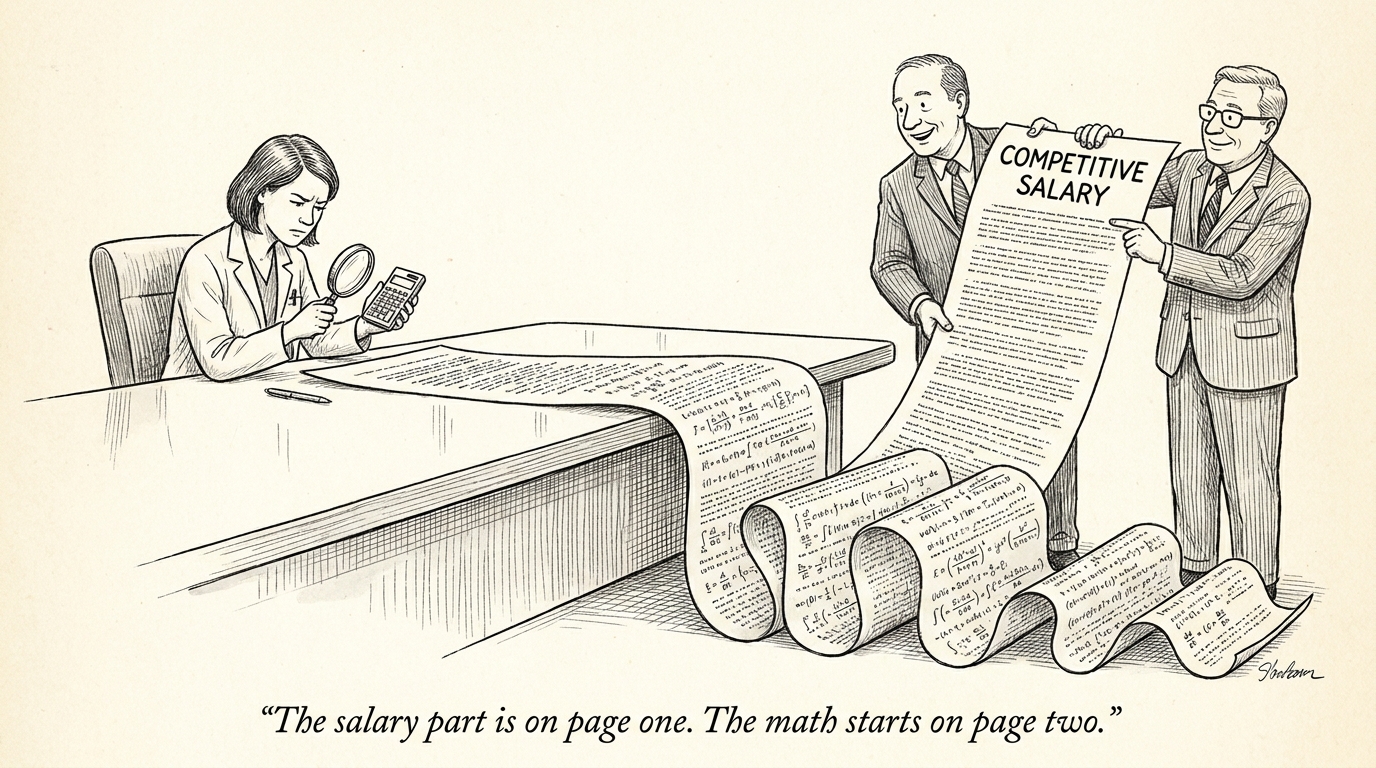
The structural mathematics embedded in physician compensation contracts are systematically transferring economic risk from health systems to individual physicians—and most physicians signing these agreements don’t recognize the mechanisms until years into their employment. As RVU-based pay models have become the dominant compensation framework across specialties, the underlying formulas have tilted toward employer flexibility while constraining physician earnings potential. This dynamic sits at the center of Physician Compensation & Demand analysis, where understanding contract architecture has become as critical as evaluating base salary figures.
Four forces are reshaping how physicians get paid in 2026: Medicare reimbursement compression, administrative burden shifting, productivity threshold manipulation, and the growing gap between gross collections and net physician compensation. They compound one another, so nominal salary increases can mask falling real earnings and shrinking practice autonomy.
The Hidden Architecture of RVU Disadvantage
RVU-based compensation was sold as objective and productivity-aligned. Current contract analysis tells a different story. Conversion factors—the dollar amount assigned per RVU—are often set below market and locked for multiple years with no inflation adjustments. At the same time, RVU thresholds required before bonuses kick in keep rising, forcing more clinical volume before incentive pay appears.
The math gets worse when you look at overhead allocations. Many contracts let employers deduct administrative costs, malpractice premiums, and support staff expenses from gross production before calculating RVU compensation. Those deductions can eat 40–60% of generated revenue before a physician sees any productivity-based payment. Public salary reports usually show gross compensation and stop there; the deductions are what determine take-home pay.
Physicians evaluating RVU-based contracts must demand transparency on three metrics rarely disclosed upfront: the actual conversion factor compared to MGMA benchmarks, the overhead allocation methodology, and historical data on what percentage of physicians in similar roles have achieved bonus thresholds.
Specialty Compensation Divergence Accelerates
The 2026 picture shows widening gaps across specialties. Five groups—emergency medicine, family medicine, internal medicine, pediatrics, and psychiatry—posted year-over-year compensation declines once you adjust for inflation and workload. Procedural specialists, meanwhile, continue to capture outsized gains. The pattern tracks a long-standing tendency to underpay cognitive work relative to procedures.
Specialties that offer faster paths to financial stability share traits: high procedural volume, a favorable payer mix, and practice models that let physicians capture a larger share of revenue. Orthopedics, cardiology, and gastroenterology remain at the top of compensation rankings. The gap with primary care has widened enough to threaten future workforce balance.
For hospital leaders and recruiters, this creates tension. Hiring primary care often requires offers that exceed what productivity alone would justify. Proceduralists command premiums that squeeze budgets. The trade-offs are immediate and uncomfortable.
Medicare’s Inadequate Response to Primary Care Reality
The 2026 Medicare payment adjustment was billed as progress. Against inflation, rising practice costs, and heavier administrative workloads, the bump still translates into real-dollar decline for many physicians whose panels skew Medicare.
Health systems trying to absorb Medicare shortfalls push those pressures onto employed physicians through lower base salaries, higher productivity targets, and fewer support resources. The physicians most affected are the ones serving older, complex patients—exactly the care Medicare says it wants encouraged.
Contract negotiations should explicitly account for Medicare panel composition and how it affects achievable productivity. Physicians taking roles with high Medicare exposure should seek base salary protections rather than pure productivity models.
Collective Action and Market Power
The organizing at a New Jersey hospital—where doctors won nearly 10% raises plus meal stipends—shows how concentrated market power can reverse these dynamics. When physicians at a community’s only hospital organized, they turned that position into tangible gains that individual bargaining rarely produces.
That case exposes a blind spot in standard advice. Most guidance focuses on one-on-one negotiation. The biggest compensation wins today come from coordinated action or from market positions that a single doctor can’t recreate. Health systems facing shortages in a specialty or region can be forced into costly concessions when groups act together.
For physicians, detailed knowledge of local market pay, regional shortage status, and a hiring system’s financial position creates bargaining power that national benchmarks miss. For executives, the New Jersey example is a warning: small perceived savings can lead to much larger costs if clinicians organize.
Data-Driven Compensation and Training Integration
Some health systems are tying pay to training investments and performance data. These models fold quality outcomes, patient experience, and professional development into compensation, not just RVUs.
That can reward clinicians whose work aligns with the chosen metrics. It also creates new risks: which metrics get picked, how they’re measured, and how reliable bonus payouts have been historically. Contracts need clear definitions, stable methodologies, and remedies if measurement approaches change mid-term.
Strategic Positioning for Contract Negotiations
Four practical moves have emerged. First, insist on complete compensation modeling that shows realistic earnings under low-, mid-, and high-productivity scenarios. Second, tie conversion-factor adjustments to inflation or market benchmarks rather than accepting a fixed rate. Third, demand full transparency on overhead allocations and historical trends. Fourth, include contract-review triggers when organizational changes alter compensation inputs.
Compensation negotiation isn’t just about the salary line anymore. The formulas, thresholds, deductions, and adjustment mechanisms determine actual pay. Health systems have put effort into designing models that protect their margins; physicians need comparable effort to understand the math in front of them.
Looking ahead, the push-and-pull between health system constraints and physician market power will sharpen. Specialty shortages, geographic imbalances, and generational shifts in practice preferences all push physicians toward stronger bargaining positions in the aggregate, even as individual contracts keep favoring employer flexibility. The organizations and clinicians who see that tension and prepare for it will have an advantage.
I keep returning to the image of that New Jersey picket line: damp signs leaning against a curb, a stack of unpaid cafeteria receipts, and a spreadsheet someone finally decided to read. The math people ignored for years turned a bargaining table into a picket line; the next round of contracts will tell which side learned anything.
Sources
How RVU pay is designed to shortchange physicians – Becker’s ASC Review
The Four Forces Shaping Physician Compensation Today – Medical Economics
The Four Forces Reshaping Physician Pay With Tynan Kugler of PYA – Medical Economics
Four Best Practices For Physician Contract Negotiations – Forbes
Hidden Math in Your Next Contract: Why Physicians Lose Out on Fair Pay – Legal Reader
What Physicians Are Getting Paid in 2026 – The DO
The 5 physician specialties who saw a decline in compensation – Becker’s ASC Review
Which specialties give physicians the best financial life — fastest? – Becker’s ASC Review
The 2026 Medicare Pay Bump Meets Primary Care Reality – MDLinx
Doctors at this N.J. city’s only hospital picketed. Now they’re getting nearly 10% raise meal stipends – NJ.com
Marit Health Sharpens Focus on Training-Based Physician Pay and Data-Driven Workforce Strategy – TipRanks