
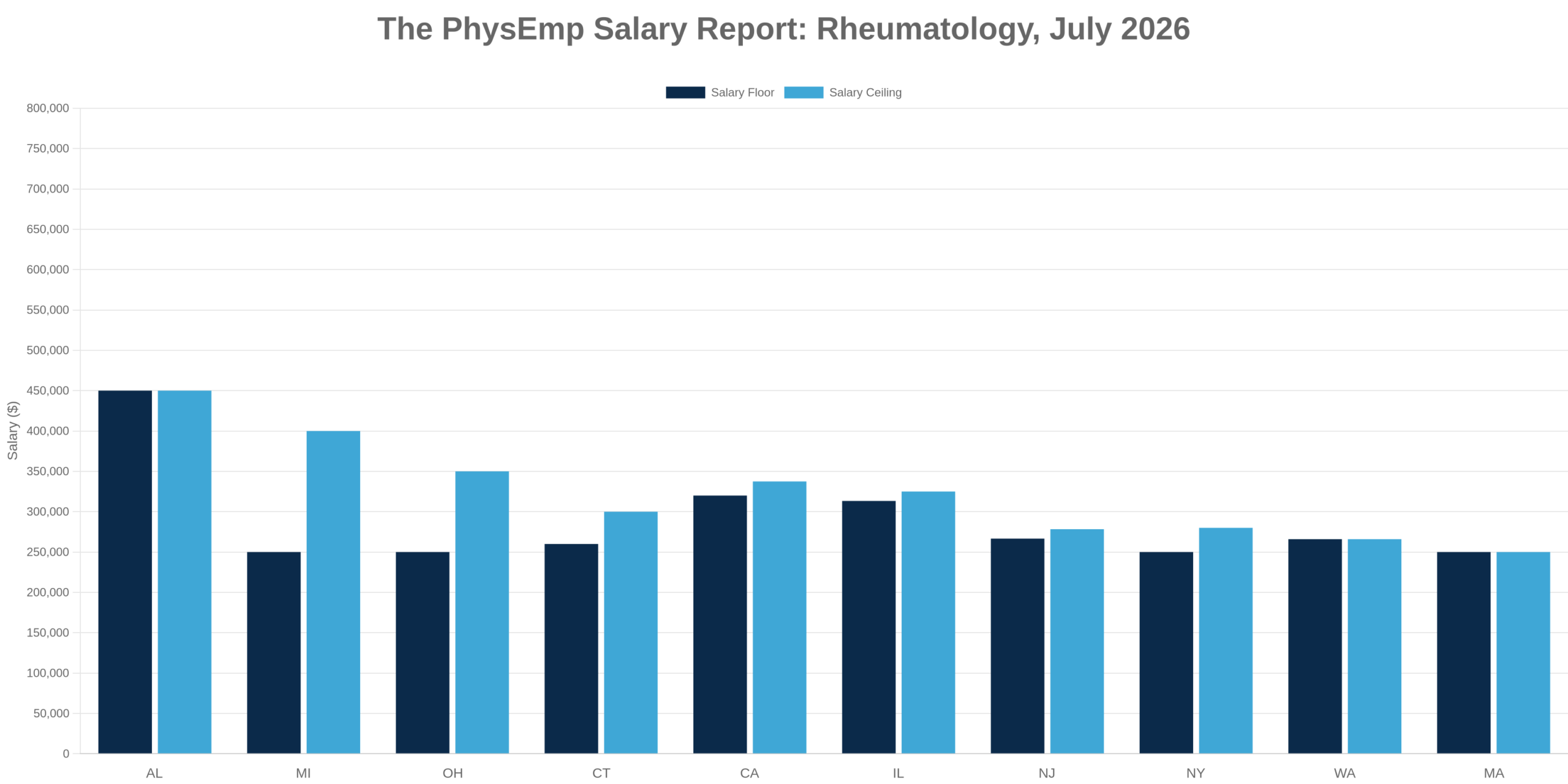
Somewhere in Alabama, a single job posting is offering a rheumatologist a flat $450,000 to manage autoimmune disease. Somewhere in Freehold, New Jersey, a different posting is offering $220,000 for what is, in clinical terms, the same job. That is a $230,000 gap for treating the same lupus panel — a spread wide enough to buy a second home in the state doing the paying. Across 119 total listings spanning 31 states, the Rheumatology market reveals itself as geographically scattered, transparently allergic to transparency, and quietly one of the more negotiable specialties on the board.
👉 Explore Rheumatology job market insights and trends
The Rheumatology Job Market at a Glance
Total listings: 119
Listings with disclosed salary: 18
Full national range: $220,000 to $450,000
National average range: $294,220 to $319,775
The spread here tells two stories. The first is that Rheumatology compensation, when disclosed, clusters politely between $250,000 and $355,000 — the sort of range a specialty settles into when demand is steady but not frantic. The second is that most employers would rather not say. Only 18 of 119 listings put a number on the table, which means 85% of the market is asking physicians to guess.
States represented: NJ, MI, CT, OH, CA, NY, IL, MA, WA, FL, PA, VA, TN, GA, NC, WI, IN, NM, OR, ND, ID, TX, MN, LA, WV, AR, SC, KY, AZ, NH, AL.
Thirty-one states. Eighteen data points. Draw your own conclusions.
👉 Browse Rheumatology physician job opportunities
How States Stack Up
Overperformers
- Alabama: One listing, $450,000 flat, and suddenly the state leads the nation (a reminder that scarcity has its perks).
- California: $320,000 to $337,500 average across two listings, including a $350,000 CompHealth posting in Temecula.
- Illinois: $313,333 to $325,000 across six disclosing listings, with Peoria, Champaign, and Normal quietly clearing $340,000.
- Michigan: One listing in Kalamazoo swings from $250,000 to $400,000 — a range so wide it functions as a personality test.
- Ohio: One listing at $250,000 to $350,000, respectable on the upper end.
Near-average
- Connecticut: $260,000 to $300,000 across one salary-reporting listing — the platonic ideal of median.
- New York: $250,000 to $280,000, competitive but not headline-grabbing.
- Washington: A single, oddly precise $265,955 posting that lands squarely on the national midpoint.
Underperformers
- New Jersey: $266,667 to $278,333 across three listings, and home to the national salary floor.
- Massachusetts: One listing, flat $250,000 — the bottom of the clustering range in a very expensive state.
Volume leaders: Indiana (9), Massachusetts (8), Illinois (7), Oregon (7), Connecticut, New Hampshire, California, Florida, and New York (6 each). Indiana leads the nation in postings and discloses exactly zero salaries. Oregon does the same. Illinois is the rare state doing both — volume and transparency — which makes it the closest thing this market has to an honest broker.
👉 Compare Rheumatology compensation and opportunities by region
What This Means If You’re a Physician
If your priority is maximum compensation: Alabama’s flat $450,000 posting is the highest single figure in the dataset, followed closely by the $400,000 upper bound on Enterprise Medical Recruiting’s Kalamazoo, MI listing. Both come with the standard caveat that outlier salaries usually come with outlier expectations.
If your priority is maximum optionality: Indiana (9), Massachusetts (8), Illinois (7), and Oregon (7) offer the deepest benches. Just know that in three of those four, you’ll be negotiating blind.
If your priority is balance: Illinois is the answer the data keeps pointing to — seven postings, six with disclosed salaries, averages north of $313,000. Massachusetts, by contrast, offers volume at Boston cost-of-living and a disclosed floor of $250,000. Scrutinize accordingly.
👉 Search Rheumatology jobs by location and compensation
What This Means If You’re a Recruiter
Salary transparency rate: 18 ÷ 119 = 15.1%.
That is not a rate. That is a rounding error. In a specialty where candidate supply is chronically tight and burnout data is not improving, asking a rheumatologist to apply without a number is asking them to skip your posting entirely. CompHealth in Florida and Michigan, Curare, and AdventHealth are the largest offenders — and collectively, they are shaping how the market perceives the entire specialty.
The volume-pay misalignment is stark. Indiana leads on postings and discloses nothing. Massachusetts is second and discloses one number, and that number is the floor. Recruiters in these markets will need to lead with something other than compensation: infusion suite infrastructure, biologics access, call structure, academic affiliation, partnership track. Anything, really. Because right now, they’re leading with silence.
👉 Post Rheumatology positions on PhysEmp
What’s Driving the Numbers
The transparency deficit is the story. When 85% of listings decline to disclose, the 15% that do become the entire market narrative — and that narrative is being written by whichever employers happen to feel chatty. Alabama looks like the highest-paying state in America based on one posting. That is not a data set. That is an anecdote wearing a suit.
Volume and pay are running on separate tracks. Indiana and Oregon lead on postings and contribute zero salary data. Illinois is the exception that proves the rule — high volume, high disclosure, above-average pay. Everywhere else, the relationship breaks.
The floor is being set by expensive states. Massachusetts at $250,000 and New Jersey at $220,000 to $230,000 are not cheap places to live. When the lowest disclosed salaries appear in the highest cost-of-living markets, that is a real-wage problem, not a rheumatology problem.
Wide intra-listing ranges signal negotiability. Michigan’s $250,000 to $400,000 spread within a single posting is not sloppy — it is an invitation. In a specialty this opaque, the physicians who ask get paid. The ones who don’t, don’t.
The Bottom Line
Rheumatology in 2026 is a specialty where demand is steady, compensation is respectable, and information is scarce. The physicians who thrive will be the ones who target the states willing to show their math (Illinois, California) and who treat wide salary ranges as opening bids rather than final offers. The employers who thrive will be the ones who stop hiding the number.
Rheumatology is a specialty that treats invisible diseases, and apparently prefers to be paid invisibly too.
👉 Browse all Rheumatology physician jobs
👉 Upload your CV to get matched with opportunities
👉 Set alerts for new Rheumatology roles
Salary data based on 18 listings with disclosed compensation. Figures may reflect part-time or specialized roles. This report is informational and should not replace professional judgment or financial planning.