
This analysis synthesizes 8 sources published the week ending Jun 15, 2026. Editorial analysis by the PhysEmp Editorial Team.
The Inflation-Adjusted Reality
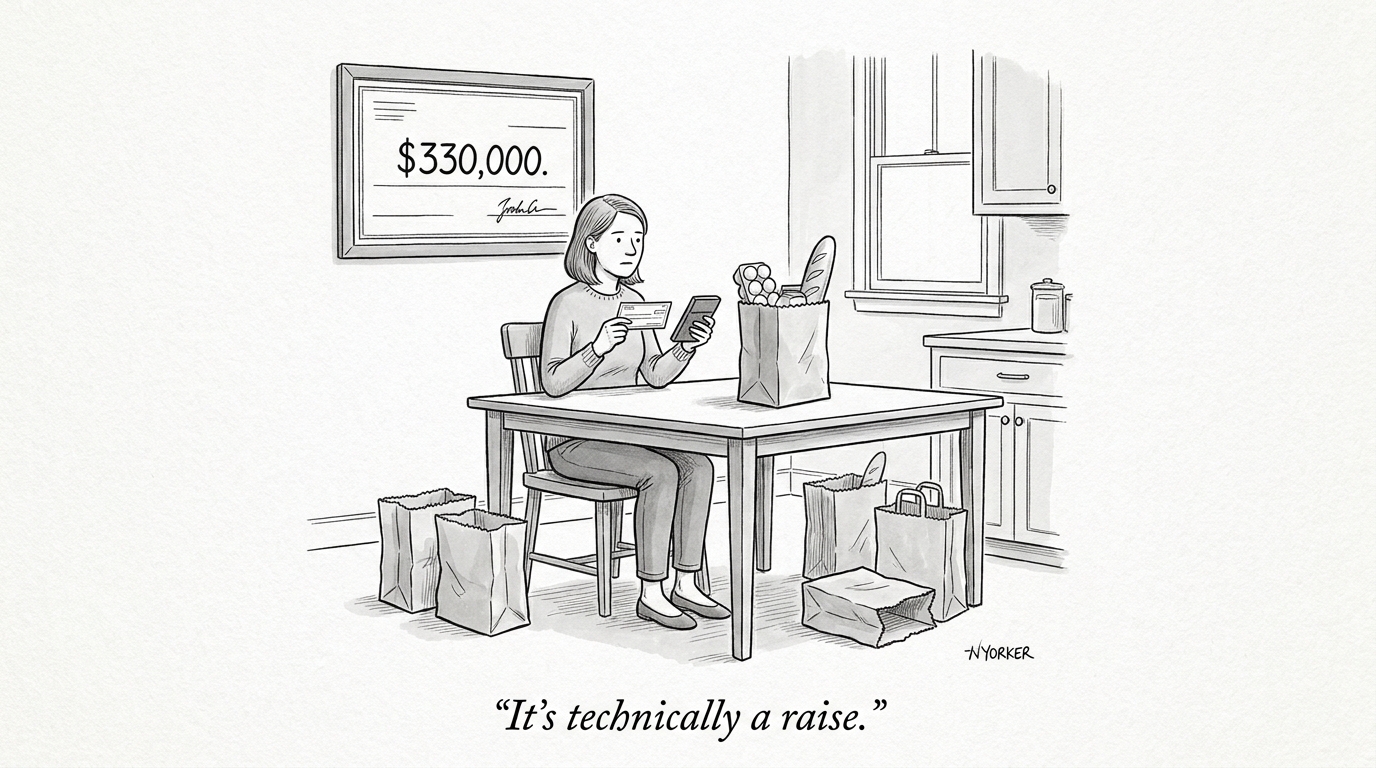
Hitting $330,000 is a nominal milestone that hides a different story. Adjusted for cumulative inflation since 2019, many physicians have seen effective pay declines. The MGMA’s latest numbers back up what people feel in their wallets: raises have trailed inflation for three straight years, so a higher paycheck today can still buy less than it did a few years ago.
That math shows up in contract talks. Raises of 3–4% annually are, in inflation-adjusted terms, pay cuts. Physicians who signed deals in 2023 or 2024 without inflation escalators are locked into contracts that lose value each year — a pattern tracked in detail across specialties and markets in the PhysEmp physician compensation and demand data.
Calculate real compensation growth against cumulative inflation since your last contract signing. A 4% raise after three years of 5%+ inflation is a net loss that compounds over multi-year deals.
The wRVU Ceiling Effect
The productivity model that dominated physician pay for decades is straining. In 2026, at least ten specialties show a clear plateau: physicians are at or near sustainable clinical capacity, but wRVU-based pay has stalled.
The system worked when there was room to increase volume. Now many physicians have optimized schedules to the limit—more visits would be clinically unsustainable or would compromise care. That creates a ceiling on earnings that extra hours can’t easily breach.
Money alone becomes a weaker recruiting tool when there’s no meaningful productivity upside. Employers need to compete on schedule flexibility, administrative support, practice autonomy, and incentives tied to outcomes rather than sheer volume.
The Employed–Independent Income Gap Widens
2026 data reveals a widening income gap: independent physicians in several specialties are earning 25–40% more than employed peers, even after overhead and admin costs.
Employment often brings productivity caps, non-competes, and administrative burdens that shave billable time. Independent physicians shoulder more business risk, but they also keep the full economic benefit of their productivity and can redesign their practices for efficiency.
Contract Terms Under Scrutiny
Employment contracts are getting closer reads. Tail coverage, non-compete scope, termination-for-cause language, and how productivity is calculated—these items no longer get cursory sign-offs. Many physicians and advisors are realizing contract structure can matter as much as the headline number.
Every employed physician should calculate their true hourly rate—including admin time, mandatory meetings, and unpaid documentation—against what independent practice in their market would yield. That often reveals hidden erosion.
Specialty-Specific Pay Pressure
Aggregate growth masks big variation. Some specialties actually lost ground in 2026 as Medicare cuts, shifts in payer mix, and system budget pressures combined to reduce income despite steady or rising demand for services.
That volatility creates choices. Physicians in hit specialties face pressure to increase volume, accept weaker contract terms, or relocate to markets with better reimbursement. At the same time, doctors in high-demand fields hold significant leverage and should avoid concessions that ignore market realities.
Recruiters and health systems need differentiated strategies. Uniform percentage increases across specialties will drive turnover where demand is strong and overpay elsewhere.
The Medicare Raise Fragility
Yes, physicians got a Medicare increase. But keeping it required legislation, and future budget talks could roll it back. Practices and physicians with heavy Medicare exposure face ongoing uncertainty that private-payer-heavy groups do not.
That uncertainty should shape employment choices and contract design. If your pay is tied tightly to Medicare collections, look for floors or guarantees; otherwise you take most reimbursement risk on yourself.
What This Means for 2026 and Beyond
Inflation-eroded purchasing power, productivity ceilings, the employed–independent gap, and specialty volatility are colliding. Physicians who treat compensation as a one-time negotiation risk slow erosion of income. Those who keep it on the agenda—and who read the fine print—have options.
Health systems, meanwhile, are running out of run-of-the-mill playbooks. Winning clinicians increasingly requires hybrid employment, equity participation, outcome-based pay, and real administrative relief so physicians can work at the top of their license.
There are no perfect answers. Expect more deals that mix salary, equity, and outcome bonuses; expect more careful scrutiny of non-competes and productivity formulas; expect recruitment pitches that emphasize time and autonomy as much as dollars. Picture a young attending calculating effective hourly pay while an inbox full of recruiter messages waits unread—that image is becoming the new normal.
Sources
Primary Care Doctor Pay Hits $330,000 — But Increase Lags U.S. Inflation – Forbes
Physician pay and productivity are moving in opposite directions, MGMA report finds – The Manila Times
The wRVU ceiling: 10 specialties where productivity pay is plateauing – Becker’s ASC Review
The hidden income gap between employed and independent physicians in 2026 – Becker’s ASC Review
The physician specialty facing the biggest pay cut in 2026 – Becker’s ASC Review
Why physicians make so much and still feel broke – Medical Economics
Physicians finally got a Medicare raise. Keeping it is the hard part – Medical Economics
Physician Employment Contract Terms Getting More Scrutiny in 2026 – Becker’s ASC Review