
This analysis synthesizes 15 sources published the week ending Jul 1, 2026. Editorial analysis by the PhysEmp Editorial Team.
The nursing workforce crisis has entered a new phase where isolated interventions—accelerated degree programs, retention technology, or state grants—cannot individually reverse structural labor deficits now exceeding 30,000 vacancies in single states. Across the Healthcare Workforce & Labor Market, health systems, universities, and state governments are deploying parallel strategies that show both the severity of the shortage and the fragmented nature of current responses. This week’s developments expose a basic tension: organizations pursue local fixes while the problem is systemic, and most employers have yet to build the enterprise-level workforce systems needed to match the scale of the shortfall.
Academic Pipeline Expansion Accelerates—But Structural Bottlenecks Persist
Universities and health systems are scaling nursing education capacity. Advocate Health says it has created the nation’s largest nursing school, and institutions from Bellevue University to Sam Houston State University are rolling out accelerated programs and renovating facilities. Bowie State University secured $2.3 million in Maryland nursing grants aimed at pipeline development, and the University of Cincinnati announced program expansions targeting the national shortage.
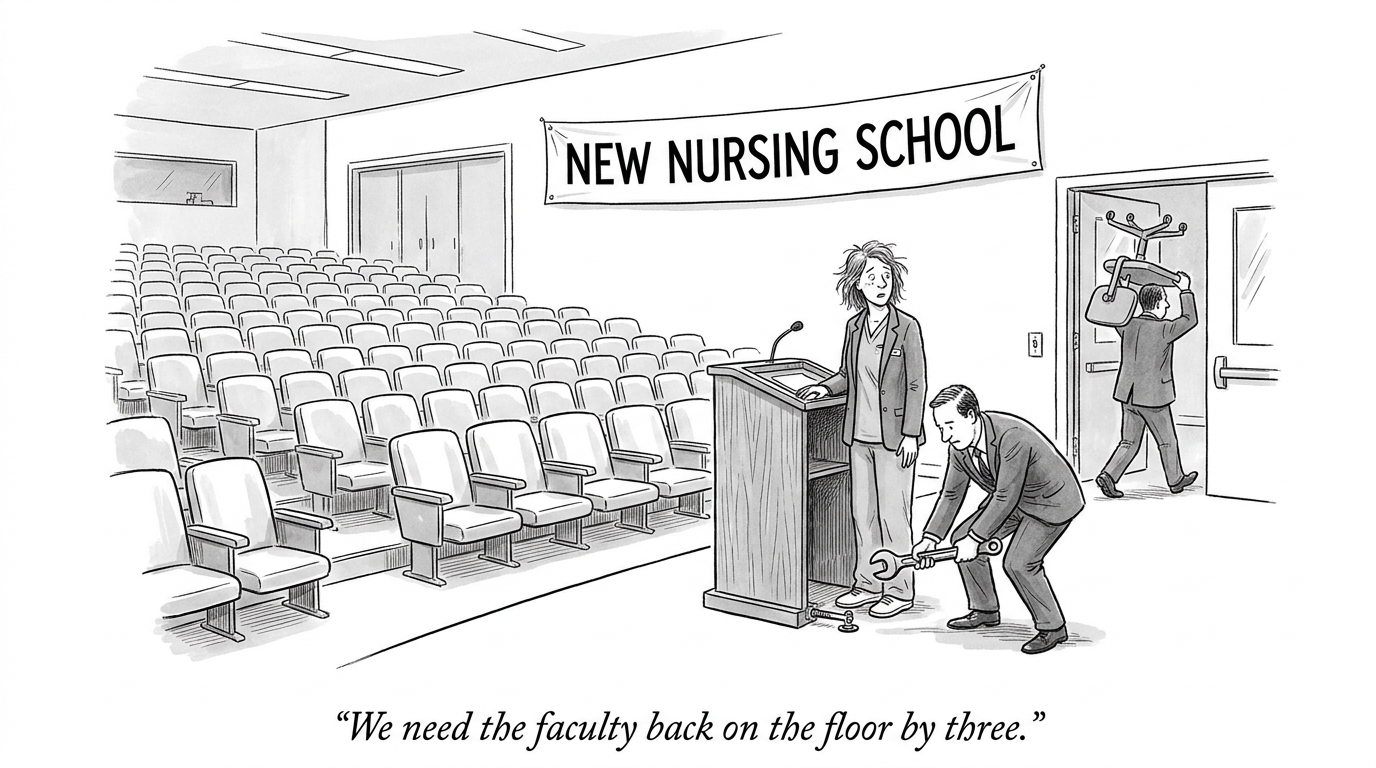
That expansion hides a chronic constraint mainstream coverage often misses: nursing program growth is limited by faculty shortages and a lack of clinical placements. The academic–practice partnerships that once supplied clinical training sites have frayed as hospitals prioritize immediate staffing over educational infrastructure. Becker’s Hospital Review argues that fixing the workforce crisis means rebuilding those partnerships—a structural repair that adding more classroom seats alone won’t achieve.
Healthcare organizations that invest in nursing school partnerships gain two clear advantages: preferential access to graduates and influence over curricula to better match clinical needs. Those are workforce gains recruitment spending rarely buys.
Physicians looking at practice environments should notice which systems are investing in pipeline work and which are treating staffing as a series of temporary fixes. The former tend to plan farther ahead and support better-resourced clinical teams.
Retention Technology Emerges as Workforce Strategy Component
The launch of Atalan’s AI nurse-retention platform—built to flag turnover risk up to 12 months in advance—shows that some vendors now treat retention as predictable and preventable rather than purely reactive. CommonSpirit Health’s use of virtual care models aimed at reducing nurse burnout reflects the same idea: change the work to keep experienced nurses at the bedside.
Shortage numbers bundle two problems together: a lack of entrants and sharper losses among experienced staff. Minnesota’s approaching 30,000-nurse deficit includes big losses from mid-career departures that academic expansion alone cannot fix.
Retention investments often produce faster capacity gains than recruitment campaigns that simply compete for a shrinking applicant pool. Organizations using predictive analytics can intervene before resignation decisions harden—an approach that changes the cycle from reactive hiring to proactive workforce maintenance.
Geographic Disparities Intensify Workforce Competition
New rural workforce grants in Wisconsin and news from Kitsap County hospitals illustrate how shortages concentrate in non-metropolitan areas. Rural facilities compete with urban centers for the same graduates while often offering fewer advancement paths and lower pay; grants help, but they don’t erase those structural disadvantages.
The Supreme Court ruling that has nursing homes bracing for staff losses adds a second layer. Post-acute facilities run on thinner margins than acute hospitals and will likely struggle more with recruiting if regulatory changes limit staffing flexibility. That pressure can cascade through a region as nursing-home shortages push more care back into hospitals and lengthen stays.
Physicians in rural and underserved markets should weigh a potential employer’s nursing strategy as heavily as compensation. Inadequate nursing support changes call schedules, workload, and whether a practice is sustainable.
Staffing Ratios and Regulatory Intervention
Ohio’s debate over mandatory nurse staffing ratios highlights the policy trade-offs. Supporters say ratios protect patient safety and nurse wellbeing; opponents warn that mandates without added supply simply shuffle shortages. The core problem is that regulatory standards assume a labor market that doesn’t exist right now.
For system leaders, ratio laws create planning uncertainty. If mandates pass, competition for nurses could spike, pushing up costs and forcing choices about service lines if coverage can’t be staffed. The likely downstream effects on physician practice—reduced services, altered call patterns—get too little attention in public debates.
Strategic Implications for Workforce Positioning
Nursing workforce strategy is moving out of HR and into the center of organizational strategy. Health systems that treat workforce development as infrastructure—building academic partnerships, applying predictive analytics and redesigning care models to retain staff—will pull ahead of organizations that rely on transactional recruitment in a tight market.
For physicians, these dynamics shape day-to-day practice and longer-term career options. Organizations with well-developed nursing pipelines and clear retention plans provide more stable practice environments than those that cycle through vacancies and short-term fixes. Expect compensation pressure to shift as systems juggle nurse pay, physician economics, and limited operating margins.
We should also expect further consolidation: hospitals that can’t build pipelines may partner with or be acquired by systems that can. That will change how and where nurses are trained and deployed—maybe for the better, maybe not. Picture a future where a community hospital signs an affiliation to get guaranteed clinical staff, where a health system buys a nearby nursing school, and where a chief nursing officer answers daily to both patient safety metrics and a balance sheet. Messier than a tidy solution, but also harder to ignore.
Sources
A Look at Nursing Shortages Across Kitsap Hospitals Schools – Bainbridge Review
Ohio nurses are overwhelmed. Could a mandatory staffing ratio help? – The Ohio Newsroom
Augusta University Athens visit highlights nursing shortage – The Augusta Chronicle
Billings Clinic earns fifth Magnet designation as nursing shortage continues nationwide – KULR 8 News
Nursing graduates enter workforce as shortage approaches 30000 in Minnesota – KARE 11
Atalan launches nurse retention platform designed to identify risk up to 12 months in advance – Business Insider
Bellevue University launches accelerated nursing program – KETV
Bowie State University Secures $2.3 Million in Statewide Nursing Grants to Strengthen Workforce Pipeline – Bowie State University
UC aims to fight national nursing shortage with program expansion – FOX19 NOW
Virtual care model helps CommonSpirit tackle nurse retention challenges – TechTarget
Advocate creates workforce pipeline with nation’s largest nursing school – Becker’s Hospital Review
Why the nursing workforce crisis won’t be solved without rebuilding academic-practice partnerships – Becker’s Hospital Review
Wisconsin rolls out new rural healthcare workforce grants – WEAU
Meeting the need for nurses: SHSU underway with nursing school renovations – Community Impact
Nursing homes brace for staff shortages after Supreme Court ruling – Becker’s Hospital Review