Idaho is offering a Gastroenterology physician $1,000,000 annually. Not Boise. Not Sun Valley. Just Idaho. Meanwhile, Cherry Hill, New Jersey—a suburb with a median home price north of $400,000—is advertising a position at $200,000. The national Gastroenterology market currently lists 568 active positions across nearly every state, with 91 disclosing salary data. The data reveals a specialty that pays exceptionally well on average but exhibits a compensation range so wide it suggests two entirely different labor markets operating under the same procedural code.
👉 Explore Gastroenterology job market insights and trends
The Gastroenterology Job Market at a Glance
Total listings: 568
Listings with salary data: 91
Full salary range: $40,000 to $1,000,000
National average range: $519,695 to $573,917
The floor of $40,000 is almost certainly a data artifact (part-time, per diem, or administrative scope), and the ceiling of $1,000,000 represents the upper bound of what rural scarcity and productivity incentives can achieve. Strip out the extremes and the market settles into a more predictable $400,000 to $700,000 corridor. But even within that band, the variance is significant. Connecticut averages $376,000 to $405,000. Illinois averages $621,429. That is not a cost-of-living adjustment. That is a structural difference in how Gastroenterology services are valued, reimbursed, and competed for.
States with active listings include New York, Florida, California, Texas, Illinois, Pennsylvania, Indiana, Georgia, South Carolina, North Carolina, Massachusetts, New Jersey, Ohio, Washington, Maryland, Connecticut, Tennessee, Alabama, Kentucky, New Hampshire, Wisconsin, Michigan, Virginia, Arizona, Mississippi, Colorado, Nevada, Hawaii, Oklahoma, New Mexico, West Virginia, Idaho, Oregon, South Dakota, North Dakota, Minnesota, Utah, Arkansas, Missouri, Iowa, Kansas, Louisiana, Wyoming, Alaska, Maine, Nebraska, Montana, Vermont, and Washington D.C.
👉 Browse Gastroenterology physician job opportunities
How States Stack Up
Overperformers:
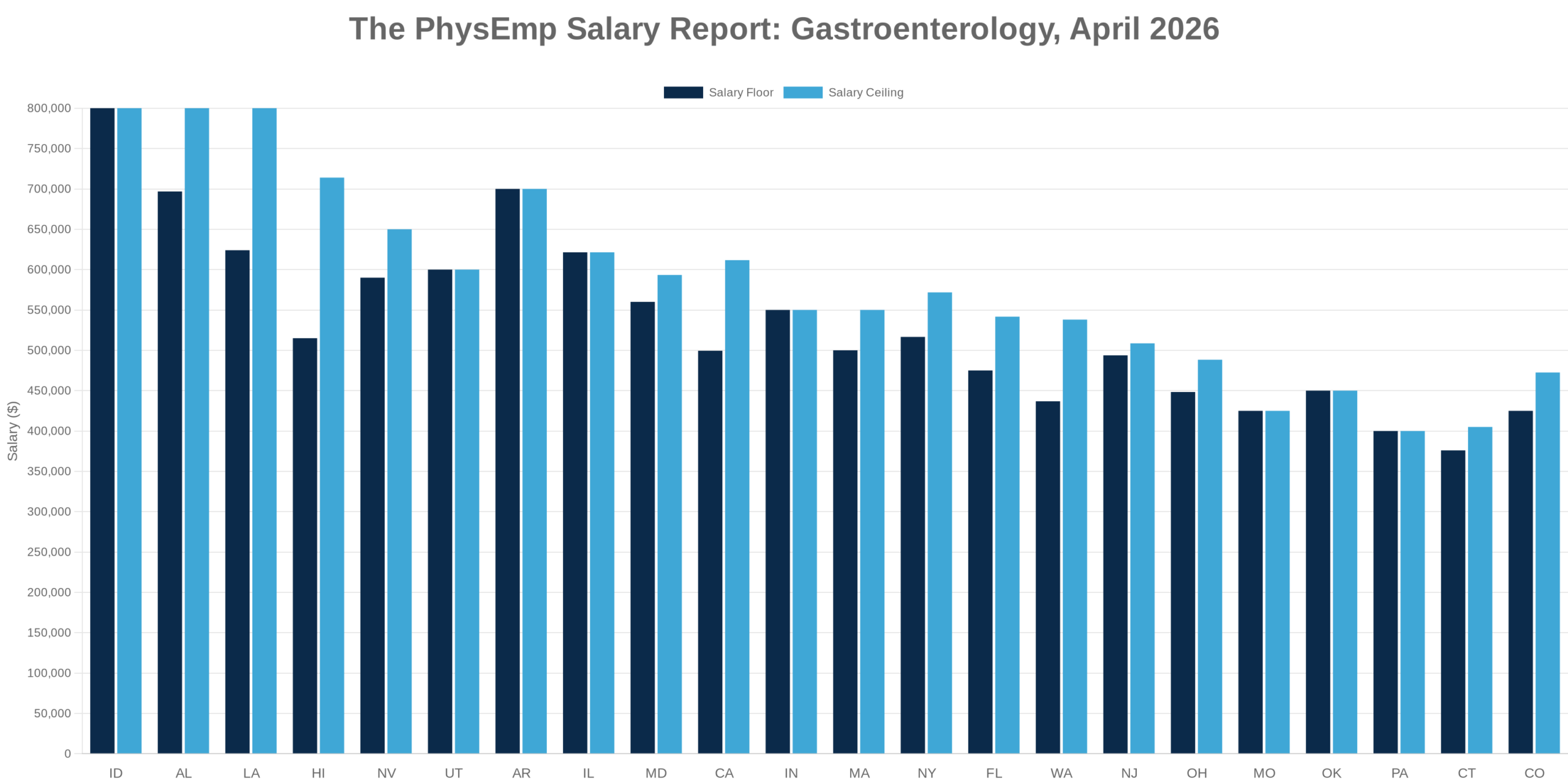
Idaho leads nationally at $1,000,000 (one salary listing among five total jobs—treat accordingly). Alabama averages $696,800 to $884,000, suggesting productivity bonuses or partnership track compensation. Arkansas posts $700,000 flat. Illinois delivers $621,429 across seven salary listings, making it the most reliable high-pay market with volume. Louisiana ranges from $624,000 to $832,000. Nevada offers $590,000 to $650,000 across two listings. Utah averages $600,000 flat. Maryland reports $560,000 to $593,333. Indiana averages $550,000 across three listings and 26 total jobs, pairing volume with above-average pay.
Near-Average:
New York averages $516,593 to $571,769 across 29 salary listings and 50 total jobs—high volume, competitive pay, strong transparency. New Jersey ranges from $493,750 to $508,625 across eight listings. California averages $499,400 to $611,700 across ten salary listings. Massachusetts reports $500,000 to $550,000. Hawaii offers $515,000 to $714,000 (two listings, island premium likely). Florida averages $475,000 to $541,667 despite 47 total listings—high volume, middling pay. Oklahoma posts $450,000 flat. Ohio averages $448,333 to $488,333. Washington state ranges from $436,856 to $538,027.
Underperformers:
Connecticut averages $376,000 to $405,000, the lowest in the nation among states with salary data. Pennsylvania reports $400,000 (one listing, 26 total jobs—volume without transparency). Colorado averages $425,000 to $472,500. Missouri posts $425,000 flat.
Volume leaders: New York (50 listings), Florida (47), Indiana and Pennsylvania (26 each), California and Georgia (25 each), Illinois and Massachusetts (24 each). Florida’s 47 listings yield below-average pay. Pennsylvania’s 26 listings yield one salary disclosure. New York and Illinois combine volume, pay, and transparency—rare in this dataset.
👉 Compare Gastroenterology compensation and opportunities by region
What This Means If You’re a Physician
If your priority is maximum compensation: Target Idaho ($1,000,000), Alabama ($696,800 to $884,000), Arkansas ($700,000), Louisiana ($624,000 to $832,000), or Illinois ($621,429 average). The Idaho listing is the highest-paying position in the dataset, location unspecified, scope undisclosed. Treat it as an outlier until you see the contract.
If your priority is maximum optionality: Focus on New York (50 listings, $516,593 to $571,769 average), Florida (47 listings), California (25 listings, $499,400 to $611,700 average), or Illinois (24 listings, $621,429 average). These states offer volume, competitive pay, and—in New York’s case—the highest salary transparency rate in the dataset.
If your priority is balance: Illinois, Indiana, Maryland, and Nevada deliver above-average pay without requiring you to move to Idaho. New York offers the best combination of volume, pay, and disclosed data. Avoid Connecticut and Pennsylvania unless cost-of-living or lifestyle factors override a six-figure pay gap.
Cost-of-living mismatch alert: Cherry Hill, New Jersey is advertising $200,000 in a metro area with a median home price above $400,000. Connecticut’s $376,000 average is similarly misaligned with Northeastern housing costs.
👉 Search Gastroenterology jobs by location and compensation
What This Means If You’re a Recruiter
Salary transparency rate: 16.0% (91 listings with data divided by 568 total listings). That is low. It is also a competitive disadvantage in a specialty where physicians have geographic leverage and compensation expectations north of half a million dollars. In states like Texas (23 listings, zero salary disclosures), Georgia (25 listings, zero disclosures), and Pennsylvania (26 listings, one disclosure), recruiters will need to lead with scope, partnership track, procedural volume, and lifestyle. But when Illinois is transparently advertising $621,429 and Idaho is posting $1,000,000, silence is not a strategy.
Candidate pipeline risk: High-volume states with below-average pay (Florida) or low transparency (Pennsylvania, Texas, Georgia) are vulnerable to poaching by higher-paying or more transparent markets. New York and Illinois are setting the benchmark. If you are not within $50,000 of their averages, you need a compelling non-financial value proposition.
👉 Post Gastroenterology positions on PhysEmp
What’s Driving the Numbers
Scarcity pricing is real, and it is extreme. Idaho’s $1,000,000 listing, Alabama’s $696,800 to $884,000 range, and Arkansas’s $700,000 flat rate all reflect markets where demand far exceeds supply and health systems are pricing in recruitment difficulty, retention risk, and the cost of leaving a territory unserved. These are not coastal premiums. They are rural necessity premiums. Physicians willing to trade density for dollars have significant leverage.
Volume and pay do not correlate as expected. Florida has 47 listings but averages $475,000 to $541,667. Pennsylvania has 26 listings but discloses only one salary ($400,000). New York has 50 listings and averages $516,593 to $571,769 with strong transparency. Illinois has 24 listings and averages $621,429. The lesson: job volume signals demand, but it does not guarantee competitive pay. Transparency and compensation are better proxies for market health than listing count alone.
The low end of the range is noisy. The reported floor of $40,000 is almost certainly a part-time, administrative, or miscategorized listing. Even the $200,000 Cherry Hill listing is an extreme outlier. Strip out the bottom decile and the functional floor is closer to $400,000. But that still leaves a $600,000 spread between Connecticut ($376,000 average) and Idaho ($1,000,000). This is not a unified market. It is a bifurcated one: high-supply urban corridors versus high-need rural and secondary markets.
Leadership and procedural scope appear to command premiums, but the data does not isolate them cleanly. The $1,000,000 Idaho listing and the $696,800 to $884,000 Alabama range likely reflect productivity bonuses, partnership equity, or expanded scope (ERCP, EUS, advanced therapeutics). The $200,000 Cherry Hill listing may reflect limited scope or part-time hours. Without role-level detail, it is difficult to separate scope premiums from geographic premiums. But the pattern holds: higher pay clusters in states where Gastroenterology services are scarce, not where they are abundant.
The Bottom Line
The Gastroenterology job market offers physicians substantial earning potential, broad geographic choice, and meaningful leverage in negotiations—but only if they are willing to look beyond the coasts and the usual suspects. The highest pay is in the least expected places. The highest volume is not always the highest value. And the widest compensation gaps exist not between specialties, but within them, state by state, listing by listing.
👉 Browse all Gastroenterology physician jobs
👉 Upload your CV to get matched with opportunities
👉 Set alerts for new Gastroenterology roles
There is a lot of money available for looking at colons. Where you do it determines how much.
Salary data based on 91 listings with disclosed compensation. Figures may reflect part-time or specialized roles. This report is informational and should not replace professional judgment or financial planning.