
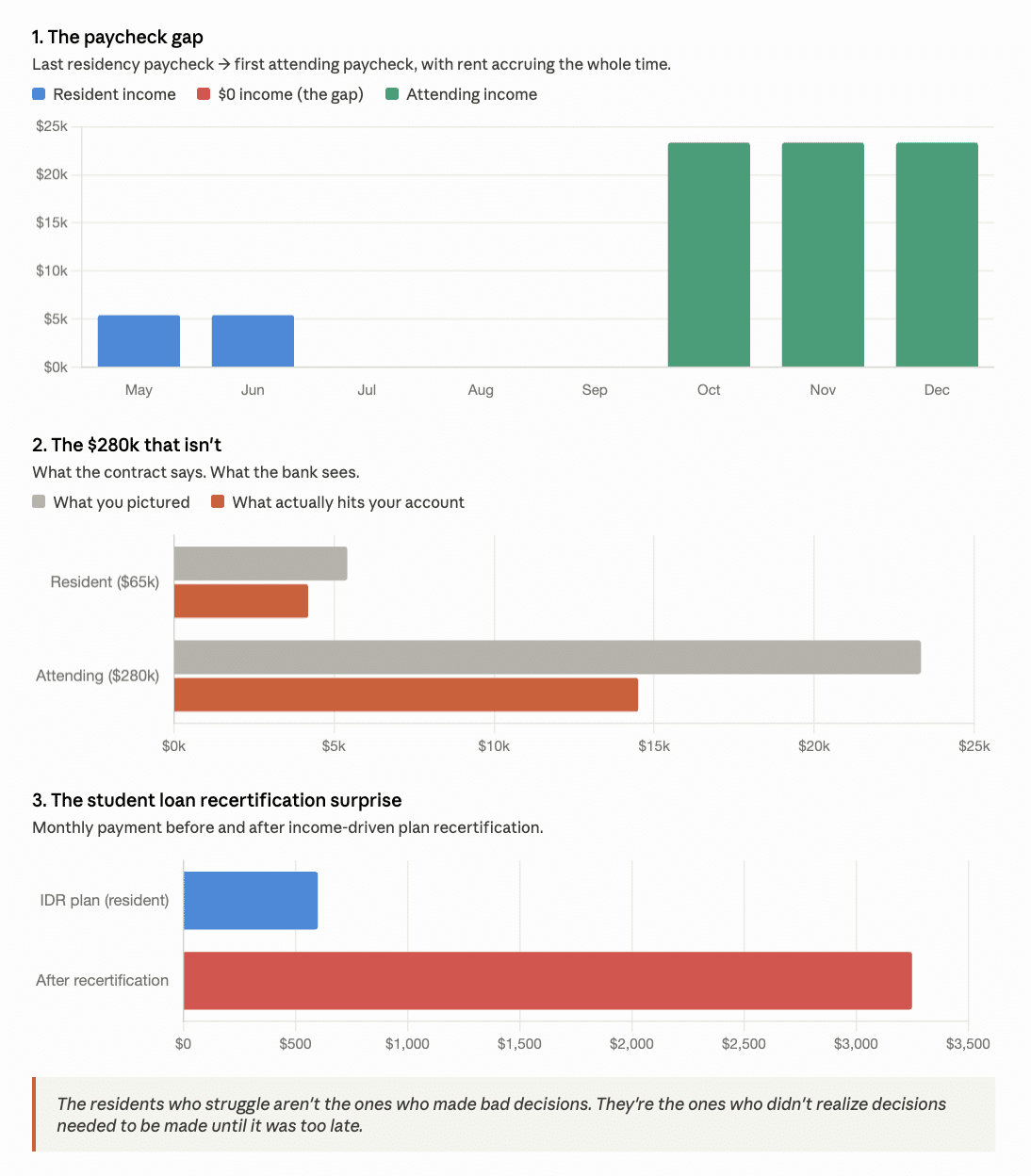
You’ve survived residency. You’ve signed your first attending contract. And now you’re staring at a calendar that shows you graduating in late June, starting your new job in mid-August, and receiving your first real paycheck sometime in September—maybe October if your employer pays in arrears. That’s 8-12 weeks without income, and you’re still paying rent, still accruing loan interest, and suddenly realizing nobody warned you about this.
This is the financial no-man’s-land that every new attending crosses, and it’s one of several money shocks waiting for you. If you’re still navigating the chaos of residency, the transition to attending feels like it should be the finish line. It’s not. It’s a gear shift, and the financial mechanics change dramatically.
The Paycheck Gap Is Real—Plan for It
Most residents finish training between mid-June and early July. Most attending jobs start between August and September. And most employers don’t cut your first check until 2-4 weeks after you start—sometimes longer if you’re on a monthly pay cycle.
That means you need 2-3 months of living expenses saved before you graduate. For most people, that’s $8,000-$15,000, depending on where you live and what your fixed costs look like. If you’re relocating, add moving expenses. If you’re putting down a deposit on a new apartment or buying furniture, add that too.
Here’s the uncomfortable truth: most residents don’t have this saved. If that’s you, your options are limited but real. You can pick up locum tenens shifts immediately after graduation (some states allow this with a temporary license while your permanent one processes). You can negotiate a signing bonus with early disbursement. Or you can take out a short-term personal loan—not ideal, but better than credit card debt at 24% interest.
The worst option is ignoring the gap and hoping it works out. It won’t.
Tax Shock Is Coming—Here’s What It Looks Like
As a resident making $65,000, your effective federal tax rate was probably around 12-14%. As an attending making $280,000, you’re now in the 32% marginal bracket, and your effective rate is closer to 22-25%—plus state taxes if you’re not in Texas or Florida.
Concrete example: A resident earning $65,000 takes home roughly $4,200/month after taxes. An attending earning $280,000 might expect to take home $17,500/month, but after federal, state, and FICA taxes, it’s closer to $14,000-$15,000. That’s still a massive raise, but it’s not the 4x multiplier you calculated in your head.
The real shock comes in April of your first attending year. If you started mid-year, your employer’s withholding was calibrated for a partial year. But if you worked any locums, had a signing bonus, or your W-4 wasn’t set up correctly, you could owe $5,000-$20,000 at tax time. Set aside 25-30% of any lump sum payments (signing bonuses, relocation stipends, moonlighting income) in a separate account. Don’t touch it until you’ve filed.
Your Loan Strategy Has to Change
If you’ve been on PAYE or REPAYE during residency, your payments were income-driven and probably $400-$800/month. The moment your income jumps, your next recertification will spike those payments to $2,500-$4,000/month—or more.
This is where you need to make a real decision, not just coast on autopilot:
If you’re pursuing PSLF: Stay on an income-driven plan, make your 120 payments, and don’t pay a dollar more than required. But verify—actually verify—that your employer qualifies. “Non-profit hospital” doesn’t automatically mean PSLF-eligible. Submit your employment certification form now, not in year nine.
If you’re going private practice or high-income specialty: PSLF probably isn’t your path. Run the math on refinancing. With $300,000 in loans at 6.5% federal rates, refinancing to 5% saves you roughly $45,000 over a 10-year repayment. But you lose income-driven options and federal protections, so don’t refinance until your job is stable and your income is predictable.
If you’re unsure: Don’t refinance yet. Stay on income-driven repayment for your first year while you figure out your career trajectory. The flexibility is worth the slightly higher interest.
Early Financial Moves That Actually Matter
Your first year as an attending isn’t the time to optimize everything. It’s the time to avoid catastrophic mistakes and build a foundation. Here’s what matters:
Max your retirement accounts. $23,000 into your 401(k) or 403(b), plus any employer match. If you have access to a backdoor Roth IRA, another $7,000 there. This isn’t optional—it’s the single highest-impact financial move you can make.
Get disability insurance. Your income is now your most valuable asset. Own-occupation disability insurance costs $300-$500/month for most physicians, and you need it before something happens, not after.
Resist lifestyle inflation for 12 months. You don’t need the $800,000 house in year one. You don’t need the Model S. Live like a senior resident for one year, and you’ll have $50,000-$100,000 in savings that gives you options—whether that’s paying down loans, building an emergency fund, or having flexibility if your first job doesn’t work out.
The Real Takeaway
The transition from residency to attending is a financial gear shift, not a finish line. The paycheck gap, the tax burden, and the loan recalculation are all predictable—which means they’re all manageable if you plan for them. The residents who struggle aren’t the ones who made bad decisions. They’re the ones who didn’t realize decisions needed to be made until it was too late.