
This analysis synthesizes 5 sources published the week ending Jun 22, 2026. Editorial analysis by the PhysEmp Editorial Team.
A federal appeals court decision limiting Stark Law and Anti-Kickback Statute claims tied to wRVU compensation has arrived just as CMS is proposing sizable RVU cuts that threaten specialty viability. The result is a paradox: legal protections for productivity-based pay are strengthening even as the payment method itself faces structural pressure. That timing forces physicians and health system leaders to rethink how Physician Compensation & Demand dynamics intersect with regulatory compliance and fair market value determinations.
The Fourth Circuit’s fair market value shield
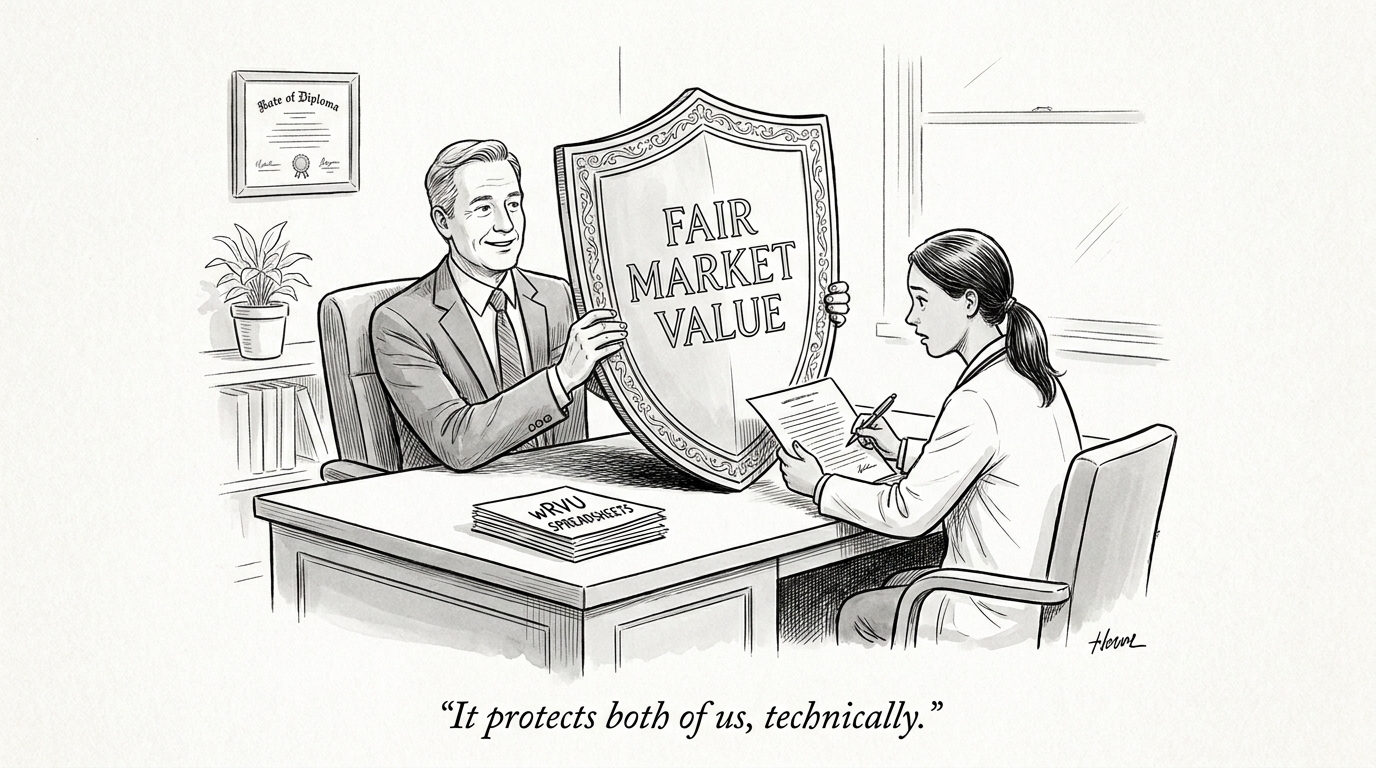
The Fourth Circuit’s recent ruling changes how courts look at wRVU-based compensation under federal fraud statutes. By finding that hospital subsidies tied to wRVU metrics don’t automatically trigger Stark Law violations, the court has validated the basic mechanics behind most physician employment pay models. The ruling stresses that arrangements benchmarked to accepted fair market value data—even when payments exceed collections—can meet regulatory standards when documented correctly.
Mainstream coverage missed an important consequence: the decision shifts leverage toward health systems without giving physicians a matching bargaining advantage. Fair market value surveys—mostly commissioned and controlled by systems—remain the default yardstick for compensation, even when those benchmarks lag market shifts or miss specialty-specific productivity differences.
Not all wRVUs are equal: compliance complexity
Compliance guidance makes a simple point with complicated implications: wRVU math depends on attribution rules, shared-service allocations, and how non-billable work is handled. Two clinicians doing the same clinical work can end up with very different wRVU credits because of incident-to billing practices, supervision attribution, or differences in how procedures are coded.
That variability often stays invisible during contract talks. Don’t treat a headline $65 per wRVU as comparable until you understand the denominator assumptions—how your employer actually counts and credits productivity. A competitive rate can become a raw deal if the system’s methodology systematically undercounts work.
Documentation and audit exposure
Ironically, lower legal exposure may bring higher paperwork. To preserve the fair market value safe harbor, systems will likely tighten documentation and productivity tracking. That can shift administrative load onto physicians while keeping compensation structures flexible for institutions.
RVU cuts and specialty sustainability
Court rulings aside, CMS’s proposals hit procedure-heavy specialties hardest. Electrophysiology looks especially vulnerable; proposed reductions could undercut practices already running on thin margins. Because Medicare uses a budget-neutral RVU system, increases in one area require offsets elsewhere. That creates a perpetual zero-sum among specialties.
For electrophysiologists and similar specialists the fallout is concrete: the same clinical workload, less effective pay. Systems that employ these doctors face three blunt choices—absorb cuts through subsidies, move away from strict productivity models, or shrink specialty capacity, with potential effects on access.
Physicians in RVU-vulnerable specialties should push for compensation floors, explicit rate-adjustment clauses tied to CMS changes, and metrics that capture value beyond billable procedures.
Gender gaps persist across models
Data show gender-based pay gaps survive across productivity-based, salary, and hybrid pay models. The size of the gap varies by specialty, and in some procedure-heavy fields it’s larger than productivity differences alone can explain. That suggests wRVU-based pay—often pitched as objective—can reproduce or even widen inequities via unequal access to high-value procedures, call schedules, and practice-building chances.
Complying with fair market value rules doesn’t guarantee equity. Systems that want to recruit in competitive specialties should treat compensation equity as both a fairness issue and a recruitment strategy.
Contract negotiation takeaways
The current mix of stronger legal cover for employers and weaker payment fundamentals for clinicians changes bargaining. The court validated wRVU-based arrangements, but that validation mainly reduces employer legal risk, not physician downside. Negotiations should focus on transparency around wRVU calculations, automatic rate adjustments tied to payer changes, and downside protection such as floors or guaranteed minimums.
For systems, the ruling buys compliance comfort but not a solution to the tension between productivity pay and specialty viability. Competing for talent in RVU-exposed areas will require creative offers—larger signing packages, quality incentives, or hybrids that blunt CMS-driven swings.
Expect wRVU-based compensation to stay central, even as more physicians push back and demand contract terms that shield them from payment volatility. Those who build clear adjustment mechanisms and multiple compensation streams will be better positioned as payment rules and regulations continue to change. And somewhere in an admin office, someone will still be manually reconciling spreadsheets and writing memos that don’t make it into the quarterly reports.
Sources
Not Sustainable: Real Impact of RVU Cuts on Electrophysiology – Cardiovascular Business
Health Care Law Today — Episode 39: Let’s Talk Compliance — Not All wRVUs Are Created Equal – The National Law Review
WRVU: Pay hospital subsidies don’t constitute Stark Law fraud court rules – Becker’s ASC Review
Fourth Circuit Limits Stark AKS and FCA Claims – Davis Wright Tremaine LLP
The gender pay gap by specialty ranked – Becker’s ASC Review