
Policy Shifts Reshaping Rural Clinician Supply

Federal hearings, state bills, and immigration rule changes are converging to shape rural clinician recruitment. Leaders must link incentives to licensure, credentialing, and retention strategies to convert short-term hires into long-term access gains.
Home Life, Gaming, and Burnout

Household stressors and nontraditional recovery behaviors like gaming significantly reshape physician burnout risk and retention. Employers that assess home-life fit, provide predictable schedules, and support healthy leisure boundaries will better retain clinicians and reduce hidden turnover drivers.
Momentum for Nurse Staffing Mandates

State lawmakers and nursing organizations are accelerating efforts to mandate nurse-to-patient ratios while WHO’s advocacy elevates safe staffing to a global patient-safety standard. This analysis examines policy design options, operational trade-offs, and concrete implications for physicians and hospital leaders — and why mandates must be paired with workforce investments to avoid reduced access.
Scaling Nursing Pipelines: Capital, Partnerships, Policy

Colleges and universities are expanding nursing capacity through investments, health-system partnerships, and community-college bachelor’s authority. These moves can relieve shortages only if clinical placements, faculty capacity, and employer onboarding scale alongside enrollment growth; otherwise added seats may not translate into more bedside nurses.
Policy Paths to Recruit Foreign Physicians

State licensing reforms could widen the pool of international physicians but federal visa costs, processing delays, and limited supervision capacity risk stalling real workforce gains. Recruiters and health system leaders must couple regulatory change with immigration support and structured onboarding to turn policy into staffed clinical shifts.
Academic-State Alliances Rebuild Rural Pipelines

Universities and state agencies are expanding rural medical education, but durable workforce gains require end-to-end pipelines: local recruitment, distributed training, residency capacity, and retention supports. Institutions must link seat expansion to funded GME and community incentives to convert trainees into retained rural clinicians.
Mandates vs. the Nursing Pipeline

State push for mandated nurse-to-patient ratios raises immediate demand for bedside nurses while federal student loan limits threaten to shrink future supply. The policy mismatch will drive higher labor costs, heavier agency reliance, and uneven access unless mandates are paired with targeted investments in education and local training programs.
States Racing to Rebuild Clinical Pipelines

State reporting converges on a single conclusion: incremental workforce growth won’t prevent geographically concentrated physician and nursing shortages. Short-term recruitment must be paired with expanded training capacity (especially residency slots), sustained retention investments, and ‘grow your own’ pipelines to secure access in rural and high-growth regions.
Licensing, Visas, and the Physician Shortage
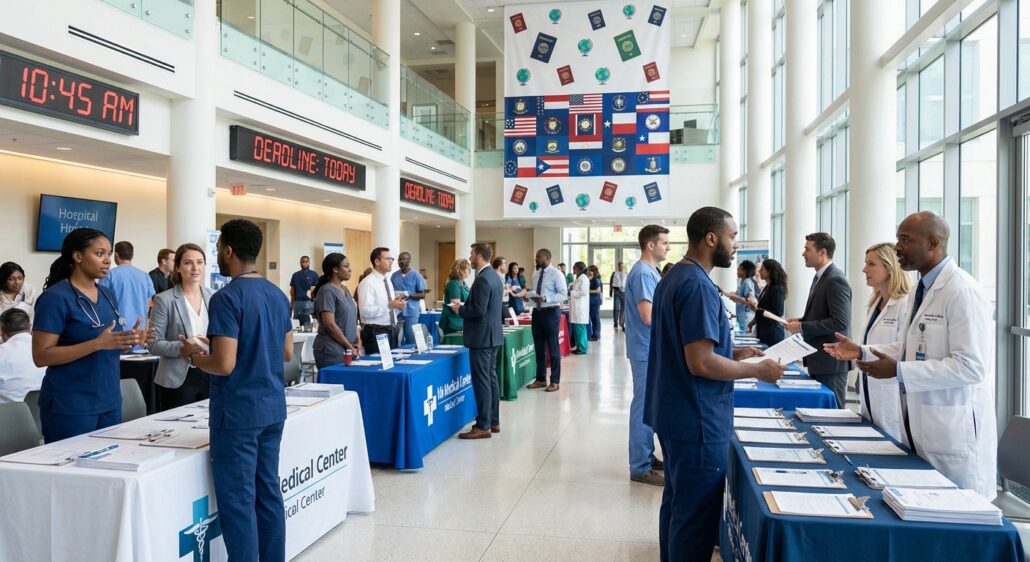
States are loosening licensing rules to recruit foreign-trained physicians, but federal visa fee proposals and administrative friction threaten to undercut those gains. Successful recruiting now requires pairing state licensure wins with immigration counsel, clear budgeting, and operational contingency planning.
AI to Reclaim Clinician Time

Administrative overload has overtaken clinician shortages as healthcare’s dominant workforce risk, and AI-powered documentation and agent tools are emerging as a primary countermeasure. Durable clinician relief depends on governance, workflow redesign, and transparent metrics that capture verification burden — not just raw documentation time savings.